Beat the Heat with High Efficiency HVAC Upgrades
Doggone Good Heating and Cooling

Discover energy efficient HVAC upgrades for the Gulf Coast: cut bills, beat humidity & boost ROI with heat pumps, zoning & more in Baton Rouge.
Why Energy Efficient HVAC Upgrades for the Gulf Coast Are Different From the Rest of the Country
If you’re exploring energy efficient HVAC upgrades for the Gulf Coast, here’s the short answer: the best upgrades for Baton Rouge and surrounding communities are variable-speed systems with high SEER2 ratings, duct sealing, smart thermostats, and whole-home humidity control — because heat alone isn’t your only enemy here.
Top energy efficient HVAC upgrades for Gulf Coast homes:
- Variable-speed HVAC systems – Run longer at lower capacity for better dehumidification and steadier comfort
- High SEER2 equipment (16+) – Can cut cooling costs by up to 37% compared to older low-efficiency units
- Smart thermostats – Save an average of 8% annually on heating and cooling through automated scheduling
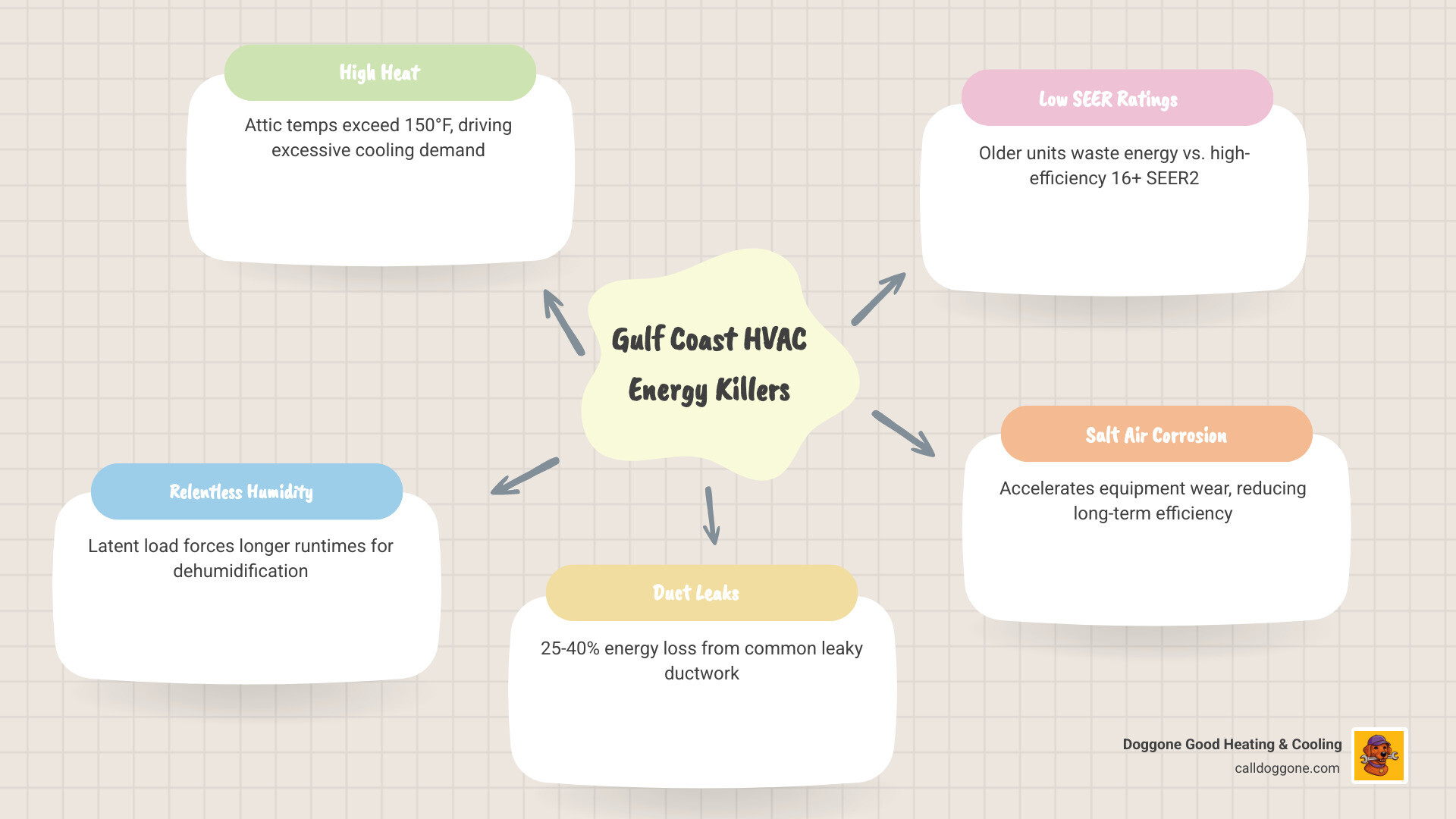
- Duct sealing – Stops the 25–40% energy loss common from leaky ductwork in Gulf Coast homes
- Whole-home dehumidifiers – Reduce the moisture load so your AC doesn’t have to work as hard
- Attic insulation and air sealing – Blocks radiant heat gain that forces your system to run longer
- Heat pumps – Highly efficient in mild Gulf Coast winters and effective year-round
Staying cool in Baton Rouge isn’t just a warm-weather preference — it’s a months-long necessity. Heating and cooling already account for more than 40% of a typical household’s energy use, and in a climate that regularly logs 2,800 to 3,400+ cooling degree days per year, that number climbs even higher. Gulf Coast HVAC systems don’t just fight heat. They battle relentless humidity, salt air, long run times, and attic temperatures that can push past 150°F in peak summer. That combination puts more stress on equipment and punches bigger holes in your energy budget than most standard efficiency advice accounts for.
The good news is that the right upgrades — matched to how Gulf Coast homes actually work — can realistically trim energy bills by 15–35% and pay back the investment within just a few years.
Explore more about energy efficient hvac upgrades for the gulf coast:
- energy efficiency improvements that pay for themselves
- energy efficiency tips for louisiana homeowners
Energy Efficient HVAC Upgrades for the Gulf Coast: Why Standard Cooling Advice Falls Short
When we talk about cooling a home in Baton Rouge, Prairieville, or Denham Springs, we aren’t just talking about lowering the temperature. We are talking about managing a “latent load”—the technical term for the heavy moisture in our air. Standard efficiency advice often focuses on how quickly a unit can drop the temperature, but in our neck of the woods, if a system cools too fast without removing moisture, you end up with a home that feels like a cold, damp cave.
The biggest HVAC challenges on the Gulf Coast
Our climate presents a unique “triple threat” to HVAC efficiency:
- Relentless Humidity: High humidity makes 75°F feel like 80°F. If your system isn’t designed to pull moisture out effectively, you’ll likely keep lowering the thermostat just to feel comfortable, sending your energy bills through the roof.
- Extreme Attic Heat: In places like Zachary and Gonzales, attic temperatures can reach 150°F. If your ductwork lives in that attic and has even tiny leaks, your AC is fighting a losing battle against a massive heat source.
- Long Run Times: Because our cooling season lasts from March through October (and sometimes beyond), Gulf Coast systems face significantly higher wear and tear than systems in the North. This makes efficiency losses from poor maintenance much more apparent.
Why energy efficient hvac upgrades for the gulf coast need a whole-home approach
Efficiency on paper—like the SEER2 rating on a box—doesn’t always equal efficiency in your home. If you put a high-efficiency unit into a home with leaky windows and crushed ductwork, you won’t see the savings you expect. We believe in a Whole-Home Energy Efficiency approach. This means looking at the building envelope, performing Load Calculations & System Sizing to ensure the unit isn’t too big or too small, and checking that your ducts can actually deliver the air the system is cooling.
The Best HVAC Upgrades for ROI in Gulf Coast Homes
If you are looking for the best return on investment (ROI), you want upgrades that tackle both heat and humidity simultaneously. In a climate as demanding as ours, high-efficiency systems often provide a payback on investment within just 3 to 5 years.
| Upgrade Type | Estimated Energy Savings | Key Benefit for Gulf Coast |
|---|---|---|
| Variable-Speed AC | 20–40% | Superior dehumidification and steady temps |
| Smart Thermostat | 8% | Learns habits and manages humidity |
| Duct Sealing | 15–25% | Stops conditioned air from escaping to the attic |
| High SEER2 (16+) | Up to 37% | Significant reduction in monthly cooling costs |
| Zoning Systems | 10–20% | Only cools the rooms you are actually using |
Upgrade to variable-speed systems and higher SEER2 performance
The most significant upgrade you can make is moving to a variable-speed system. Traditional AC units are either “on” (100% power) or “off.” Variable-speed systems (using inverter technology) can dial their output up or down in tiny increments.
Imagine driving a car: traditional AC is like slamming on the gas and then the brakes repeatedly. Variable-speed is like using cruise control. Because these units can run at lower speeds for longer periods, they are incredible at pulling moisture out of the air. Upgrading from an old 10 SEER unit to a modern 16 or 18 SEER2 unit can reduce your cooling costs by nearly 40%.
Add smart controls, zoning, and energy monitoring
A smart thermostat is one of the easiest energy efficient HVAC upgrades for the Gulf Coast. These devices don’t just let you change the temp from your phone; they learn your routine. If you’re heading to a festival in Baton Rouge for the afternoon, the system knows to drift up a few degrees and then pre-cool the house before you get home. Smart ways to cool your home often start with these small, intelligent changes.
Seal ducts and fix airflow before or with replacement
It’s a heartbreaking statistic, but efficiency losses of 25-40% are common in our region due to ductwork leaks. If your AC is working perfectly but your ducts are leaking, you are essentially paying to cool your attic. Before installing a new unit, we recommend Energy Audits to identify where your “cool” is escaping. Properly balanced airflow ensures every room stays comfortable without the system having to overwork.
Pair HVAC upgrades with insulation and attic improvements
To truly support your HVAC system, look up. Attic insulation acts as a thermal blanket for your home. If your insulation is thin or settled, heat radiates through the ceiling, forcing the AC to run longer cycles. Improving Attic Ventilation helps flush out that 150°F air, reducing the load on your equipment and extending its lifespan.
What Gulf Coast Homeowners Should Prioritize in 2026
As we move through May 2026, the technology available for home comfort has never been better. Federal standards have shifted, and the focus is now squarely on “decarbonization” and extreme efficiency.
SEER2 ratings and technologies worth prioritizing now
In 2026, SEER2 is the standard you’ll see on all new equipment. For the Gulf Coast, don’t just settle for the minimum. Look for systems with an ECM (Electronically Commutated Motor). These motors use significantly less electricity than older permanent split capacitor motors and allow for the precise airflow needed to manage Louisiana’s humidity.
Heat pumps vs traditional AC in a Gulf Coast climate
There is a common myth that heat pumps aren’t for the South. In reality, the Gulf Coast is the perfect place for a heat pump. Since our winters are relatively mild, a high-efficiency heat pump can handle both cooling in July and heating in January with incredible efficiency. They transfer heat rather than generating it, which is much cheaper than traditional electric strip heating.
Proper sizing matters more than bigger equipment
Bigger is not better when it comes to AC. About 20-30% of systems in our region are actually oversized. An oversized unit “short cycles”—it turns on, blasts the house with cold air, and turns off before it has a chance to dehumidify. This leaves you feeling clammy and leads to more frequent breakdowns. We use System Performance Audits and professional Energy Audits to ensure your system is sized perfectly for your home’s square footage and layout.
Maintenance and Coastal Protection That Keep Efficiency From Slipping
Even the most expensive, high-efficiency system will eventually become a “clunker” without proper care. In the humid, salt-tinged air of the Gulf Coast, maintenance is a survival skill for your HVAC.
How regular maintenance improves energy efficient hvac upgrades for the gulf coast
A professional tune-up can improve cooling output and efficiency by up to 30%. When coils are coated in dust or pollen, they can’t transfer heat effectively. This forces the compressor to work harder and run longer. Our Annual Efficiency Inspections catch these issues early. Following a regular AC Maintenance Checklist is the best way to ensure your “high-efficiency” unit actually stays high-efficiency.
Salt air corrosion and storm-related wear on coastal systems
While we aren’t all sitting directly on the beach, the salt air and high moisture in the Baton Rouge area can still lead to corrosion. Salt air targets fan blades and electrical connections, leading to premature failure. We recommend regular coil cleanings and the use of surge protection to guard against the frequent power fluctuations caused by our summer storms.
Signs it is time to replace instead of just maintain
How do you know when to stop repairing and start upgrading?
- The 10-15 Year Rule: Most systems in our climate begin to decline rapidly after a decade.
- Frequent Breakdowns: If you’re seeing your technician more than your neighbors, it’s time.
- Rising Bills: If your utility costs are climbing but your habits haven’t changed, high energy bills are signaling problems.
- Humidity Issues: If the house feels “sticky” even when it’s cool, the system is no longer doing its primary job.
Simple DIY Efficiency Wins You Can Start This Week
You don’t always need a major renovation to start saving. Here are some quick wins for immediate relief:
- The 78°F Rule: The Department of Energy recommends setting your thermostat to 78°F when you’re home. Every degree lower can add significantly to your bill.
- Ceiling Fans: Fans don’t lower the temperature, but they cool people via air movement. A fan can make a room feel 4 degrees cooler, allowing you to raise the thermostat without losing comfort.
- Filter Checks: Check your filters monthly. A clogged filter is the #1 cause of airflow restriction and energy waste.
- Exhaust Fans: Use your bathroom and kitchen exhaust fans to vent moisture directly outside so your AC doesn’t have to process it.
- Shade: Close your blinds or curtains during the hottest part of the day to block the “greenhouse effect.”
For more tips, check out these Energy Upgrades That Literally Pay for Themselves. If you find your system is making strange sounds while trying to keep up, you might also be interested in Noise Reduction strategies.
Rebates, Tax Credits, and How to Choose the Right Baton Rouge HVAC Partner
Making energy efficient HVAC upgrades for the Gulf Coast is more affordable in 2026 thanks to various incentives.
Incentives that can improve upgrade value in 2026
The Federal 25C tax credit is a game-changer, providing 30% back (up to $2,000 annually) for qualifying high-efficiency heat pumps and HVAC equipment. Additionally, many local utility programs offer rebates for smart thermostats, duct sealing, and high-SEER2 installations. We can help you navigate how to score big on Louisiana utility rebates so you don’t leave money on the table.
What to look for in a Gulf Coast HVAC contractor
Choosing the right partner is just as important as choosing the right equipment. You need a team that understands the local “micro-climates” of Prairieville and Denham Springs. Look for a contractor who:
- Performs detailed Manual J load calculations.
- Offers 24/7 emergency response (because AC never breaks on a Tuesday morning at 10 AM).
- Provides honest, upfront advice without high-pressure sales.
- Offers a membership plan, like our Pack Perks, to make maintenance easy and affordable.
At Doggone Good Heating & Cooling, we pride ourselves on being locally attuned. We know exactly what the Louisiana humidity does to a condenser, and we know how to fix it. If you’re ready to see where your home is losing energy, schedule one of our Energy Consultations today.
Conclusion
Achieving true energy efficiency in the Gulf Coast requires more than just a new AC unit; it requires a strategy that respects our unique humidity and heat. By combining high-efficiency hardware like variable-speed systems with “software” like smart thermostats and “envelopes” like sealed ductwork, you can create a home that is both affordable to run and incredibly comfortable to live in.
Ready to stop sweating your utility bills? Start your journey toward a cooler, more efficient home by exploring our Energy Efficiency services. Whether you are in Baton Rouge, Zachary, or Gonzales, we are here to help you beat the heat the smart way.
{"@context": "https://schema.org", "@graph": [{"@type": "Article", "headline": "Energy Efficient HVAC | Doggone Good Heating & Cooling", "description": "Explore energy efficient HVAC upgrades for the Gulf Coast that lower bills, control humidity, and boost comfort. Call Doggone Good today!", "author": {"@type": "Person", "name": "Arthur Lancaster"}, "publisher": {"@type": "Organization", "name": "Doggone Good Heating & Cooling", "logo": {"@type": "ImageObject", "url": "https://calldoggone.com/wp-content/uploads/2025/04/menu-logo.png"}}, "datePublished": "2026-06-24T02:48:27+00:00", "dateModified": "2026-06-24T02:48:41.889909", "mainEntityOfPage": {"@type": "WebPage", "@id": "https://calldoggone.com/blog/beat-the-heat-with-high-efficiency-hvac-upgrades/"}, "image": "https://images.bannerbear.com/direct/4mGpW3zwpg0ZK0AxQw/requests/000/145/429/390/APW1bDp49YKW9Pk7YjmVoORax/14ed93ff604a8b24dd4ce0d3a1247071127888d1.jpg"}, {"@type": "FAQPage", "mainEntity": [{"@type": "Question", "name": "What are the best energy efficient HVAC upgrades for Gulf Coast homes?", "acceptedAnswer": {"@type": "Answer", "text": "The best upgrades for Gulf Coast homes include variable-speed HVAC systems, high SEER2 equipment rated 16 or higher, smart thermostats, duct sealing, whole-home dehumidifiers, attic insulation and air sealing, and heat pumps."}}, {"@type": "Question", "name": "Why are HVAC upgrades different for homes on the Gulf Coast?", "acceptedAnswer": {"@type": "Answer", "text": "Gulf Coast HVAC systems must handle not only heat but also high humidity, salt air, long run times, and extremely hot attics. These conditions put extra stress on equipment and make standard cooling advice less effective."}}, {"@type": "Question", "name": "How much can energy efficient HVAC upgrades reduce energy bills in Baton Rouge and nearby areas?", "acceptedAnswer": {"@type": "Answer", "text": "The right HVAC upgrades for Gulf Coast homes can realistically reduce energy bills by 15–35%. High SEER2 equipment alone can cut cooling costs by up to 37% compared with older low-efficiency units."}}, {"@type": "Question", "name": "Why are variable-speed HVAC systems recommended for Gulf Coast homes?", "acceptedAnswer": {"@type": "Answer", "text": "Variable-speed HVAC systems run longer at lower capacity, which helps provide steadier comfort and better dehumidification. This is especially useful in Gulf Coast climates where moisture control is a major part of cooling."}}, {"@type": "Question", "name": "How do duct sealing and smart thermostats improve HVAC efficiency?", "acceptedAnswer": {"@type": "Answer", "text": "Duct sealing helps stop the 25–40% energy loss that is common from leaky ductwork in Gulf Coast homes. Smart thermostats can save an average of 8% annually on heating and cooling through automated scheduling."}}]}]}About the Author
Doggone Good Heating and Cooling
Doggone Good Heating and Cooling — your local HVAC experts in Baton Rouge, LA.
Need HVAC Service?
Get a free estimate or schedule your service today. Our team is ready to help.
Recent Posts


Related Articles
Ready to Get Started?
Prefer to Call?
Talk with a local technician and get clear next steps for your home.
Call Now(225) 230-9784