Don’t Let Your AC Become a Petri Dish: A Guide to Mold-Free Maintenance
Doggone Good Heating and Cooling


Learn how proper hvac maintenance prevents mold growth in Baton Rouge homes. Control humidity, clean coils & filters to avoid health risks!
Why Mold and HVAC Systems Are a Dangerous Combination in Baton Rouge
How proper HVAC maintenance prevents mold growth is one of the most important things a Baton Rouge homeowner can understand — especially when you’re dealing with some of the most stubborn humidity in the country.
Here’s the quick answer:
- Change air filters every 1–3 months to maintain airflow and reduce moisture buildup
- Clean condensate drain lines regularly to prevent standing water where mold thrives
- Keep indoor humidity between 30–50% using your AC and, if needed, a whole-home dehumidifier
- Seal leaky ductwork to stop warm, moist air from entering your system
- Schedule professional HVAC inspections twice a year — before cooling season and before heating season
- Clean evaporator coils and drain pans to eliminate damp surfaces mold feeds on
That’s the short version. But if you’re living in Baton Rouge, the details matter a lot more than they do in drier climates.
Mold spores are always in the air around us — they’re microscopic and invisible. They only become a problem when they land on a damp surface and start to grow. Your HVAC system, if neglected, gives them exactly what they need: moisture from condensation, darkness inside ducts, and organic dust to feed on. A 2004 study found that roughly 20% of buildings across the US, Canada, and Europe showed signs of dampness — and much of that moisture traces back to HVAC-related issues that routine maintenance could have prevented.
In Baton Rouge’s climate, where humidity rarely lets up, your AC isn’t just keeping you cool. It’s your first line of defense against a mold problem that can damage your home and harm your family’s health.
How Proper HVAC Maintenance Prevents Mold Growth in Baton Rouge Homes
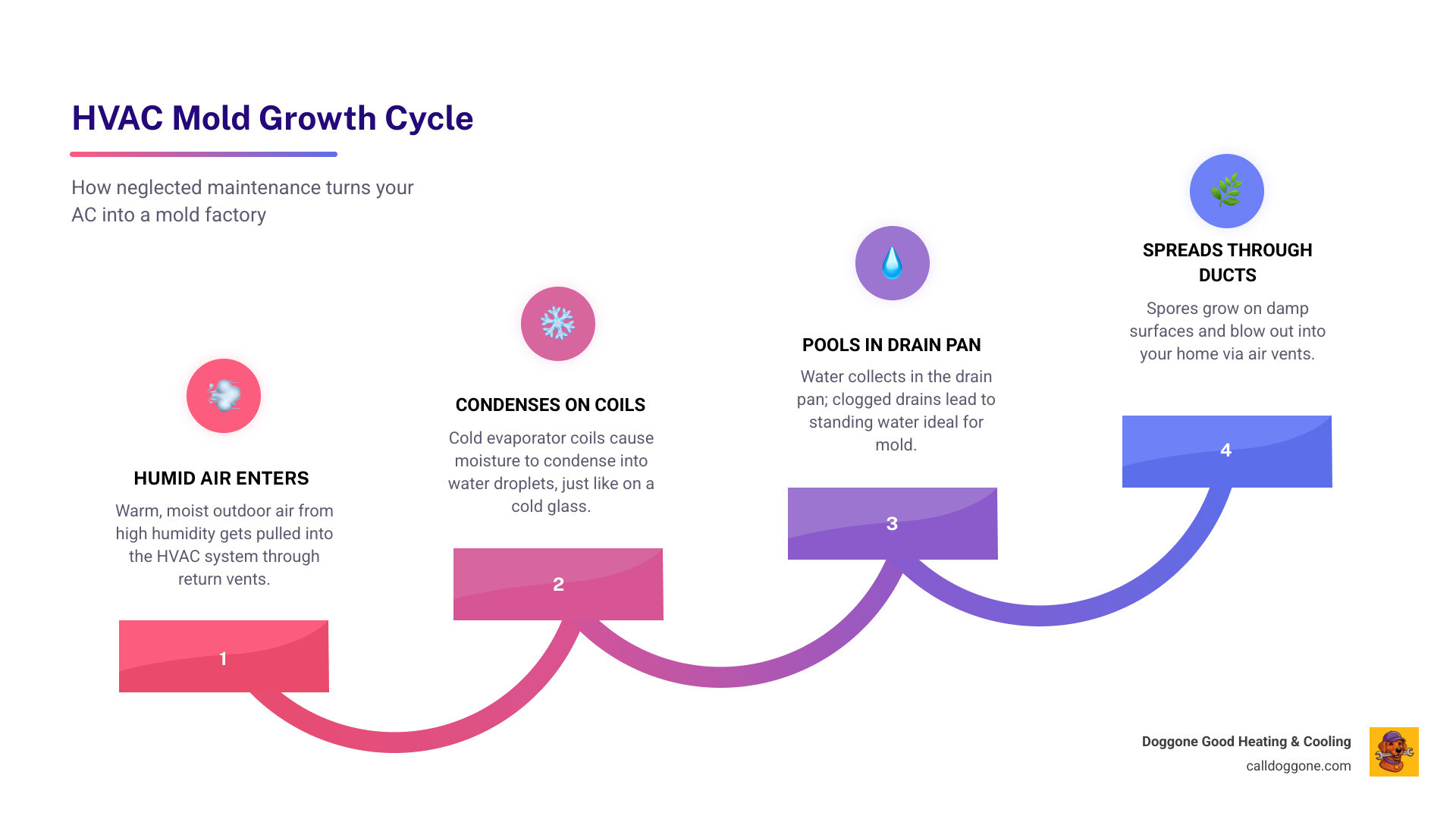
Living in the Baton Rouge area, from Zachary down to Gonzales, means living with water. It’s in our bayous, it’s in our rain, and unfortunately, it’s often in our air. When that heavy, humid air meets the cold surfaces of your air conditioning system, physics takes over. Condensation forms, just like on a cold glass of sweet tea on a July afternoon.
The primary way how proper HVAC maintenance prevents mold growth is by managing that moisture. Mold is a sneaky little bugger; it doesn’t need much to throw a party in your vents. It just needs a food source (like dust or skin cells) and moisture. In a neglected system, the dust acts as the snack and the condensation acts as the drink.
To keep your home safe, we focus on the “60% Rule.” Mold typically flourishes in environments where the relative humidity stays above 60%. Our goal with Indoor Air Quality services is to keep your home in the “sweet spot” of 30% to 50% humidity. When your system is running efficiently, it acts as a giant dehumidifier. But when maintenance slips, that dehumidification stops working, and your AC unit can quickly turn into a mold factory.
Understanding what you can do versus what requires a professional is the first step in your prevention plan.
DIY vs. Professional HVAC Maintenance for Mold Prevention
| Task | Frequency | DIY or Pro? |
|---|---|---|
| Change Air Filters | Every 1-3 Months | DIY |
| Clear Debris from Outdoor Unit | Monthly | DIY |
| Inspect Vents for Visible Growth | Monthly | DIY |
| Flush Condensate Drain Line | Every 3 Months | DIY / Pro |
| Clean Evaporator & Condenser Coils | Annually | Professional |
| Inspect & Seal Ductwork | Every 3-5 Years | Professional |
| Check Refrigerant Levels | Annually | Professional |
| Calibrate Thermostat/Humidity Sensors | Annually | Professional |
How Proper HVAC Maintenance Prevents Mold Growth via Humidity Control
Your air conditioner has a dual personality: it’s a cooler and a dehumidifier. As warm air from your home is pulled across the cold evaporator coils, the moisture in that air “falls out” and collects on the coils. This is the dehumidification process.
However, if your system isn’t maintained, this process breaks down. Dirty coils can’t absorb heat or moisture effectively. If the blower fan is struggling, you get stagnant air. Stagnant, humid air is exactly what mold spores look for when they want to settle down and raise a family. By investing in regular HVAC Maintenance Services, you ensure that your system is moving enough air to keep surfaces dry and pulling enough moisture out of the air to keep the relative humidity below that dangerous 60% threshold.
How Proper HVAC Maintenance Prevents Mold Growth through Filter Care
We often tell our neighbors in Prairieville and Denham Springs that the humblest part of their AC system is also one of the most important: the air filter.
Air filters are rated by MERV (Minimum Efficiency Reporting Value). A higher MERV rating (ideally between 8 and 13 for most homes) can trap microscopic mold spores before they ever enter your ductwork. But there’s a catch—if you don’t change that filter, it becomes part of the problem.
A dirty filter creates airflow restriction. When air can’t move freely, the system has to work harder, often leading to colder coils that freeze over. When that ice melts, it creates a massive amount of moisture in a dark, dusty area. Furthermore, a dirty filter covered in organic dust provides the “food” mold needs to grow right on the filter itself. Following a strict 1-3 month HVAC Maintenance schedule for filter changes is the easiest and cheapest way to prevent a mold outbreak.
Common Culprits: Why Mold Loves Neglected AC Systems
If you’ve ever walked into a room and smelled something “musty” or “earthy,” you’re likely smelling the byproduct of mold growth. Mold doesn’t just appear out of nowhere; it’s usually invited by a specific failure in the HVAC system.
Clogged Condensate Drains
This is the number one cause of HVAC-related water damage and mold in Baton Rouge. As your AC pulls moisture from the air, that water drips into a pan and flows out through a PVC pipe. Over time, “algae” (actually a mix of bacteria and fungi) can grow in that pipe, creating a clog. When the line clogs, water backs up into the drain pan. This standing water is a perfect breeding ground. Our Condensate Drain Cleaning & Pump Repair service ensures these lines stay clear, preventing “petri dish” conditions in your attic or closet.
Leaky and Uninsulated Ductwork
Think of your ducts like the veins of your home. If they have leaks, they “sweat.” In unconditioned spaces like a hot Louisiana attic, cold air leaking out of a duct causes the outside of the metal or plastic to hit the dew point. This creates condensation on the outside of the duct, which can soak into your insulation and drywall. Proper Ductwork Services involve sealing these leaks and ensuring the insulation is thick enough to prevent this “sweating” effect.
Oversized Systems and Short Cycling
There is a common misconception that “bigger is better” when it comes to AC units. In reality, an oversized system will cool your house down so fast that it shuts off before it has a chance to remove the humidity. This is called “short cycling.” You end up with a house that is 70 degrees but feels “clammy” because the humidity is still at 70%. That remaining moisture settles on your furniture, walls, and inside the vents, inviting mold to grow.
Essential Maintenance Tasks to Stop Mold in Its Tracks
Preventing mold isn’t about one big fix; it’s about a series of small, consistent actions. When we perform a tune-up, we aren’t just looking for broken parts; we are looking for moisture risks.
Coil Cleaning and Drain Line Flushing
The evaporator coil is the heart of the cooling process. If it’s covered in a layer of grime, moisture gets trapped in that dirt rather than flowing into the drain pan. We use specialized, self-rinsing cleaners to keep these coils spotless. For homeowners, a simple trick is to pour a cup of plain white vinegar down the condensate drain line every few months. The acidity helps kill off the “slime” that causes clogs. However, if a clog is already present, you’ll need a professional to blow the line out safely.
Seasonal Inspections
We recommend scheduling Seasonal Preventative Maintenance twice a year.
- Spring: We focus on the cooling side, ensuring the system is ready to handle the humidity of a Baton Rouge summer.
- Fall: We inspect the heating components and check the ductwork for any summer-induced moisture damage.
These HVAC Tune-Ups allow us to catch small issues—like a slightly tilted drain pan or a small refrigerant leak—before they turn into a full-blown mold remediation nightmare.
Vent and Airflow Management
It might seem harmless to close the vents in guest rooms to save energy, but this actually disrupts the pressure balance of your HVAC system. Restricted airflow leads to increased humidity in those closed-off rooms. Ensure all vents are clear of furniture and curtains to keep the air moving.
Advanced Solutions for Superior Indoor Air Quality
Sometimes, standard maintenance needs a little help, especially if someone in your family suffers from asthma or severe allergies.
UV Germicidal Lights
One of the most effective tools in our arsenal is the UV light. These are installed inside your air handler, specifically shining on the evaporator coil. The UVC light penetrates the DNA of mold spores and bacteria, rendering them unable to reproduce. It’s a proactive way to keep your system’s “wettest” area sterile 24/7.
Whole-Home Dehumidifiers
In some homes, the AC unit alone can’t keep up with Louisiana’s 90% humidity days. A whole-home dehumidifier works alongside your HVAC system to pull out gallons of water every day, ensuring your indoor humidity never crosses that 60% danger zone.
Duct Cleaning and Sanitizing
If mold has already found its way into your system, standard maintenance won’t be enough. You need Air Duct Cleaning & Sanitizing. We use specialized vacuums and botanical sanitizers to clear out the spores and the dust they feed on, essentially resetting your home’s air quality to zero.
Frequently Asked Questions about HVAC Mold Prevention
What are the first signs of mold in my HVAC system?
The nose usually knows first. A musty, “locker room” smell when the AC kicks on is a major red flag. You should also look for visible signs:
- Discoloration: Black or green fuzzy spots on your air registers (vents).
- Physical Symptoms: If your family experiences unexplained headaches, itchy eyes, or coughing that gets better when you leave the house, the HVAC system might be the culprit.
- Excessive Condensation: If you see water dripping from your vents or “sweat” on the outside of your AC unit, mold isn’t far behind.
How often should I have my ducts professionally inspected?
In the Baton Rouge climate, we recommend a professional duct inspection every 2-3 years, though they should be checked for major leaks during your biannual tune-up. If you’ve recently had a plumbing leak, roof leak, or flood event (which we know all too well in this area), you should have them inspected immediately. Generally, a full professional cleaning is recommended every 3 to 5 years to remove the organic dust that acts as mold food.
Can a dirty air filter really cause mold growth?
Absolutely. It’s a chain reaction. A dirty filter blocks airflow → blocked airflow causes the evaporator coil to get too cold → the coil freezes → the ice eventually melts and overflows the drain pan → the standing water and the dust on the filter create the perfect mold habitat. Changing your filter is the single most important DIY task for how proper HVAC maintenance prevents mold growth.
The Long-Term Benefits of Preventative Maintenance
While our focus today is mold, it’s worth noting that the same steps that prevent mold also save you a lot of money. A clean, well-maintained system:
- Lasts Longer: You won’t have to replace your unit as often because it isn’t straining to breathe.
- Lower Bills: An efficient system uses significantly less electricity to cool your home.
- Better Sleep: Proper humidity control makes 75 degrees feel much cooler and more comfortable than “wet” 75 degrees.
At Doggone Good Heating & Cooling, we treat your home like our own. We know the local challenges because we live here too. Whether you’re in Zachary or Prairieville, we’ve seen what the humidity can do to a neglected system.
Protect Your Home with Doggone Good Heating & Cooling
Don’t wait until you’re smelling musty air to take action. Mold is much easier (and cheaper) to prevent than it is to remove. Our team is dedicated to providing honest, reliable service to our Baton Rouge neighbors.
If you want the ultimate peace of mind, check out our Pack Perks Membership. It’s our affordable way of making sure your system gets the Maintenance Programs it needs twice a year, without you having to remember to call us. We also offer 24/7 emergency response because we know AC units never seem to break down at a convenient time.
Take the first step toward a healthier, drier, and mold-free home. Schedule your indoor air quality assessment today and let us help you keep your AC from becoming a petri dish. We’ll make sure your system is running “doggone good” all year long!
About the Author
Doggone Good Heating and Cooling
Doggone Good Heating and Cooling — your local HVAC experts in Baton Rouge, LA.
Need HVAC Service?
Get a free estimate or schedule your service today. Our team is ready to help.
Recent Posts


Related Articles
Ready to Get Started?
Prefer to Call?
Talk with a local technician and get clear next steps for your home.
Call Now(225) 230-9784