How High-Efficiency Systems Reduce Summer Energy Costs in Baton Rouge
Doggone Good Heating and Cooling


Discover how high efficiency systems reduce summer costs in Baton Rouge with smarter cooling and better humidity control.
Why Baton Rouge Homeowners Are Searching for How High-Efficiency Systems Reduce Summer Costs
Understanding how high efficiency systems reduce summer costs comes down to one simple idea: modern AC equipment does the same cooling job as older units while using far less electricity to do it. Here is a quick breakdown:
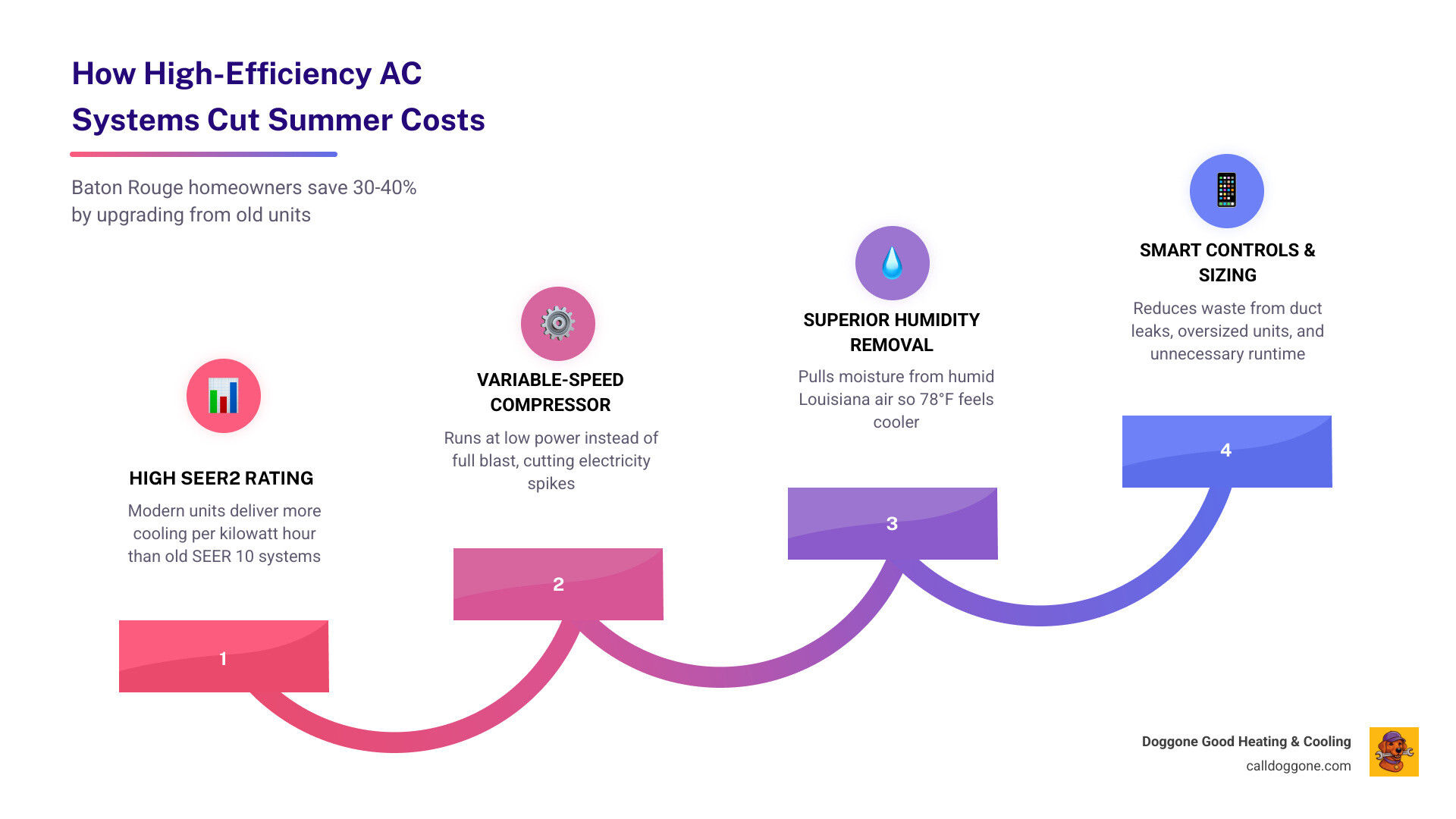
How high-efficiency systems lower your summer energy bills:
- Higher SEER2 ratings mean more cooling output per unit of electricity consumed
- Variable-speed compressors run at lower power instead of blasting on and off at full strength
- Better dehumidification makes your home feel cooler at higher thermostat settings
- Reduced cycling cuts the high-wattage startup surges that older single-stage units trigger repeatedly
- Smart thermostat compatibility prevents the system from running when no one is home
- Proper sizing and sealed ductwork stop cooled air from going to waste before it reaches you
Homeowners upgrading from a SEER 10 unit to a SEER 15 or higher system commonly see cooling cost reductions of 30% or more, with some reaching 40% or beyond when moving to SEER 18+ equipment.
If you live in Baton Rouge, you already know the summers here are no joke. The heat arrives early, stays late, and brings relentless humidity that makes every degree on the thermostat feel like two. Air conditioners in Louisiana do not get a break — they run long hours, fight heavy heat gain through roofs and walls, and work overtime just to keep indoor air from feeling like a sauna.
The result for many households is a summer electricity bill that climbs higher every year, even when nothing obvious has changed. Older or standard-efficiency AC systems are a major reason why. They were not built for precision. They run at full blast or not at all, struggle to pull moisture out of humid air, and lose efficiency steadily as they age. Upgrading to a high-efficiency system changes that equation significantly — and in a climate like Baton Rouge’s, the difference shows up fast on your monthly bill.
Why summer cooling costs climb so fast in Louisiana
In the Baton Rouge area, including Prairieville and Denham Springs, summer isn’t just a season; it’s an endurance test for your HVAC system. Several factors cause our utility bills to skyrocket between May and September. First, the humidity in Louisiana is a “latent” heat load. Your AC has to work twice as hard to remove moisture before it can even begin to lower the air temperature. If your system is old or inefficient, it may run for hours without ever making the air feel “crisp.”
Long run times are another culprit. When it’s 95°F outside with a high heat index, your system might run for 15 to 20 hours a day. During these long stretches, heat gain through poorly insulated attics or drafty windows forces the AC to consume massive amounts of power. Furthermore, if your ductwork has leaks, you could be losing up to 20% of your cooled air to the attic before it even reaches your living room. When you combine these factors with a standard-efficiency unit, you’re essentially paying for a system that is “burning cash” just to keep up.
How high efficiency systems reduce summer costs in real homes
So, how exactly does a modern upgrade change things? It starts with the technology under the hood. High-efficiency systems utilize variable-speed technology. Unlike an old unit that is either 100% “on” or 100% “off,” a high-efficiency system can adjust its output to match the cooling needs of your home. If it only needs 30% power to maintain your set temperature, that’s all it uses.
Beyond the mechanical parts, how high efficiency systems reduce summer costs involves smarter management. These systems are designed to work in harmony with smart controls that optimize every cooling cycle. By removing more humidity and reducing the number of high-wattage startups (the moment your lights flicker when the AC kicks on), these systems slash the total wattage consumed daily. In many cases, we see homes reduce their daily energy consumption from 72,000 watts down to just 24,000 watts simply by making the switch to more efficient technology.
What a high-efficiency AC system is and how it differs from older models
When we talk about high-efficiency AC, we are referring to systems that go above and beyond the federal minimum standards. In the past, a SEER (Seasonal Energy Efficiency Ratio) of 10 was common. Today, the industry has moved to SEER2, a more rigorous testing standard that better reflects real-world conditions. A high-efficiency unit today typically starts at SEER 16 and can go as high as SEER 22 or more.

What counts as “high efficiency” in 2026
As of May 2026, the bar for efficiency has been raised. While the federal minimums have increased over the years, a truly high-efficiency system is generally one that carries the ENERGY STAR label and boasts a SEER2 rating of 16 or higher. These systems are also evaluated by their EER2 (Energy Efficiency Ratio), which measures how well the unit performs during the hottest part of a Louisiana afternoon. While SEER2 tells you the average efficiency over a season, EER2 tells you how it handles the “peak” heat—which is vital for our local climate.
Older AC vs high-efficiency AC: what changes inside the system
The difference between an old “clunker” and a new high-efficiency unit is like comparing a 1990s truck to a modern hybrid.
| Feature | Older AC (SEER 10-12) | High-Efficiency AC (SEER 18+) |
|---|---|---|
| Compressor | Single-stage (All or nothing) | Variable-speed (Precise adjustment) |
| Startup Power | 4,000–6,000 watts surge | 2,000–3,000 watts ramp-up |
| Blower Motor | Constant speed (Noisy/Inconsistent) | Variable-speed (Quiet/Steady) |
| Dehumidification | Limited (Air feels clammy) | Advanced (Superior moisture removal) |
| Refrigerant | Phased-out types (Expensive repairs) | Modern, eco-friendly refrigerants |
Older units rely on a single-stage compressor that blasts on at full power, cools the house quickly, and then shuts off. This “short-cycling” is incredibly inefficient and wears out parts faster. High-efficiency units use “inverter” technology to ramp up and down slowly, avoiding that massive power surge every time the thermostat calls for cooling.
Why high-efficiency systems feel better even at the same temperature
Efficiency isn’t just about the bill; it’s about the “feel.” Because high-efficiency systems run longer cycles at lower speeds, they are much better at circulating air and removing humidity. In a humid place like Gonzales or Zachary, humidity is the enemy of comfort.
When your AC removes moisture effectively, you can actually set your thermostat a few degrees higher—say 78°F instead of 72°F—and feel just as comfortable. Since every degree you raise the thermostat can save you 3% to 5% on your cooling costs, this improved comfort translates directly into lower bills. You lose that “clammy” feeling and gain a home with even temperatures and no “hot spots.”
How high efficiency systems reduce summer costs through ratings, sizing, and setup
To maximize the benefits of a new system, it isn’t enough to just pick the highest number on the box. The way the system is designed and installed for your specific home in Baton Rouge determines whether you actually see those savings. This is where load calculations and system sizing become critical.
Which efficiency ratings matter most for summer savings
While SEER2 is the “miles per gallon” of the HVAC world, homeowners in our area should also look at the EER2 rating. Because we experience long stretches of 90°F+ days, you need a system that doesn’t lose its “cool” when the sun is beating down on your roof. High-efficiency systems are engineered to maintain their rated performance even under extreme stress, whereas standard units may see their efficiency drop significantly when it gets truly hot outside.
How much energy savings homeowners can reasonably expect
The savings are measurable and often dramatic. Based on industry data and real-world performance:
- Upgrading from a SEER 10 to a SEER 15 unit can create a 33% annual savings on cooling.
- Moving to an 18 SEER unit can save 40% or more.
- Most homeowners who switch from an older unit (SEER 10 or less) to a high-efficiency model save at least 30% on monthly electricity bills.
For a standard 2,000-square-foot home in Louisiana, this can mean the difference between a $200 monthly cooling bill and a $120 bill. Over the 15-to-20-year lifespan of a system, those savings pay for the upgrade many times over.
Why proper sizing is just as important as the equipment itself
A common mistake is thinking “bigger is better.” If an AC is oversized for your home, it will cool the air so fast that it shuts off before it can remove the humidity. You’ll end up with a cold, damp house and a system that breaks down prematurely due to frequent starting and stopping. Conversely, an undersized unit will run 24/7 and still never reach your desired temperature. We use “Manual J” load calculations to ensure your system is perfectly matched to your home’s square footage, insulation levels, and window orientations.
The biggest factors that affect your actual summer savings
Even the most efficient AC in the world can’t do its job if your home is “leaking” energy. To truly understand how high efficiency systems reduce summer costs, you have to look at the whole house. Your home’s “envelope”—the walls, roof, and windows—acts as a barrier. If that barrier is weak, your new AC will have to work harder than necessary.
We often recommend starting with energy audits to identify where you are losing money. Improving your overall energy efficiency ensures that every bit of cooling your new system produces stays inside where you want it.
How maintenance protects efficiency all summer long
A high-efficiency system is a precision machine, and like a fine car, it needs regular care. Neglecting your AC can cause it to lose up to 5% of its efficiency every single year. Dust on the coils, low refrigerant levels, or a clogged filter can force a SEER 18 unit to perform like a SEER 12 unit.
Following a comprehensive AC maintenance checklist is the best way to protect your investment. Simple tasks like changing your filters every 1–3 months and scheduling an annual professional tune-up keep the airflow clear and the components running at peak performance.
How smart thermostats and settings influence cooling costs
The “brain” of your high-efficiency system is the thermostat. Smart thermostats learn your schedule and use geofencing to raise the temperature when you leave the house and cool it back down before you arrive.
For maximum savings, the Department of Energy suggests setting your thermostat to 78°F when you are home. While that might sound high, high-efficiency systems remove more moisture, so 78°F feels much cooler than it would with an old unit. Raising the temperature by just one degree can save you 3% to 5% on energy costs.
Home improvements that help a new AC save more
To get the most out of your upgrade, consider these “partners” in efficiency:
- Duct Sealing: Leaky ducts can waste 20% of your system’s output.
- Attic Insulation: This keeps the Louisiana sun from “baking” your living space.
- Window Treatments: Closing blinds during the day prevents solar heat gain.
Some of these energy upgrades literally pay for themselves through the massive reduction in system workload. For more practical advice, check out our guide on smart ways to cool your Louisiana home.
Best time to upgrade and the common mistakes that ruin efficiency
Timing is everything. Many homeowners wait until their AC dies in the middle of a 100-degree July day to think about an upgrade. At that point, you’re in an emergency situation and might not have the time to research the best high-efficiency options.
Why spring, especially April, is the smartest time to install
April is the “sweet spot” for HVAC upgrades in Baton Rouge and Denham Springs. Why?
- Availability: We have more flexible scheduling before the summer rush begins.
- Incentives: Manufacturers often offer their best rebates and promotions in the spring.
- Preparedness: You can ensure your system is commissioned and ready before the first heat wave hits.
Plus, taking the time to learn how to score big on Louisiana utility rebates in the spring can save you a significant amount on the initial investment.
Common mistakes that reduce the savings of a new system
Even the best equipment can fail to deliver savings if the installation is botched. Common pitfalls include:
- Ignoring the Ducts: Putting a high-efficiency unit on old, leaky, or undersized ducts.
- Wrong Refrigerant Charge: If the system isn’t charged exactly to manufacturer specs, efficiency plummets.
- Blocked Vents: Closing vents in unused rooms actually disrupts airflow and makes the system work harder.
- Skipping the Filter: A dirty filter is the #1 cause of “high efficiency” systems underperforming.
Signs your current system may already be costing you more than it should
How do you know if it’s time to move on? Sometimes high energy bills are the first signal of HVAC problems. If your bills are rising despite your habits staying the same, your system is likely losing the battle against age. Other signs include rooms that never get cool, a house that feels “heavy” or humid, and a unit that seems to be making strange noises or requiring frequent repairs. If your system was made before 2010, it is almost certainly a low-efficiency model by today’s standards.
Frequently Asked Questions About How High Efficiency Systems Reduce Summer Costs
How high efficiency systems reduce summer costs if my AC still runs all day?
It’s actually a good thing! High-efficiency systems with variable-capacity compressors are designed to run longer cycles at very low power. This allows them to constantly filter the air and remove humidity without the “start-stop” waste of electricity. Running at 30% power for a long time is much cheaper than running at 100% power in short bursts.
Do high-efficiency systems need more maintenance than standard AC units?
Not “more,” but they do need “precise” maintenance. They use advanced sensors and inverter boards that need to be kept clean and free of debris. An annual tune-up is essential to protect these high-tech components and ensure you keep getting the SEER2 performance you paid for.
Is a high-efficiency upgrade worth it if my home still has insulation or duct issues?
An upgrade will still save you money because the machine itself is more efficient, but you won’t reach the full savings potential. We always recommend addressing duct leaks and insulation gaps alongside a new installation to ensure you get the best possible return on your investment.
Ready to lower summer energy use and improve comfort in Baton Rouge?
At Doggone Good Heating & Cooling, we’ve spent years helping our neighbors in Baton Rouge, Prairieville, Zachary, and Gonzales stay cool without breaking the bank. We know the local climate, and we know exactly how high efficiency systems reduce summer costs for Louisiana families.
Whether you need a full system replacement, a smart thermostat upgrade, or just an honest assessment of your current unit’s efficiency, we are here to help. Our team provides reliable, locally attuned service with the transparency you deserve. To make staying efficient even easier, ask about our Pack Perks Membership, which includes pre-season tune-ups and discounts to keep your system in top shape year-round.
Don’t spend another summer sweating over your utility bills. Explore our energy-efficiency services today and let us help you find a cooling solution that’s “doggone good” for your wallet and your comfort. Give us a call or schedule your consultation online to get started!
{"@context": "https://schema.org", "@graph": [{"@type": "Article", "headline": "High-Efficiency AC Cuts Summer Costs | Doggone Good", "description": "Learn how high efficiency systems reduce summer costs in Baton Rouge with lower energy use, better humidity control and smart AC upgrades. Call today!", "author": {"@type": "Person", "name": "Arthur Lancaster"}, "publisher": {"@type": "Organization", "name": "Doggone Good Heating & Cooling", "logo": {"@type": "ImageObject", "url": "https://calldoggone.com/wp-content/uploads/2025/04/menu-logo.png"}}, "datePublished": "2026-07-04T02:47:45+00:00", "dateModified": "2026-07-04T02:48:02.066843", "mainEntityOfPage": {"@type": "WebPage", "@id": "https://calldoggone.com/blog/how-high-efficiency-systems-reduce-summer-energy-costs-in-baton-rouge/"}, "image": "https://images.bannerbear.com/direct/4mGpW3zwpg0ZK0AxQw/requests/000/146/010/984/5R7NlW8nEzjaN43kYmvbxgLyP/d83ba9e03c11056e965e084622c811961894f82d.jpg"}, {"@type": "FAQPage", "mainEntity": [{"@type": "Question", "name": "How do high-efficiency AC systems reduce summer energy costs?", "acceptedAnswer": {"@type": "Answer", "text": "High-efficiency AC systems use less electricity to deliver the same cooling as older units. They lower costs through higher SEER2 ratings, variable-speed compressors, better dehumidification, reduced cycling, smart thermostat compatibility, and proper sizing with sealed ductwork."}}, {"@type": "Question", "name": "How much can Baton Rouge homeowners save by upgrading to a high-efficiency AC system?", "acceptedAnswer": {"@type": "Answer", "text": "Homeowners upgrading from a SEER 10 unit to a SEER 15 or higher system commonly see cooling cost reductions of 30% or more. Some may save 40% or more when moving to SEER 18+ equipment."}}, {"@type": "Question", "name": "Why are summer cooling bills so high in Baton Rouge?", "acceptedAnswer": {"@type": "Answer", "text": "Baton Rouge summers bring long periods of intense heat and heavy humidity, forcing air conditioners to run for extended hours. The humidity adds a latent heat load, meaning the AC must remove moisture before it can effectively lower indoor air temperature."}}, {"@type": "Question", "name": "Why do older AC systems cost more to run in Louisiana summers?", "acceptedAnswer": {"@type": "Answer", "text": "Older or standard-efficiency AC systems often run at full blast or not at all, struggle to remove moisture, and lose efficiency as they age. This makes them work harder during Baton Rouge’s hot, humid summers and can drive up electricity bills."}}, {"@type": "Question", "name": "How does better dehumidification help lower AC costs?", "acceptedAnswer": {"@type": "Answer", "text": "Better dehumidification makes indoor air feel cooler even at higher thermostat settings. This can reduce how hard and how often the air conditioner needs to run during humid Louisiana summers."}}]}]}About the Author
Doggone Good Heating and Cooling
Doggone Good Heating and Cooling — your local HVAC experts in Baton Rouge, LA.
Need HVAC Service?
Get a free estimate or schedule your service today. Our team is ready to help.
Recent Posts


Related Articles
Ready to Get Started?
Prefer to Call?
Talk with a local technician and get clear next steps for your home.
Call Now(225) 230-9784