Keep Your Cool When the Wind Howls with These HVAC Prep Tips
Doggone Good Heating and Cooling

Learn how to protect your AC during a hurricane: secure units, pre-cool, shut off power & inspect post-storm in Baton Rouge.
What Baton Rouge Homeowners Must Know About How to Protect Your AC During a Hurricane
Knowing how to protect your AC during a hurricane can save you thousands of dollars in repair or replacement costs. In Baton Rouge, LA, hurricane season runs from June 1 through November 30 — and storms in this region can bring wind speeds well above 74 mph, heavy flooding, and dangerous power surges that can destroy an AC system within minutes.
Your outdoor condenser unit is one of the most expensive and exposed components on your home. Flying debris, rising floodwater, and electrical surges from lightning strikes are all very real threats. According to FEMA, just one inch of floodwater can cause up to $25,000 in damage to an HVAC system.
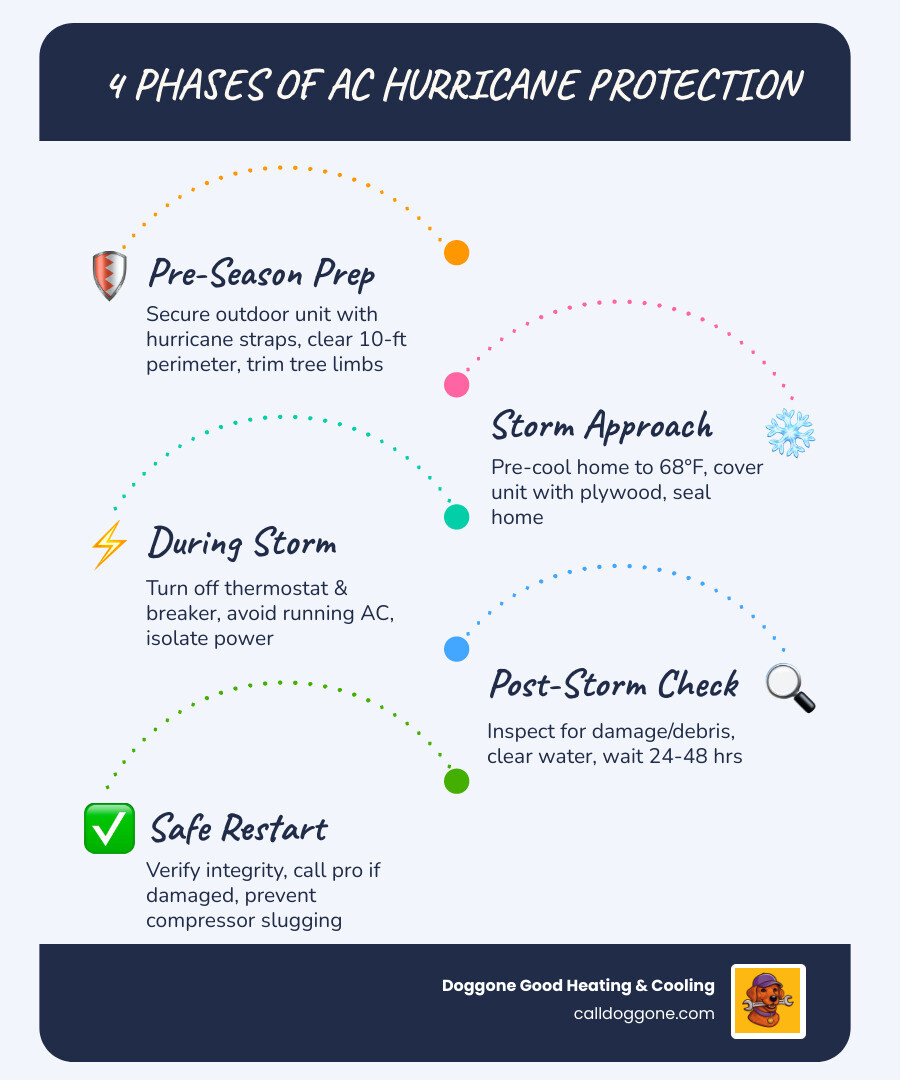
Here is a quick overview of how to protect your AC during a hurricane:
- Pre-cool your home — Set your thermostat to around 68°F several hours before the storm arrives to store cool air in your home’s insulation.
- Clear the area around your outdoor unit — Remove patio furniture, debris, and trim overhanging tree branches within a 10-foot perimeter.
- Cover the outdoor unit — Use a plywood enclosure or a breathable, manufacturer-approved cover secured with straps.
- Shut off power at the thermostat AND the circuit breaker — Turning off the thermostat alone is not enough. Cutting the breaker fully isolates the unit from dangerous power surges.
- Do not run your AC during the storm — Keep it off the entire time the storm is active.
- Inspect before restarting after the storm — Check for standing water, debris, damaged refrigerant lines, or unusual smells before restoring power.
- Wait before turning the compressor back on — Allow 24 to 48 hours after power is restored so the crankcase heater can warm the compressor oil and prevent damage.
- Call a professional — If there is any visible damage, flooding, or unusual sounds, do not attempt to restart the unit yourself.
The sections below walk through each of these phases in detail — from pre-season prep to post-storm recovery — so your system survives hurricane season and keeps your family comfortable on the other side.
Why You Need to Know How to Protect Your AC During a Hurricane
When we talk about hurricane-force winds, we are looking at speeds starting at 74 mph. At these velocities, everyday backyard objects like garden gnomes, patio chairs, and even heavy tree limbs become high-speed projectiles. Your outdoor condenser unit is essentially a box of delicate copper coils and thin aluminum fins. If a branch strikes those fins at 80 mph, it can flatten them instantly, choking off the airflow your system needs to breathe.
Beyond wind, water is a silent killer for HVAC systems. We often see heavy rainfall totals exceeding 10 to 15 inches during a single Louisiana storm event. While outdoor units are designed to handle rain, they are not designed to be submerged. Just one inch of floodwater can migrate into the electrical compartment, corroding control boards and ruining the compressor. This is why staying on top of Residential Air Conditioning Maintenance is so critical; a well-maintained system has a better chance of resisting minor environmental stressors, but a direct flood hit often leads to a total system loss.
Finally, there is the “invisible” threat: electricity. Lightning strikes and transformer explosions during a storm cause massive power surges. These surges can travel through the lines and “fry” the sensitive electronics inside your AC. Salt air corrosion is another factor for our friends closer to the coast, as the high-velocity winds can carry salt spray miles inland, accelerating the rust on your unit’s internal components.
Pre-Storm Preparations: Securing the Outdoor Unit
Preparation for a hurricane shouldn’t start when the clouds turn gray; it starts weeks in advance. One of the most effective ways to ensure your unit stays put is to use hurricane straps or anchor bolts. A standard condensing unit weighs between 150 and 200 pounds, which might seem heavy, but 160 mph winds can easily flip it over or slide it off its pad. Ensuring your unit is bolted to a heavy concrete base is a foundational step in storm safety.
We recommend clearing a 10-foot “no-fly zone” around your condenser. This means:
- Trimming heavy tree limbs that hang over the unit.
- Moving patio furniture, potted plants, and garden decor into the garage or shed.
- Picking up loose debris, rocks, or branches from the yard.
Regular HVAC Maintenance can help identify if your unit’s current mounting is loose or if the surrounding area poses a risk. For the unit itself, many experts recommend a plywood cover. Plywood is sturdy enough to deflect flying debris without trapping as much moisture as a plastic tarp. If you do use a cover, it must be removed the second the storm passes—running a covered AC will cause the compressor to burn out in as little as 15 minutes.
How to Protect Your AC During a Hurricane with Pre-Cooling
If the power goes out, your home will quickly turn into a sauna in the Louisiana humidity. You can use your AC as a “cool-storage battery” by pre-cooling your home. About 4 to 8 hours before the storm is expected to hit, drop your thermostat to 68°F.
This chills the air, but more importantly, it cools the “thermal mass” of your home—the walls, furniture, and floors. By sealing all windows and doors and closing the curtains, you can keep your home comfortable for hours after the power fails. For more tips on managing the local climate, check out our guide on How to Prepare Your Air Conditioner for Louisiana Summer Heat.
Critical Steps to Take When the Storm Hits
As the wind begins to pick up, it is time to shut everything down. Do not just turn the AC off at the thermostat. You must go to your electrical panel and flip the circuit breaker to the “OFF” position.
Why is this necessary? When power lines go down, the electricity often flickers or “browns out.” These rapid on-off cycles put immense pressure on the compressor. Furthermore, a massive surge from a nearby lightning strike can jump the small gap in a thermostat switch, but a flipped breaker provides a much more robust physical disconnect. Our HVAC Services team often sees control boards that were literally melted because the homeowner left the breaker on during a lightning storm.
If you have window AC units, the best move is to remove them entirely, close the window, and seal any gaps. If they must stay in place, they should be unplugged and covered tightly to prevent rain from being driven through the vents into your living room.
Electrical Safety and How to Protect Your AC During a Hurricane
Erratic power failures are the primary cause of post-storm electrical “burnout.” When the grid is struggling to stay online, the voltage can fluctuate wildly. This forces the AC motor to work much harder than it’s designed to, leading to overheating.
Installing a dedicated HVAC surge protector is a smart long-term move. These devices act like a fuse for your entire system, sacrificing themselves to save your expensive compressor and control boards. For business owners, Light Commercial Air Conditioning Maintenance plans often include electrical inspections to ensure your surge protection is up to the task of a Baton Rouge summer. Always remember to unplug sensitive electronics and ensure your home’s grounding wires are intact before the storm season peaks.
Post-Storm Inspection and Safe Restart Procedures
Once the “all clear” is given, resist the urge to immediately flip the breaker back on. You need to perform a thorough visual inspection first. Walk out to the condenser and look for:
- Standing water: If the unit is sitting in a puddle, do not turn it on.
- Debris: Check for branches, leaves, or mud packed into the fins.
- Lines: Ensure the copper refrigerant lines and electrical conduits are still connected and haven’t been bent or broken.
| Feature | DIY Visual Check | Professional Diagnostic |
|---|---|---|
| Exterior Fins | Check for visible flattening or mud | Straighten fins with specialized tools |
| Electrical | Look for charred wires or smells | Test voltage and capacitor health |
| Refrigerant | Check for oily spots (leaks) | Measure pressure and subcooling |
| Drainage | Ensure the area is clear of water | Flush condensate lines and check pans |
After clearing any surface debris, refer to your AC Maintenance Checklist to Lower Energy Bills to ensure the rest of your system is in good shape. If the unit was covered, remove the cover immediately to allow the components to dry out.
When to Call a Professional for Hurricane Damage
There are certain red flags that mean you should stay away from the breaker and Contact Us for a professional inspection. If you notice bent condenser fins, oily residue (which indicates a refrigerant leak), or if the unit was even partially submerged in floodwater, it is not safe to operate.
One of the most critical “pro tips” is the 24-48 hour wait rule. Most modern compressors have a “crankcase heater” designed to keep the oil warm so that liquid refrigerant doesn’t mix with it. If the power has been off for a long time, the oil gets cold. When power returns, you should wait at least a day before starting the cooling cycle to let that heater do its job. This prevents “slugging,” which can destroy a compressor on the very first rotation. Furthermore, running a damp, idle system can lead to rapid mold growth in your ductwork—a professional can ensure your air stays clean and safe.
Long-Term Strategies for Hurricane Resilience
If you live in a flood-prone area of Baton Rouge or Prairieville, consider elevating your outdoor unit. Mounting the condenser on a 12-to-24-inch platform or a sturdy concrete pad can be the difference between a minor inconvenience and a $10,000 replacement bill.
For those in coastal-adjacent areas, look into “coastal-grade” equipment. These units feature corrosion-resistant coils and special coatings that resist the salt air and high humidity that define our region. Investing in whole-home surge protection is another layer of defense that protects your AC, refrigerator, and entertainment systems simultaneously. As always, the best defense is a good offense: regular Residential Air Conditioning Maintenance ensures that small issues like loose bolts or aging capacitors don’t become catastrophic failures when a storm rolls through.
Frequently Asked Questions about Hurricane AC Prep
Should I cover my AC unit with a plastic tarp during a hurricane?
No, we generally advise against using standard plastic tarps for long periods. Plastic traps moisture against the metal, which can lead to rapid rusting of the electrical components. If you must cover the unit to protect it from flying debris, use a piece of plywood weighted down or a breathable, manufacturer-approved cover. Always remove it immediately after the storm.
How long should I wait to restart my AC after power returns?
Ideally, you should wait 24 hours. This allows the crankcase heater to warm up the compressor oil. If you start the unit immediately after a long power outage, you risk “slugging” the compressor with liquid refrigerant, which can cause permanent mechanical failure.
Can one inch of floodwater really damage my HVAC system?
Yes. According to FEMA, even a small amount of water can migrate into the sealed electrical components of your outdoor unit. Once silt and salt get into the wiring and control boards, they begin to corrode. Even if the unit starts up initially, the internal damage will likely lead to a failure a few weeks later.
Conclusion
At Doggone Good Heating & Cooling, we know that hurricane season is a stressful time for Baton Rouge families. Our mission is to provide honest, reliable, and locally attuned service to help you navigate these challenges. Whether you need a pre-storm tune-up or an emergency post-storm inspection, our team is ready to help 24/7.
Don’t wait for the next named storm to think about your comfort. Consider joining our Pack Perks Membership for affordable, year-round peace of mind. If you suspect your system has sustained storm damage or you want to upgrade your home’s hurricane resilience, reach out to us for expert HVAC Maintenance Services today. We are proud to serve Baton Rouge, Prairieville, Denham Springs, Zachary, and Gonzales with the quality care your home deserves.
About the Author
Doggone Good Heating and Cooling
Doggone Good Heating and Cooling — your local HVAC experts in Baton Rouge, LA.
Need HVAC Service?
Get a free estimate or schedule your service today. Our team is ready to help.
Recent Posts


Related Articles
Ready to Get Started?
Prefer to Call?
Talk with a local technician and get clear next steps for your home.
Call Now(225) 230-9784