Knowing When to Replace Your AC Before It Quits on You
Doggone Good Heating and Cooling

Discover when should you replace your AC: age, repair costs, efficiency, performance red flags & Baton Rouge tips for reliable comfort.
Why Knowing When Should You Replace Your AC Can Save You From a Sweaty Surprise
Knowing when should you replace your AC is one of the most important decisions you’ll make as a Baton Rouge homeowner — especially when summer heat and humidity can make a broken system feel like a genuine emergency.
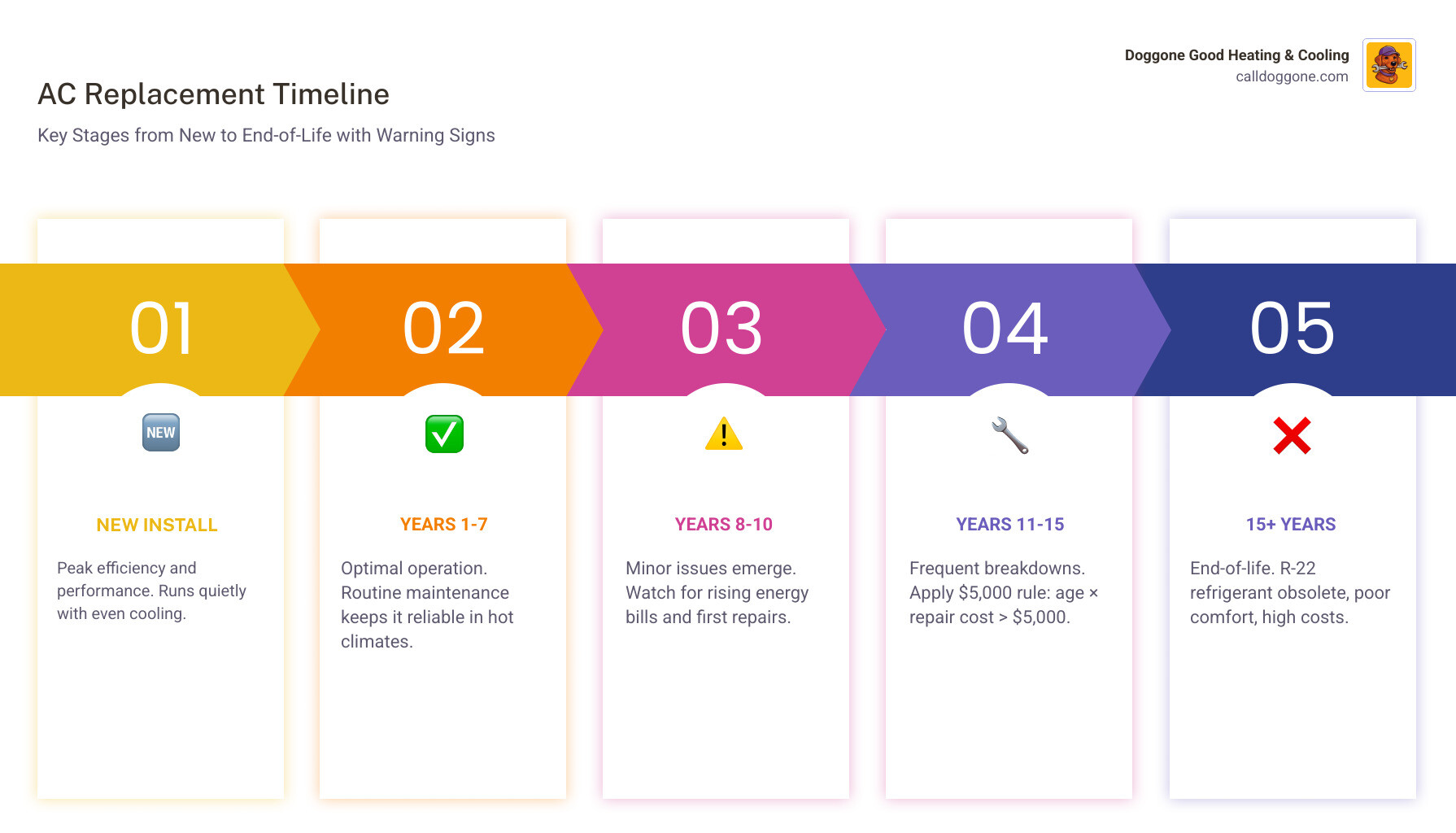
Most central AC units last 10 to 15 years. But age alone isn’t the only signal. Here’s a quick look at the key replacement triggers:
- Age: Your unit is 10–15 years old or older
- The $5,000 Rule: Unit age × repair cost exceeds $5,000
- Refrigerant type: Your system uses R-22 (Freon), which was banned in 2020
- Rising energy bills: Costs keep climbing with no change in your habits
- Frequent repairs: You’ve needed two or more fixes in a single year
- Poor comfort: Uneven cooling, high indoor humidity, or weak airflow
- Unusual noises or odors: Grinding, squealing, musty, or burning smells
No one wants to come home on a sweltering Baton Rouge afternoon to find their AC has given out completely. The good news is that your system almost always gives you warning signs before it quits for good — much like a car that starts making strange sounds before it finally breaks down on the highway. Catching those signs early means you get to make a smart, planned decision instead of a panicked one.
The Core Indicators: When Should You Replace Your AC?
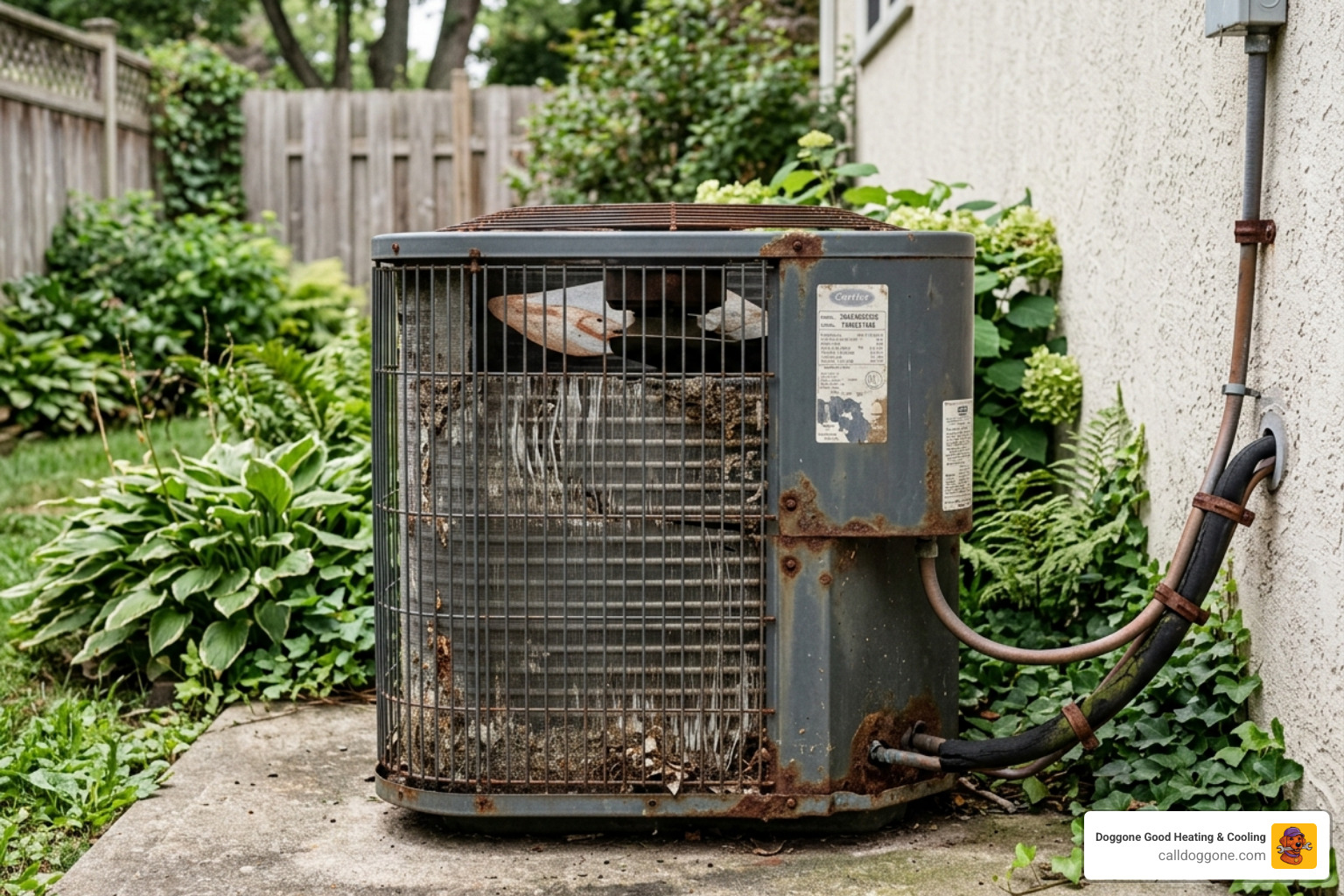
In our neck of the woods—from Baton Rouge to Prairieville and Gonzales—our air conditioners work harder than almost anywhere else in the country. Because of our intense Louisiana climate, the average lifespan of a central air conditioning unit typically falls between 10 and 15 years. While some “overachievers” might push toward the 20-year mark, they are often running on borrowed time and a lot of luck.
As your system ages, it undergoes significant mechanical wear. The internal components, particularly the compressor and motor, begin to lose efficiency. Research shows that units over a decade old can be 20% to 40% less efficient than modern models. If you are noticing early signs your air conditioner will fail this summer, such as the unit running for longer cycles just to keep up with the thermostat, it’s a strong indicator that the mechanical “heart” of the system is tired.
Common age-related failure signs include:
- A steady climb in monthly utility bills.
- Frequent breakdowns that require professional intervention.
- Difficulty maintaining a consistent temperature when it’s over 90 degrees outside.
- Visible corrosion or rust on the outdoor condenser unit.
Determining When Should You Replace Your AC Using the $5,000 Rule
When a major part breaks, homeowners often find themselves in a “guessing game” of whether to fix it or ditch it. To take the emotion out of the decision, we recommend using the $5,000 Rule.
This is a simple mathematical formula: Multiply the age of your AC unit by the cost of the repair. If the result is more than $5,000, replacement is generally the more cost-effective choice. For example, if you have a 12-year-old unit and the repair estimate is $500, the total is $6,000. In this case, investing that money into a new, warrantied system makes more financial sense than patching up an old one.
Using this logic helps you avoid the “sunk cost fallacy”—the feeling that you have to keep repairing a unit just because you’ve already spent money on it recently. If you’re still on the fence, check out our guide on should you repair or replace an old air conditioner in Baton Rouge? to see how these numbers play out in real-world scenarios.
The R-22 Freon Phase-Out and Your System
If your AC was installed before 2010, there is a very high chance it uses R-22 refrigerant, commonly known as Freon. Because R-22 is an ozone-depleting substance, the EPA officially phased out its production and importation on January 1, 2020.
What does this mean for you in May 2026? It means that R-22 is now extremely scarce and expensive. If your older system develops a leak, the cost of the refrigerant alone could be higher than the mechanical repair itself. Since these units are now at least 16 years old, they are well past their prime. In the HVAC world, an R-22 leak is often considered the “death knell” for a system. Upgrading to a modern unit that uses environmentally friendly refrigerants is not just a green choice—it’s a financial necessity. For more on this, see the ultimate guide to knowing when your AC is toast.
Performance Red Flags and Comfort Issues
Sometimes the signs aren’t about the unit breaking down entirely, but rather about how your home feels. If you have noticed that your master bedroom is a meat locker while the living room feels like a sauna, you are dealing with uneven cooling.
These performance red flags often stem from top reasons your AC is not cooling properly, such as an undersized unit or a failing blower motor. Furthermore, as systems age, they struggle to push air through the ductwork effectively. If your ducts are leaky or poorly insulated, your AC has to work double-time to compensate, leading to a downward spiral of efficiency.
Performance Signs: When Should You Replace Your AC for Better Comfort?
In Louisiana, your AC has two jobs: cooling the air and removing humidity. If your home feels “muggy” or “sticky” even when the air is blowing, your AC is failing its second job.
We generally aim for an indoor humidity level below 50%. When a system can no longer manage moisture, it can lead to mold growth in air ducts or on evaporator coils. If you’ve ever wondered “why is my AC running but not cooling?“, the answer often lies in the system’s inability to dehumidify. Modern variable-speed units are excellent at this—they can run at lower speeds for longer periods to pull maximum moisture out of the air without over-cooling the house.
Unusual Noises and Odors as Warning Signs
Your AC should be seen and not heard (mostly). If you start hearing “symphonies” of grinding, screeching, or rattling, it’s time to pay attention.
- Grinding: Often indicates failing bearings in the motor.
- Squealing: Usually points to a belt or motor issue.
- Rattling: Can be something as simple as a loose screw or as serious as a failing compressor.
Odors are just as telling. A musty smell usually signals mold or mildew accumulation, while a sharp, “electrical” burning smell could mean wires are overheating. If you experience these, a residential AC replacement might be the safest way to ensure your home’s air remains clean and your family stays safe.
Efficiency Gains and Modern Standards
One of the biggest perks of deciding when should you replace your AC is the immediate drop in your power bill. Air conditioning can account for 12% to 27% of monthly energy costs in humid states like ours. Modern systems are built to much higher standards than the units of 10 or 15 years ago.
| Efficiency Standard | Minimum Rating (South) | Potential Savings |
|---|---|---|
| Old Standard (Pre-2015) | 10 – 13 SEER | Baseline |
| 2023 Standard | 15 SEER2 | 20% – 30% |
| High-Efficiency Models | 18 – 20+ SEER2 | 40%+ |
As of 2023, the Department of Energy requires a minimum of 15 SEER (or the updated SEER2 equivalent) for new installations in southern states. Upgrading from an old 10-SEER unit to a modern 16-SEER2 system can slash your cooling costs by nearly half. Our AC replacement services focus on finding the right efficiency level for your specific home and budget.
Benefits of Upgrading to a Matched System
When it’s time for a new AC, we often get asked: “Do I have to replace the furnace, too?” While you can sometimes replace just the outdoor unit, we highly recommend a matched system.
A matched system means the outdoor condenser and the indoor evaporator coil (and often the furnace/air handler) are designed to work together. Benefits of central AC installation & replacement as a matched set include:
- Maximum Efficiency: You won’t get the full SEER2 rating if you pair a new outdoor unit with an old, inefficient indoor coil.
- Warranty Protection: Many manufacturers require matched components to honor the full length of the warranty.
- Longevity: A new outdoor unit won’t have to work harder to compensate for an old, dirty furnace blower.
- Improved Air Quality: New systems often come with better filtration options and smart home compatibility.
Maximizing Savings with Tax Credits and Rebates
The initial investment in a new system can be offset by several incentives available in 2026. Thanks to the Inflation Reduction Act, federal tax credits are available for homeowners who install ENERGY STAR certified, high-efficiency systems. These credits can significantly lower the net cost of your HVAC installation.
Additionally, many local utility companies in the Baton Rouge area offer rebates for upgrading to energy-efficient equipment. To get the best deal, consider scheduling your replacement during the “off-season”—typically spring or fall. Not only are schedules more flexible, but manufacturers often offer their best promotions during these times to prepare for the summer rush.
Frequently Asked Questions about AC Replacement
What is the average lifespan of an AC unit in Louisiana?
In the Baton Rouge area, the combination of extreme heat and high humidity means most central AC units last between 10 and 15 years. Regular maintenance can help you reach the upper end of that range, but units over 12 years old generally start showing a significant decline in efficiency.
Is it better to replace the furnace and AC at the same time?
Yes, in most cases. Replacing them together ensures that the entire system is “matched” for peak efficiency. It also saves you money on labor costs in the long run, as our technicians only have to make one trip and perform one installation process rather than two separate ones a few years apart.
When is the best time of year to buy a new air conditioner?
The “shoulder seasons”—spring (March to May) and fall (October to November)—are the best times. During these months, you won’t be stuck in a heatwave emergency, giving you time to research and choose the best system for your home. You’re also more likely to find off-season discounts and manufacturer rebates.
Conclusion
Deciding when should you replace your AC doesn’t have to be a stressful experience. By watching for the warning signs—like rising bills, strange noises, and the 10-year age mark—you can take control of your home’s comfort before the Louisiana summer takes it from you.
At Doggone Good Heating & Cooling, we pride ourselves on providing honest, reliable service to our neighbors in Baton Rouge, Prairieville, Denham Springs, Zachary, and Gonzales. Whether you need a quick repair or a full energy-efficiency consultation, our team is here to help you stay cool. Don’t wait for a total breakdown; reach out to us today for an expert evaluation of your system. We’ll help you decide if your current unit is a “keeper” or if it’s time for a residential AC replacement that will keep your home comfortable for the next decade and beyond.
{"@context": "https://schema.org", "@graph": [{"@type": "Article", "headline": "When to Replace AC | Doggone Good Heating & Cooling", "description": "Wondering when should you replace your AC? Learn signs like age, repairs and rising bills. Call Doggone Good for Baton Rouge help.", "author": {"@type": "Person", "name": "Arthur Lancaster"}, "publisher": {"@type": "Organization", "name": "Doggone Good Heating & Cooling", "logo": {"@type": "ImageObject", "url": "https://calldoggone.com/wp-content/uploads/2025/04/menu-logo.png"}}, "datePublished": "2026-06-25T02:48:29+00:00", "dateModified": "2026-06-25T02:48:45.609965", "mainEntityOfPage": {"@type": "WebPage", "@id": "https://calldoggone.com/blog/knowing-when-to-replace-your-ac-before-it-quits-on-you/"}, "image": "https://images.bannerbear.com/direct/4mGpW3zwpg0ZK0AxQw/requests/000/144/511/560/bknAjN4e763Dw2LXQXPRKxlD8/b636fc7147259bbc86b103719b17fa46ba6920e3.jpg"}, {"@type": "FAQPage", "mainEntity": [{"@type": "Question", "name": "When should you replace your AC unit?", "acceptedAnswer": {"@type": "Answer", "text": "You should consider replacing your AC if it is 10–15 years old or older, needs frequent repairs, uses R-22 refrigerant, causes rising energy bills, or struggles with comfort issues like uneven cooling, high humidity, or weak airflow."}}, {"@type": "Question", "name": "How long does a central AC unit typically last in Baton Rouge?", "acceptedAnswer": {"@type": "Answer", "text": "In Baton Rouge and nearby areas, a central AC unit typically lasts 10 to 15 years because the hot, humid Louisiana climate makes air conditioners work especially hard."}}, {"@type": "Question", "name": "What is the $5,000 rule for AC replacement?", "acceptedAnswer": {"@type": "Answer", "text": "The $5,000 rule says to multiply the age of your AC unit by the repair cost; if the total exceeds $5,000, replacement may be the smarter option."}}, {"@type": "Question", "name": "What are warning signs that an air conditioner may fail soon?", "acceptedAnswer": {"@type": "Answer", "text": "Warning signs include steadily rising utility bills, frequent breakdowns, longer run times, trouble maintaining temperature when it is over 90 degrees, visible corrosion or rust, and unusual noises or odors such as grinding, squealing, musty, or burning smells."}}, {"@type": "Question", "name": "Why are older AC units less efficient?", "acceptedAnswer": {"@type": "Answer", "text": "As AC systems age, components like the compressor and motor wear down and lose efficiency. Units over 10 years old can be 20% to 40% less efficient than modern models."}}]}]}About the Author
Doggone Good Heating and Cooling
Doggone Good Heating and Cooling — your local HVAC experts in Baton Rouge, LA.
Need HVAC Service?
Get a free estimate or schedule your service today. Our team is ready to help.
Recent Posts


Related Articles
Ready to Get Started?
Prefer to Call?
Talk with a local technician and get clear next steps for your home.
Call Now(225) 230-9784