Louisiana Humidity vs Your AC: A Survival Guide
Doggone Good Heating and Cooling

Discover how long does an ac system last in Louisiana’s humidity. Learn signs, maintenance tips & replacement advice for Baton Rouge homes.
How Long Does an AC System Last in Louisiana — And Why It Matters
How long does an ac system last in louisiana is one of the most common questions Baton Rouge homeowners ask — and the answer is shorter than most people expect.
Here’s a quick breakdown:
| AC System Type | National Average | Louisiana Average |
|---|---|---|
| Central Split-System AC | 15-20 years | 10-15 years |
| Heat Pump | 10-15 years | 8-12 years |
| Ductless Mini-Split | 12-20 years | 10-16 years |
| Window Unit | 8-10 years | 6-9 years |
| Package Unit | 12-15 years | 8-12 years |
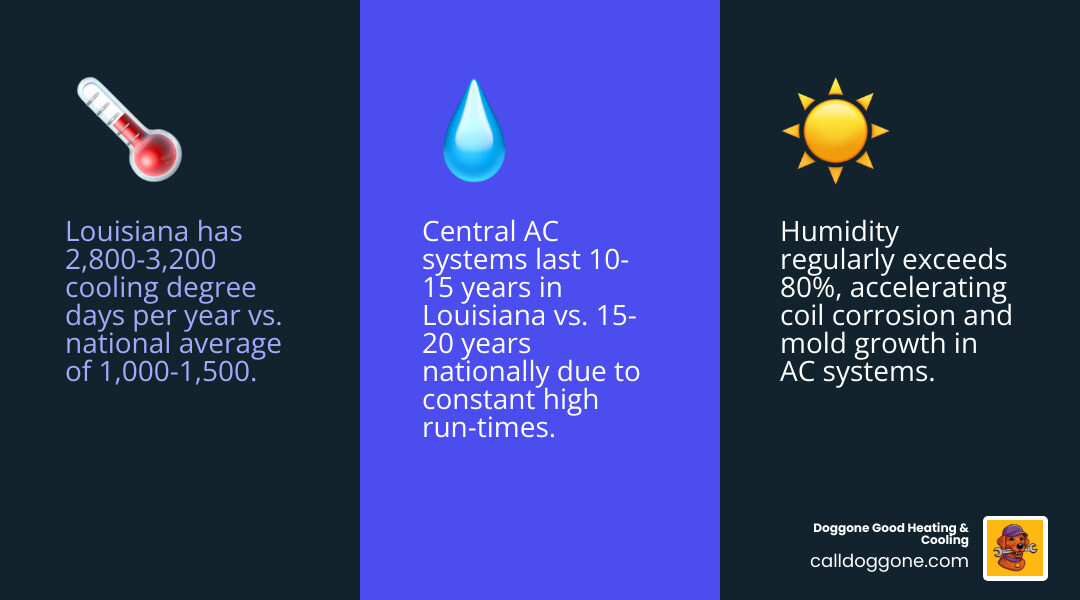
Louisiana’s subtropical climate is relentless. With 2,800 to 3,200 cooling degree days per year — compared to the national average of just 1,000 to 1,500 — your AC system works far harder and far longer than units in most other states. Add in humidity that regularly climbs above 80%, salt air in coastal parishes, and the occasional flooding event, and it’s easy to see why local systems age faster than the national numbers suggest.
For Baton Rouge homeowners, that means a system installed in 2014 or 2015 may already be approaching the end of its useful life — even if it’s still technically running. Running isn’t the same as running well.
This guide walks you through everything you need to know: what shortens your AC’s lifespan here in Louisiana, the warning signs to watch for, how to squeeze more years out of your system, and when it finally makes more sense to replace than repair.
Understanding How Long an AC System Lasts in Louisiana
When we talk about the average lifespan of an AC system in Louisiana, we have to look at the numbers through a local lens. While a manufacturer might slap a “15-20 year” label on a box, that estimate often assumes a mild climate where the unit takes a nap for six months of the year. In Baton Rouge, Prairieville, and Denham Springs, our air conditioners are the marathon runners of the appliance world.
The 10-15 year average for Residential Air Conditioning in our area is directly tied to “cooling degree days.” This is a technical way of saying how often and how hard your AC has to work to keep you comfortable. Because we face nearly triple the national average of these high-demand days, our systems experience accelerated mechanical wear.
Subtropical stressors like 80%+ humidity don’t just make your hair frizz; they force your AC to work double duty. Your system isn’t just cooling the air; it’s acting as a giant dehumidifier. This constant “thermal cycling”—the starting and stopping of the compressor to maintain temperatures—places immense strain on electrical components like capacitors and contactors. When a system runs for 12 hours straight in July, the internal heat buildup can degrade lubricants and seals much faster than in cooler states.
How long does an ac system last in louisiana coastal areas?
If you live in the southern reaches of our service area or closer to the coast, you face an additional enemy: salt air. Even miles inland, salt-heavy moisture can be carried by the wind, leading to a process called “coil pitting.” This is where the delicate aluminum fins on your outdoor unit literally begin to dissolve or corrode.
In these conditions, HVAC Services are needed more frequently to combat the 8-12 year life expectancy. High humidity levels combined with salt accelerate the galvanic corrosion between the copper tubing and aluminum fins. Once these coils degrade, the heat transfer efficiency plummets, forcing the compressor to run hotter and die younger.
Impact of the 2026 cooling season on older units
As we move through the April 2026 cooling season, many homeowners are noticing that systems installed around 2011-2015 are struggling. The extreme heat we typically see from June through August acts as a “stress test.” If your unit is already 12 years old, that first 95-degree day in June might be the breaking point for a tired fan motor or a struggling compressor.
Mechanical wear is cumulative. Every hour your system spends fighting the Louisiana sun is an hour closer to retirement. We often see Early Signs Your Air Conditioner Will Fail This Summer manifest as longer run times or a system that simply can’t keep up when the sun is at its peak.
Warning Signs Your System is Nearing Retirement
Knowing how long does an ac system last in louisiana is helpful for budgeting, but your equipment will usually tell you when it’s ready to call it quits. One of the first things you’ll notice isn’t a sound or a smell—it’s your wallet feeling lighter. Rising utility bills are a classic sign that your system is losing its “muscle.” As components wear out, they draw more electricity to produce the same amount of cooling.
Inconsistent temperatures are another red flag. If your bedroom feels like a sauna while the living room is a walk-in freezer, your system may no longer have the “push” required to circulate air properly through your ducts. You might also notice odd noises—squealing belts, banging metal, or a loud “thunk” when the unit starts up. While some of these can be fixed with HVAC Repair, they often signal that the mechanical soul of the machine is reaching its limit.
Perhaps the most annoying sign is excess indoor humidity. If your home feels “clammy” even when the air is cool, your evaporator coil is likely struggling to pull moisture from the air. This often leads to frequent breakdowns, where you find yourself calling us every few months for a new part.
Evaluating how long an ac system last in louisiana with the $5,000 Rule
When you’re facing a big repair bill, how do you decide if it’s worth it? We recommend using the $5,000 Rule. It’s a simple math equation:
Age of the Unit x Cost of Repair = Total Score
If that score is over $5,000, it’s usually time to replace. For example, if you have a 10-year-old unit and the repair cost is $600, your score is $6,000. In this scenario, investing that money into a new, warranted system is almost always the smarter financial move.
This rule is especially important for units using R-22 refrigerant (Freon). Since the EPA phase-out, the cost of R-22 has skyrocketed because it is no longer produced. If your old unit has a leak, the “recharge” cost alone can be hundreds of dollars, making it much harder to justify the repair. For more help on this, check out our guide on Should You Repair or Replace an Old Air Conditioner in Baton Rouge?
Efficiency degradation and SEER ratings
Even if an old unit is still running, it might be an “energy hog.” Over time, dirt buildup, coil corrosion, and motor wear lead to performance loss. A system that was rated at 14 SEER (Seasonal Energy Efficiency Ratio) ten years ago might only be performing like an 8 or 10 SEER unit today.
Modern HVAC Installation standards have moved to SEER2, which is a more rigorous testing method. Upgrading from a 10-year-old unit to a new high-efficiency model can often reduce your cooling energy costs by 20% to 40%. In Louisiana, where the AC runs almost year-round, those savings add up fast.
Maximizing Longevity Through Proactive Care
While the climate is tough, you aren’t powerless. The difference between a system that lasts 10 years and one that makes it to 15 often comes down to one word: maintenance. Think of your AC like a truck—you wouldn’t drive 100,000 miles without an oil change, right?
Annual inspections and professional coil cleaning are the “oil changes” of the HVAC world. When dirt builds up on your outdoor coils, it acts like a blanket, trapping heat inside the system. This makes the compressor work harder and run hotter, which is the fastest way to kill it. Following an AC Maintenance Checklist to Lower Energy Bills ensures that every part of your system is operating at peak performance. Routine HVAC Maintenance is the best insurance policy you can have against a mid-July breakdown.
The role of professional tune-ups
In Louisiana, timing is everything. We recommend scheduling your Tune Ups between March and May. This allows us to catch small issues—like a bulging capacitor or a slightly low refrigerant charge—before they turn into a total system failure during a June heatwave.
During a professional visit, we don’t just “look” at the unit. We perform component lubrication to reduce friction, check electrical connections that can loosen due to vibration, and clear out the condensate drain line. A clogged drain line is one of the most common causes of emergency shut-offs in Baton Rouge, often leading to water damage in attics or closets.
Homeowner maintenance habits
Between our professional visits, your habits at home play a huge role in how long an ac system lasts in louisiana. The single most important thing you can do is change your air filters. A dirty filter chokes your system, forcing the blower motor to work harder and reducing the airflow across the evaporator coil. In a dusty or pet-filled home, you should check these every 30 days.
You should also keep the area around your outdoor condenser clear. Trim back bushes and weeds to allow at least two feet of “breathing room” around the unit. If grass clippings or leaves get sucked into the fins, they block airflow. We also suggest homeowners keep an eye on their drain lines. If you see water dripping from the secondary “emergency” pipe (usually located over a window or door), it’s a sign the main line is clogged. Our Maintenance Programs are designed to take the guesswork out of these tasks for you.
Comparing Lifespans by System Type in the South
Not all air conditioners are created equal. Depending on the technology used, your expected lifespan will vary.
| System Type | Louisiana Lifespan | Key Advantage |
|---|---|---|
| Central Split-System | 10-15 Years | Reliable, familiar, high capacity |
| Heat Pump | 8-12 Years | Efficient heating and cooling in one |
| Ductless Mini-Split | 10-16 Years | Precise zoning, no duct loss |
| Geothermal | 18-24 Years | Extreme efficiency, longest life |
Why heat pumps wear faster in Baton Rouge
You might notice that heat pumps have a slightly shorter lifespan in Louisiana compared to straight AC units. This isn’t because they are “worse” technology; it’s because they work harder. While a central AC gets a break during our (admittedly short) winters, a heat pump switches into reverse to heat your home.
This year-round operation means more “miles” on the compressor. The reversing valve—the part that switches the unit from cooling to heating—is a mechanical component that can eventually wear out. Additionally, heat pumps must go through “defrost cycles” in the winter, which adds another layer of mechanical stress. If your heat pump is nearing the 10-year mark, it’s a good idea to start looking at HVAC Replacement options before the next big temperature swing.
Benefits of ductless technology
Ductless mini-split systems are becoming increasingly popular in Prairieville and Zachary. These systems are excellent for Louisiana because they offer variable-speed technology. Instead of being “all on” or “all off,” they can ramp up or down to meet the exact cooling needs of a room.
This reduces the “thermal cycling” stress we mentioned earlier. Because they don’t rely on ducts, they also avoid the 20-30% energy loss associated with leaky ductwork in a hot attic. For many homeowners, the superior humidity control of a mini-split makes them a favorite for master bedrooms or home offices. You can learn more about these on our Residential Air Conditioning page.
Frequently Asked Questions about Louisiana AC Lifespan
Does R-22 refrigerant mean I must replace my unit?
Not necessarily “must,” but you should definitely “plan.” The EPA has completely phased out the production and import of R-22. If your system was built before 2010, it likely uses this older refrigerant. While we can still perform HVAC Services on these units, the cost of repairing a leak is often prohibitive. We usually suggest that if an R-22 unit has a major component failure or a significant leak, replacement is the only logical path forward.
How does flooding affect my AC system’s life?
Flooding is a reality in the Baton Rouge area. If your outdoor unit or indoor air handler has been submerged, do not turn it on! Electrical contamination from silt and water can cause immediate shorts or long-term corrosion. According to NFPA 70 standards, electrical equipment that has been submerged usually needs to be replaced to ensure safety. Even if it “dries out” and runs, the internal corrosion will likely lead to a failure within a few months. In these cases, a professional HVAC Repair assessment is vital.
When is the best time to replace an AC in Louisiana?
The best time to replace is during the “shoulder seasons”—March through May or October through November. Why? Because you can take your time to choose the right system without the pressure of a 100-degree afternoon. Furthermore, scheduling an HVAC Installation is much easier when our teams aren’t busy with emergency repair calls. Replacing your unit proactively also allows you to research the best SEER2 ratings and available rebates.
Conclusion
At the end of the day, understanding how long does an ac system last in louisiana helps you take control of your home’s comfort and your budget. In the Baton Rouge area, we can’t change the humidity, but we can change how we care for the machines that keep us cool.
At Doggone Good Heating & Cooling, we pride ourselves on being locally attuned. We know exactly what the heat in Gonzales and the humidity in Prairieville do to an AC unit. Whether you need a precision tune-up to squeeze a few more years out of your current system or a professional HVAC Replacement to lower your energy bills, our team is here to help.
Don’t wait for your system to bark at you! Joining our Pack Perks Membership is the easiest way to ensure your AC gets the annual love it needs to survive the Louisiana summer. We’re honest, reliable, and always ready to help our neighbors stay cool. Give us a call today!
About the Author
Doggone Good Heating and Cooling
Doggone Good Heating and Cooling — your local HVAC experts in Baton Rouge, LA.
Need HVAC Service?
Get a free estimate or schedule your service today. Our team is ready to help.
Recent Posts


Related Articles
Ready to Get Started?
Prefer to Call?
Talk with a local technician and get clear next steps for your home.
Call Now(225) 230-9784