The Great AC Debate and When a Mini Split Beats Central Air
Doggone Good Heating and Cooling


Discover central ac vs ductless mini split comparison: efficiency, costs & best picks for Baton Rouge homes. Find your ideal AC upgrade!
The Central AC vs Ductless Mini Split Comparison Every Baton Rouge Homeowner Should See
The central ac vs ductless mini split comparison comes down to one practical question: does your home already have ductwork, and is it actually doing its job?
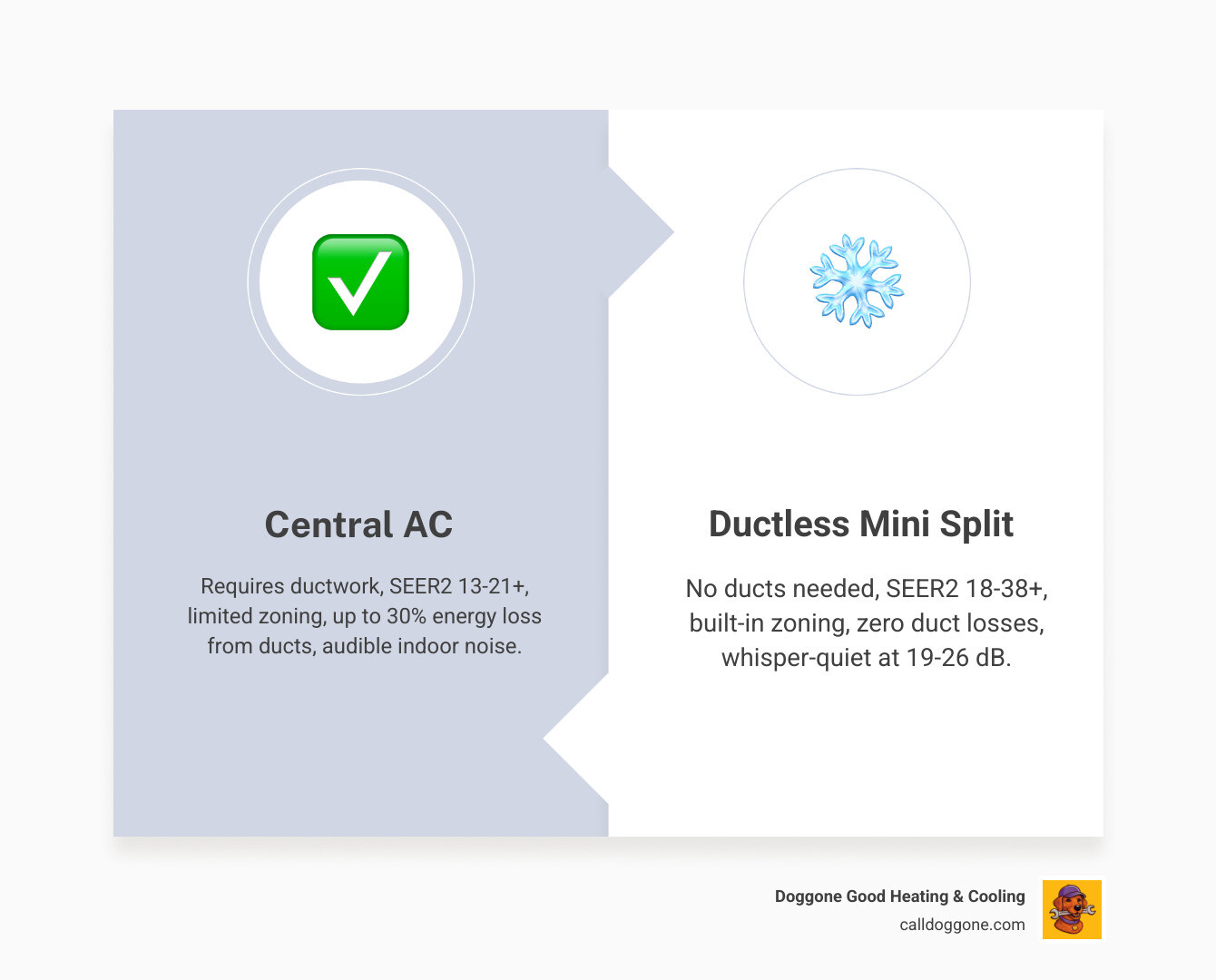
| Factor | Central AC | Ductless Mini Split |
|---|---|---|
| Requires ductwork | Yes | No |
| Energy efficiency (SEER2) | 13-21+ | 18-38+ |
| Zoning capability | Limited (add-on) | Built-in |
| Best for | Homes with existing ducts | Additions, older homes, no ducts |
| Duct energy loss | Up to 25-30% | None |
| Heating capability | Paired furnace/heat pump | Built-in heat pump |
| Indoor noise | Audible airflow | 19-26 dB (whisper-quiet) |
Here in Baton Rouge, the stakes are high. Summers are brutally humid, cooling season runs long, and your HVAC system carries a heavy load for most of the year. Choosing the wrong system means paying more than you should — every single month.
Central AC has been the go-to choice for decades. It cools the whole house from one thermostat, uses familiar technology, and works well when the ductwork is solid. But here’s the catch: the U.S. Department of Energy estimates that typical duct systems lose between 25% and 30% of cooled air through leaks, poor insulation, and thermal bypass. That’s a significant chunk of your energy bill disappearing before the air ever reaches your living room.
Ductless mini splits take a completely different approach. Instead of pushing air through a network of ducts, they deliver conditioned air directly into each room using small wall-mounted units connected to an outdoor compressor by a refrigerant line that requires only a 3-inch hole in the wall. No duct losses. No single thermostat controlling every room. Just targeted, efficient comfort exactly where you need it.
Neither system is automatically the right answer. The best choice depends on your home’s layout, your existing infrastructure, how you use your space, and what kind of comfort you’re after.
Understanding the Central AC vs Ductless Mini Split Comparison
When we look at the core of the central ac vs ductless mini split comparison, we are looking at two different philosophies of home comfort. One treats the house as a single, unified volume, while the other treats it as a collection of individual living zones.
A traditional Residential Air Conditioning system relies on a large outdoor condenser and an indoor evaporator coil, usually housed in a central air handler. This unit uses a powerful blower fan to force air through a network of metal or flexible ducts hidden in your attic, crawlspace, or walls. It is a “forced air” system, meaning it creates high pressure to move air across the entire square footage of your home.
Ductless mini splits, on the other hand, bypass the “middleman” of ductwork entirely. A slim refrigerant line connects the outdoor unit to one or more indoor air handlers mounted directly on the walls or ceilings of specific rooms. Because there are no ducts to navigate, the system doesn’t need to work nearly as hard to deliver cool air exactly where you are sitting.
Operational Differences in 2026
As we move through 2026, the technology behind these systems has reached incredible heights. Modern Residential Mini Split Systems almost exclusively use inverter technology. Think of this like a dimmer switch for your AC. Traditional central units are often “all or nothing”—they roar to life at 100% capacity, cool the room, and then shut off. This leads to those annoying temperature swings we’ve all felt.
Inverter-driven mini splits use variable-speed compressors. They can slow down or speed up to maintain a perfectly steady temperature. While high-end central AC units can also feature variable-speed technology, it is a standard hallmark of ductless systems, allowing them to sip electricity rather than gulp it.
The Role of Existing Infrastructure
In areas like Gonzales and Prairieville, the “Infrastructure Question” is usually the tie-breaker. If you live in a newer home with well-insulated, modern ductwork, sticking with central air is often the most straightforward path.
However, many of our local homes have ducts that have seen better days. If your attic is cramped or your home was built on a slab without room for bulky metal pipes, Ducting the Issue: A Guide to the Best Ductless Systems in Gonzales LA becomes a very real conversation. Mini splits only require a tiny 3-inch hole for their lines, making them far less invasive for older architecture.
Energy Efficiency and the Impact of Ductwork
Efficiency isn’t just a buzzword; it’s a measurement of how much money stays in your pocket during a Louisiana July. The standard metric is SEER2 (Seasonal Energy Efficiency Ratio 2).
| System Type | Typical SEER2 Range | Efficiency Potential |
|---|---|---|
| Standard Central AC | 13 – 17 | Baseline |
| High-End Central AC | 18 – 21+ | High |
| Ductless Mini Split | 18 – 38+ | Ultra-High |
While a high-efficiency central unit can hit a respectable 21 SEER2, Ductwork can be its Achilles’ heel. Even the most efficient unit in the world can’t overcome “thermal bypass”—the process where cold air warms up while traveling through a hot attic before it hits your vents.
How Duct Losses Affect Performance
Research from the Department of Energy suggests that the average home loses 25% to 30% of its cooling energy through duct leaks and poor insulation. Imagine buying four bags of groceries and dropping one in the parking lot every time you go to the store—that is essentially what leaky ducts do to your utility bill.
When choosing The Best Ductless Mini Splits for Your Baton Rouge Home, you eliminate this waste. There is no air traveling through unconditioned spaces. 100% of the air cooled by the unit is delivered directly into your living space. This is why a mini split with a SEER2 of 20 often outperforms a central system with the same rating in real-world energy savings.
Maximizing Efficiency with Zoning
One of the biggest energy-wasters in any home is cooling rooms that nobody is using. Why spend money to keep a guest bedroom or a formal dining room at 68 degrees at 2:00 PM on a Tuesday?
Ductless systems offer built-in Zone Control Systems. Each indoor unit has its own thermostat. You can keep the kitchen cool while you’re cooking and turn off the units in the bedrooms until bedtime. This targeted approach can lead to energy savings of up to 30% compared to a central system that treats the entire 2,500-square-foot house as one giant zone.
Choosing the Right System for Your Baton Rouge Home Layout
Your home’s “bones” often dictate the winner of the central ac vs ductless mini split comparison.
When a Central AC vs Ductless Mini Split Comparison Favors Traditional Ducts
If you value a “hidden” look, central AC is the gold standard. Aside from the registers on the floor or ceiling, the system is invisible. It also offers superior whole-home air filtration because it can accommodate thick, high-MERV filters in the central return. For large, open-concept homes where air needs to circulate freely across many rooms, Central AC Installation & Replacement is often the most cost-effective and aesthetically pleasing solution.
Why a Central AC vs Ductless Mini Split Comparison Often Leads to Mini-Splits
Ductless systems are the problem-solvers of the HVAC world. We frequently see them shine in these specific scenarios:
- Historic Homes: In older neighborhoods near downtown Baton Rouge, many homes lack the wall cavity space for ducts. Mini splits allow for modern cooling without tearing out plaster walls.
- Room Additions: If you’ve added a sunroom or a “man cave” in the garage, your existing central AC might not have the capacity to handle the extra load. A mini split provides independent cooling for that new space.
- Attic Suites: Finished attics are notoriously difficult to cool with central air because they are at the end of the duct run. The Complete Zachary Guide to Mini Split Systems highlights how a dedicated ductless head can turn a sweltering attic into a comfortable bedroom.
- Slab Homes: Homes built directly on concrete slabs often have no place for ductwork other than the attic, which can be inefficient in our heat. Why Your Denham Springs Home Needs a Ductless System Upgrade often focuses on the ease of installing ductless units in these layouts.
Comfort, Aesthetics, and Maintenance Requirements
Comfort isn’t just about temperature; it’s about sound and visuals, too.
Mini splits are famously quiet. Most indoor units operate at 19 to 26 decibels—that’s quieter than a whisper in a library. You won’t hear the “whoosh” of air or the clanking of metal ducts expanding and contracting. On the flip side, some homeowners find the wall-mounted “heads” to be a visual distraction, though modern designs are increasingly slim and unobtrusive.
Maintenance Schedules and Filter Care
Maintenance is where the two systems diverge significantly.
- Central AC: You typically replace a single large filter every 30 to 90 days. You also need to keep an eye on duct cleanliness to prevent dust buildup.
- Ductless Mini Split: These units have small, washable filters inside each indoor head. Because they are smaller, they need to be rinsed off more frequently—usually every 2 to 4 weeks.
Both systems require an annual professional Residential Mini Split Systems tune-up to check refrigerant levels and clean the outdoor coils. Neglecting this in our humid climate can lead to mold growth or “dirty sock syndrome” in the indoor units.
Indoor Air Quality and Humidity Control
Baton Rouge is a swamp—let’s be honest. Managing moisture is just as important as managing heat. Residential Air Conditioning systems are excellent at dehumidification because they pull air from the entire house through a large evaporator coil.
Ductless systems also dehumidify, but because they are sized for specific rooms, they can sometimes be too efficient at cooling, reaching the target temperature so quickly that they don’t run long enough to pull all the moisture out of the air. This is why proper sizing by a professional is non-negotiable.
Frequently Asked Questions about Home Cooling
Can mini-splits provide effective heating in Louisiana winters?
Absolutely. Most modern mini splits are actually “heat pumps.” They don’t create heat; they move it. Even when it’s 40 degrees outside, there is heat energy in the air that the system can pump into your home. Many Residential Ductless models are rated to provide efficient heat even when temperatures drop well below freezing, which is more than enough for our mild winters.
Is a hybrid approach beneficial for larger homes?
We often recommend a “best of both worlds” strategy. You might use a central AC system for the main living areas and kitchen where ductwork is already in place, but add a single-zone mini split for a primary bedroom or a home office. This allows you to keep your sleeping or working area at a perfect 68 degrees without paying to cool the rest of the house all night. This targeted Zone Control Systems approach is a favorite for families with “thermostat wars.”
What are the typical lifespans of these systems?
Both central AC and ductless mini splits generally last between 15 and 20 years. However, because mini splits use inverter technology and don’t “hard start” as often as traditional units, some premium models can push toward the 25-year mark with meticulous maintenance. Regardless of the system, the humid, salty air in South Louisiana is tough on equipment, making regular Central AC Installation & Replacement or maintenance checks vital for longevity.
Conclusion
The central ac vs ductless mini split comparison isn’t about finding a “winner.” It’s about finding the right fit for your specific roofline and lifestyle. Whether you are looking for the invisible, whole-home power of central air or the hyper-efficient, room-by-room control of a ductless system, the goal is the same: a home that feels like an oasis when the Louisiana humidity hits 90%.
At Doggone Good Heating & Cooling, we’ve spent years navigating the unique challenges of homes in Baton Rouge, Denham Springs, and Zachary. We don’t believe in one-size-fits-all solutions. We believe in honest assessments, reliable service, and helping you find the system that makes your home the most comfortable place on earth.
Ready to see which system is right for your space? Contact us today for a personalized comfort assessment. Whether it’s a Central AC Installation & Replacement or a new ductless upgrade, we’ll make sure the job is done doggone right.
About the Author
Doggone Good Heating and Cooling
Doggone Good Heating and Cooling — your local HVAC experts in Baton Rouge, LA.
Need HVAC Service?
Get a free estimate or schedule your service today. Our team is ready to help.
Recent Posts


Related Articles
Ready to Get Started?
Prefer to Call?
Talk with a local technician and get clear next steps for your home.
Call Now(225) 230-9784