The Sticky Truth About Mini Splits and Humidity Control
Doggone Good Heating and Cooling


Discover why is a mini split better than central air in humid climates. Beat sticky air, save energy, and prevent mold with ductless solutions.
Is a Mini Split Better Than Central Air in Humid Climates? Here’s What Baton Rouge Homeowners Need to Know
Is a mini split better than central air in humid climates — and in a place like Baton Rouge, LA, that question carries real weight. South Louisiana doesn’t just get hot. It gets wet. The air hangs heavy with moisture for months on end, and your HVAC system has to fight on two fronts: pulling down the temperature and wringing out the humidity.
Here’s the short answer most homeowners are looking for:
Mini Split vs. Central Air in Humid Climates — Quick Comparison
| Feature | Mini Split | Central Air |
|---|---|---|
| Humidity control | Superior — runs longer, steadier cycles | Can struggle — short cycles leave air sticky |
| Energy efficiency | SEER2 ratings of 18–30+ | Typically 14–17 SEER2 |
| Duct energy loss | None — fully ductless | 20–30% loss through duct leaks |
| Zoned cooling | Built-in per room | Requires costly add-ons |
| Best for older homes | Yes — no ductwork needed | Costly to retrofit |
| Whole-home coverage | Requires multiple units | Single system covers entire home |
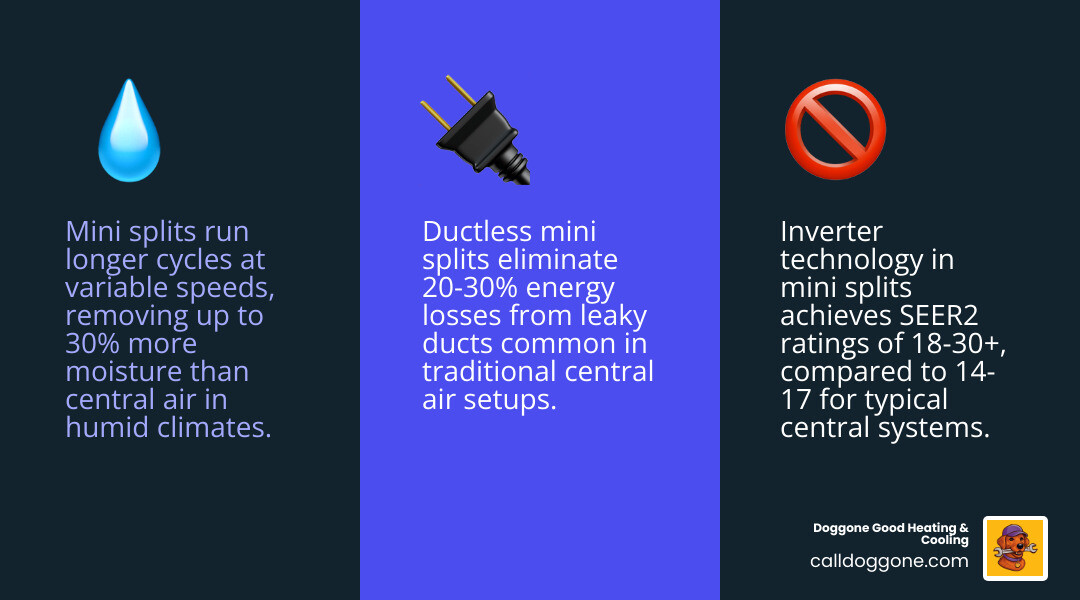
In most high-humidity scenarios — especially in homes without existing ductwork, room additions, or spaces with persistent moisture problems — mini splits have a clear edge. Their inverter-driven compressors run at variable speeds, which means they stay on longer at lower intensity. That longer run time is exactly what pulls moisture out of the air effectively.
Central air systems, by contrast, cycle on and off to hit a temperature setpoint. In a place like Baton Rouge, where latent heat (the moisture load in the air) is relentless, that on/off pattern can leave your home feeling cool but still uncomfortably damp.
That said, central air isn’t obsolete — especially if your home already has well-sealed ductwork and you need consistent whole-home coverage. The right answer depends on your home’s layout, age, and how you use your space day to day.
This guide breaks it all down so you can make a confident, informed decision.
How Mini Splits and Central Air Manage Humidity Differently
When we talk about air conditioning in South Louisiana, we aren’t just talking about cooling; we are talking about moisture management. Both systems use refrigerant to absorb heat and humidity from your indoor air and dump it outside. However, the way they go about it makes all the difference in how “sticky” your living room feels on a Tuesday in July.
A traditional central air conditioning system is usually a “single-stage” or “two-stage” machine. It’s either all the way on, or it’s all the way off. When the thermostat hits 75 degrees, the system kicks on at 100% power, blasts cold air until the sensor hits 72, and then shuts down.
Mini splits, on the other hand, use something called inverter technology. Think of it like a dimmer switch for your cooling. Instead of roaring to life and then dying out, the variable-speed compressor in a mini split adjusts its output to match the exact cooling demand of the room. It might run at 40% capacity for three hours straight rather than running at 100% for twenty minutes.
Advantages of Continuous Operation
Why does running longer matter for humidity? To remove moisture, the air in your home has to pass over the cold evaporator coils long enough for the water vapor to condense into liquid (reaching the dew point).
In our experience keeping your home comfortable year-round in South Louisiana, we’ve found that mini splits excel here because they maintain a steady, lower temperature on the coil for longer periods. This constant airflow allows the system to wring out significantly more pints of water per day than a system that is constantly stopping and starting. While a central unit is resting between cycles, the humidity in your home is actually creeping back up. A mini split stays on the job, keeping that moisture level consistently low.
Limitations of Traditional Cycling
The biggest enemy of comfort in Baton Rouge is short-cycling. This happens when a central air unit is oversized for the home or when the temperature drops quickly but the humidity remains high. The unit turns on, chills the air in ten minutes, and shuts off.
The problem? Ten minutes isn’t enough time to remove the “latent load” (the moisture). You end up with what we call the “cold and clammy” effect. Your thermostat says it’s 70 degrees, but your skin feels like you’re sitting in a damp cave. This is where many homeowners start asking is a mini split better than central air in humid climates, because they are tired of that “sticky air” feeling. If you’re struggling with this, looking into residential ductless options might be the solution to finally drying out your indoor environment.
Why a Mini Split is Better Than Central Air in Humid Climates
In the HVAC world of April 2026, the data is clearer than ever: mini splits are the heavyweights of humidity control. When we compare the two, several technical advantages stand out that directly impact your comfort in the Southeast.
| Performance Feature | Mini Split | Central Air |
|---|---|---|
| Cooling Delivery | Direct, room-by-room | Via network of ducts |
| Moisture Removal | Constant and modulated | Intermittent |
| Energy Loss | 0% (No ducts) | 20-30% (Duct leaks) |
| Zoning | Independent per head | Difficult/Expensive |
| SEER2 Rating | Up to 35+ | Up to 26 |
One of the most compelling reasons to choose a mini split is the 30-50% energy savings many homeowners see. Because there are no ducts, you aren’t losing conditioned air to a hot attic. Furthermore, mini splits offer zoned cooling. You wouldn’t leave every light in your house on when you go to bed, so why cool every room? Zoned control allows you to keep the bedroom at a crisp 68 degrees while letting the kitchen stay at 75, saving you a fortune on your monthly bills. For more details on these systems, check out our guide on the best ductless mini splits for your Baton Rouge home.
Superior Moisture Removal with Inverters
The “secret sauce” is the inverter-driven compressor. By modulating the speed, the mini split ensures the evaporator coil stays at the optimal temperature for dehumidification without overcooling the room.
Many modern mini splits even feature a dedicated “Dry Mode.” In this setting, the fan slows down significantly, and the compressor runs at a specific frequency designed to maximize moisture removal while minimizing the drop in temperature. It’s like having a high-capacity dehumidifier built directly into your AC. This is a massive win for mini-split services in areas like Prairieville and Gonzales, where the humidity can reach 90% before breakfast.
Energy Efficiency in High-Latent Regions
In the Southeast, our cooling season can last 8 to 10 months. That means efficiency isn’t just a “nice to have”—it’s a financial necessity. Mini splits typically carry SEER2 ratings between 18 and 30+, with some high-end models hitting as high as 35. Compare that to standard central air systems that usually hover around 14 to 17 SEER2.
The U.S. Department of Energy notes that ductless systems can cut your energy bills by up to 30% simply by eliminating the losses associated with ductwork. When you factor in the inverter technology, the savings can be even higher. If you live in Denham Springs and are tired of summer electric bills that look like mortgage payments, a ductless system upgrade is often the smartest long-term investment you can make.
The Role of Ductwork in South Louisiana Humidity
Ductwork is the silent efficiency killer in humid climates. In a typical central air setup, your ducts run through the attic. In Baton Rouge, an attic can easily reach 130 degrees or hotter. If those ducts have even tiny leaks—which most do—you are losing 20-30% of your paid-for cold air into the rafters.
But it’s worse than just losing air. Leaky ducts create a pressure imbalance. When air escapes the ducts, it has to be replaced, so the house sucks in “makeup air” through cracks in windows, doors, and the foundation. In Louisiana, that makeup air is hot and soaking wet. This essentially turns your central air system into a giant vacuum that pulls humidity into your home.
Preventing Mold and Improving Air Quality
Humidity and ductwork are a dangerous combination for indoor air quality. When cool air travels through ducts in a hot attic, condensation can form on the outside (or inside) of the ducting if the insulation is compromised. This standing moisture is a breeding ground for mold and mildew.
By going ductless, you eliminate the “lungs” of the house that can become contaminated. Mini splits use multi-stage filtration in each individual unit, often capable of catching particles as small as 0.3 microns. This localized purification is a game-changer for allergy sufferers. If you want to dive deeper into how to handle duct issues, read our guide to ductless systems in Gonzales. For those already committed to the ductless path, our residential mini-split services ensure your system stays clean and mold-free.
Best Scenarios for Mini Split Performance in Baton Rouge
While we love a good central air system for large, open-concept new builds, there are specific scenarios where the answer to is a mini split better than central air in humid climates is a resounding “Yes!”
- Room Additions: If you’ve added a sunroom or a “mother-in-law” suite, your existing central AC likely wasn’t sized to handle the extra square footage. Adding a mini split is much more efficient than trying to overextend your current system.
- Garages and Workshops: For the hobbyist in Zachary who wants to work on their car without melting into a puddle, a mini split is the only logical choice.
- Bonus Rooms: Those rooms above the garage are notoriously difficult to cool and dehumidify because they are surrounded by hot roof space. A dedicated mini split fixes the “hot spot” problem instantly.
Residents in Zachary can find specialized help through our expert mini-split services.
Is a mini split better than central air in humid climates for older homes?
Baton Rouge and Zachary are full of beautiful, historic homes. Many of these houses were built long before air conditioning was a standard feature, meaning they lack the wall cavities and ceiling space required for modern 12-inch ductwork.
In these cases, installing central air often means dropping ceilings or building “bulkheads” that ruin the architectural integrity of the home. Mini splits are the perfect “no-duct” solution. They only require a small three-inch hole in the wall for the refrigerant lines, preserving the high ceilings and original plasterwork that make older homes so special. If you’re a local history buff with a hot house, check out The Complete Zachary Guide to Mini-Split Systems for more tailored advice.
Is a mini split better than central air in humid climates for energy efficiency?
If your primary goal is to lower your carbon footprint and your utility bill, mini splits win the efficiency race—sometimes by a wide margin. The ability to utilize zoned cooling means you aren’t wasting energy on guest rooms or dining areas that only see use once a week.
Furthermore, the high SEER2 ratings (often 20-30% higher than central air) mean that for every dollar you spend on electricity, you get significantly more cooling and dehumidification. In a climate where the AC runs almost year-round, those savings add up to thousands of dollars over the 15- to 20-year lifespan of the system.
Frequently Asked Questions about Humidity and HVAC
Do mini splits prevent mold better than central air?
Generally, yes. Because there is no ductwork for moisture to collect in, the risk of “hidden” mold growth is significantly reduced. Additionally, the longer run cycles of a mini split ensure that the indoor humidity stays below 50%, which is the threshold where mold typically begins to grow. However, you must still clean the filters every few weeks to keep the airflow unrestricted.
Can I use a mini split to supplement my central AC?
Absolutely! We see this all the time in Baton Rouge. A homeowner might have a perfectly good central air system, but the master bedroom stays at 78 degrees while the rest of the house is 72. Adding a single-zone mini split to that “problem room” allows you to get the comfort you need without replacing your entire whole-home system. It’s a hybrid approach that offers the best of both worlds.
What maintenance ensures the best humidity control?
For both systems, the key is the condensate drain. In humid climates, your AC produces gallons of water every day. If the drain line gets clogged with algae or “gunk,” that water can back up, causing high humidity or even water damage. We recommend:
- Filter Cleaning: Every 2-4 weeks for mini splits.
- Annual Tune-ups: A professional should check refrigerant levels and coil cleanliness.
- Line Flushing: Ensure the drain lines are clear.
Conclusion
At the end of the day, the “sticky truth” is that is a mini split better than central air in humid climates depends on your specific home and comfort goals. If you want the most precise humidity control, the highest energy efficiency, and the flexibility of zoned cooling, the mini split is the clear winner for our South Louisiana climate.
At Doggone Good Heating & Cooling, we’ve spent years helping our neighbors in Baton Rouge, Prairieville, and Zachary navigate these choices. We know exactly how the local humidity affects your equipment and your comfort. Whether you decide on a high-efficiency central system or a state-of-the-art ductless setup, we’re here to provide honest, reliable service.
Don’t forget to ask about our Pack Perks Membership—it’s the most affordable way to ensure your system gets the maintenance it needs to fight off the Louisiana humidity year after year.
Ready to dry out your home and lower those energy bills? Schedule your central AC installation or replacement today or give us a call to discuss a ductless upgrade!
About the Author
Doggone Good Heating and Cooling
Doggone Good Heating and Cooling — your local HVAC experts in Baton Rouge, LA.
Need HVAC Service?
Get a free estimate or schedule your service today. Our team is ready to help.
Recent Posts


Related Articles
Ready to Get Started?
Prefer to Call?
Talk with a local technician and get clear next steps for your home.
Call Now(225) 230-9784