Why Louisiana Weather is a Workout for Your Air Conditioner
Doggone Good Heating and Cooling


Discover how Louisiana climate affects your HVAC system with heat, humidity & storms. Boost efficiency, cut bills & extend AC life in Baton Rouge!
How Louisiana Climate Affects Your HVAC System — And Why It Matters for Baton Rouge Homeowners
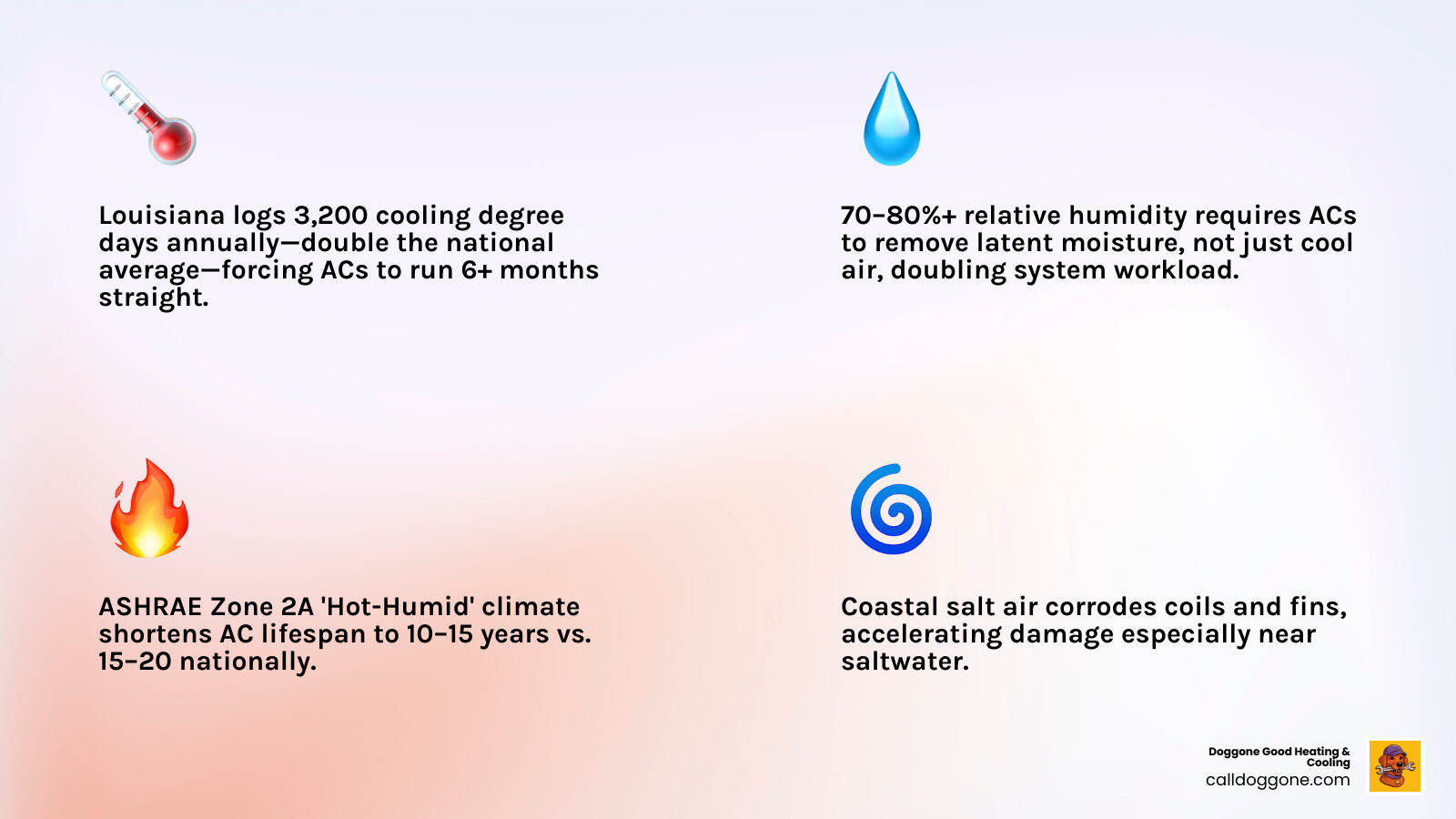
How Louisiana climate affects your HVAC system comes down to three relentless forces: extreme heat, oppressive humidity, and unpredictable weather swings that run your equipment harder and longer than almost anywhere else in the country. Louisiana sits in ASHRAE Climate Zone 2A — classified as “Hot-Humid” — and that label carries real consequences for the heating and cooling equipment inside your home. While the average American home logs roughly 1,000 to 1,500 cooling degree days per year, Louisiana racks up 2,800 to 3,200. That’s not just a number — it’s the difference between a system that lasts 20 years and one that taps out in 10.
Here’s a quick summary of the ways Louisiana’s climate puts extra strain on your HVAC system:
- Extended cooling seasons — Your AC runs for 6+ months straight, accumulating wear at roughly double the national rate
- High humidity (70–80%+ relative humidity) — Forces your system to work harder to remove moisture from the air, not just lower the temperature
- Shortened equipment lifespan — Central AC units last 10–15 years in Louisiana vs. 15–20 years nationally; heat pumps average just 8–12 years
- Coastal salt air and corrosion — Accelerates damage to coils, fins, and electrical components, especially within a mile of saltwater
- Sudden cold snaps — Louisiana’s mild winters lull homeowners into skipping heating maintenance, then a hard freeze exposes every neglected problem
- Hurricane and flood risk — Storm surges and high winds (130–150 mph in coastal parishes) can destroy outdoor equipment outright
- Indoor air quality threats — Persistent moisture feeds mold, mildew, and “Dirty Sock Syndrome” inside your ducts year-round
The bottom line: Louisiana doesn’t just ask more of your HVAC system — it demands more, every single day. Understanding exactly how that happens is the first step toward protecting your home, your comfort, and your investment.
The Triple Threat: Heat, Humidity, and How Louisiana Climate Affects Your HVAC System
In the HVAC world, we often talk about “design conditions.” In Baton Rouge, our peak design dry-bulb temperatures hover between 93°F and 95°F. While that might sound manageable compared to a desert climate, it’s the moisture that changes the game. Being in ASHRAE Zone 2A means we deal with a “Hot-Humid” environment where the air is frequently saturated.
With 3,200 cooling degree days annually, your air conditioner isn’t just a luxury; it’s a life-support system for your home’s structural integrity. When relative humidity routinely exceeds 70%—and often tops 80% in parishes closer to the coast—your AC has to pull double duty. It has to lower the temperature (sensible heat) while simultaneously wringing gallons of water out of the air (latent heat). If you want to dive deeper into local comfort strategies, check out our guide on Keeping Your Home Comfortable Year-Round in South Louisiana.
Managing Latent Loads and How Louisiana Climate Affects Your HVAC System
One of the most technical aspects of how louisiana climate affects your hvac system is the Sensible Heat Ratio (SHR). In drier states, an AC might spend 80% of its energy cooling the air and only 20% removing moisture. In Louisiana, that ratio often shifts to 0.65–0.75, meaning up to 35% of your system’s capacity is dedicated solely to dehumidification.
This is why “bigger is not better” in the Bayou State. If a system is oversized, it will “short-cycle”—turning on, cooling the room quickly, and then shutting off before it has had a chance to remove the humidity. This leaves you feeling “clammy” even if the thermostat says it’s 72 degrees.
| Feature | Oversized Unit | Correctly Sized Unit |
|---|---|---|
| Run Time | Short bursts (5-10 mins) | Steady cycles (20+ mins) |
| Humidity Removal | Poor; leaves air damp | Excellent; maintains <55% RH |
| Energy Usage | High (frequent start-up spikes) | Optimized and efficient |
| Component Wear | High stress on compressor | Even, predictable wear |
Why 15 SEER2 is the New Standard in 2026
As of April 2026, the Department of Energy (DOE) has firmly established 15 SEER2 as the minimum efficiency standard for split systems in the South. This mandate is specifically designed for climates like ours, where the cooling season is long and intense. High-efficiency systems are no longer just an “upgrade”; they are a necessity for managing utility bills. To see how your current unit stacks up, review our AC Maintenance Checklist to Lower Energy Bills.
Why the “Swamp Heat” Shortens Your AC Lifespan
National averages suggest a central AC unit should last 15 to 20 years. In Baton Rouge, Prairieville, or Denham Springs, we typically see units reach the end of their reliable service life between 10 and 15 years. Heat pumps, which often run year-round for both heating and cooling, may only last 8 to 12 years.
The reason is simple: run-time accumulation. A compressor in Louisiana might log as many hours in five years as a unit in Michigan does in fifteen. This constant thermal cycling—expanding and contracting as the system starts and stops—creates microscopic stress fractures in the coils and puts immense strain on the motor windings. Learn more about protecting your unit in our post on How to Prepare Your Air Conditioner for Louisiana Summer Heat.
Environmental Stressors on Outdoor Units
It’s not just the internal mechanical wear; the environment itself is trying to reclaim your HVAC system.
- UV Degradation: The intense Louisiana sun can turn plastic components brittle and fade protective coatings on your outdoor unit.
- Fin Damage: High humidity keeps the aluminum fins on your condenser damp, which attracts dust and organic matter, leading to “clogging” that chokes off airflow.
- Coil Pitting: If you live near the coast or even within range of salt-laden winds, salt-air corrosion can eat through copper coils, leading to refrigerant leaks that are expensive to repair.
The Winter Trap: Damp Cold and Sudden Temperature Swings
Louisiana winters are notoriously “damp.” While our design temperature is around 28°F, a New Orleans or Baton Rouge 40-degree day often feels colder than a 20-degree day in a dry climate like Colorado. This is because moist air is an incredible conductor of heat, pulling warmth away from your body—and your home—faster.
For those with heat pumps, these damp, chilly days trigger frequent “defrost cycles.” The system has to reverse itself to melt ice off the outdoor coils, often engaging “auxiliary heat” (electric heat strips) to keep you warm inside. This is significantly less efficient and can lead to a shock when you open your January energy bill. Stay ahead of the curve with our Best Winter HVAC Maintenance Tips.
How Louisiana Climate Affects Your HVAC System During Cold Snaps
The real danger in Louisiana isn’t a steady winter; it’s the “yo-yo” effect. One day it’s 75 degrees and sunny; the next, a cold front drops us into the 30s. This sudden stop-start operation is incredibly taxing on a system that has been sitting idle.
When the heat finally kicks on after months of cooling, any dust that settled on the heat exchanger or heat strips can produce a burning smell—often called “Dirty Sock Syndrome” if moisture is involved. To keep your air clean during these transitions, remember How Often Should You Change Your HVAC Air Filter in Winter.
Indoor Air Quality and the Battle Against Mold
In Louisiana, the battle for indoor air quality (IAQ) is actually a battle against moisture. If your indoor humidity levels stay above 55% to 60%, your home becomes a breeding ground for mold and mildew. This often starts in the ductwork or on the evaporator coil, where condensation is constant.
To combat this, we often recommend:
- Whole-Home Dehumidifiers: These work alongside your AC to pull moisture out even when the cooling cycle isn’t running.
- UV Germicidal Lights: Installed over the evaporator coil, these lights kill mold spores and bacteria before they can be blown into your living spaces.
- High-Efficiency Filtration: Using the right MERV-rated filter can catch allergens, though you must ensure your system is designed to handle the increased static pressure.
Protecting Your Investment from Coastal Corrosion and Storms
Living in South Louisiana means respecting the power of the Gulf. For homeowners in Gonzales, Zachary, and surrounding areas, hurricane readiness is a way of life. This extends to your HVAC system.
- Wind Zones: According to ASCE 7, coastal Louisiana parishes are in 130–150 mph wind zones. This requires specialized hurricane tie-downs and heavy-duty pads to ensure your outdoor unit doesn’t become a projectile during a storm.
- Base Flood Elevation (BFE): If you are in a FEMA-designated flood zone, your mechanical equipment should be elevated. Even a few inches of water can ruin the electrical controls and compressor of an outdoor unit.
Maintenance Strategies for the Baton Rouge Climate
Because of the extreme workload, a “once-a-year” checkup often isn’t enough for Louisiana systems. We recommend a proactive approach to handle the unique stressors of our region.
- Spring Tune-Ups: Before the first 90-degree day hits in May, a professional should check your refrigerant levels and clean the coils. This ensures maximum efficiency when you need it most. See the Spring HVAC Tune-Up Benefits for more details.
- Drain Line Clearing: With the amount of water our ACs pull from the air, condensate drains can easily clog with algae or “sludge.” A backed-up drain line is one of the most common causes of emergency service calls in the summer.
- Professional Coil Cleaning: Dust and pollen combined with high humidity create a “blanket” on your coils. Cleaning these is essential to maintain the heat transfer required to cool your home.
Frequently Asked Questions about Louisiana HVAC Performance
Why do air conditioners fail faster in Louisiana than in the North?
It’s a matter of total “engine hours.” Our systems run for significantly more hours per year due to the long cooling season and high humidity. Additionally, the constant moisture promotes corrosion that drier climates simply don’t experience.
What is the ideal indoor humidity level for a Baton Rouge home?
We recommend keeping your indoor relative humidity between 45% and 55%. Anything above 60% drastically increases the risk of mold growth and makes the air feel much warmer than it actually is.
Can a heat pump handle a sudden Louisiana cold snap?
Absolutely. Modern air-source heat pumps are efficient down to about 25°F–30°F. While they may need to use auxiliary heat during a rare hard freeze, they are perfectly suited for the 95% of Louisiana winter days that stay above freezing.
Conclusion
At Doggone Good Heating & Cooling, we’ve spent years learning the quirks of the Baton Rouge climate. We know that a system in Prairieville faces different challenges than one in a dry, northern state. That’s why we take a “locally attuned” approach to every repair, installation, and maintenance visit.
Whether it’s protecting your unit from salt-air corrosion or ensuring your dehumidification is dialed in for a humid July afternoon, we’re here to help. Our Pack Perks Membership is specifically designed to provide the regular maintenance required to help your system survive the Louisiana “workout.”
Don’t let the swamp heat win. Schedule your professional HVAC maintenance today and keep your home comfortable, no matter what the Louisiana sky throws your way!
About the Author
Doggone Good Heating and Cooling
Doggone Good Heating and Cooling — your local HVAC experts in Baton Rouge, LA.
Need HVAC Service?
Get a free estimate or schedule your service today. Our team is ready to help.
Recent Posts


Related Articles
Ready to Get Started?
Prefer to Call?
Talk with a local technician and get clear next steps for your home.
Call Now(225) 230-9784