Will a Mini Split Save You Money Compared to Central AC?
Doggone Good Heating and Cooling


Discover mini split vs central ac cost comparison for Baton Rouge homes. Compare upfront costs, efficiency, lifespan & savings to choose wisely.
Is a Mini Split Worth It? A Real Cost Comparison for Baton Rouge Homeowners
The mini split vs central ac cost comparison is one of the most common questions homeowners ask when it’s time to replace or upgrade their cooling system — and the honest answer is: it depends on your home.
Here’s a quick breakdown to help you decide:
| Factor | Mini Split | Central AC |
|---|---|---|
| Best for homes without ductwork | Yes | No (adds significant cost) |
| Best for homes with existing ducts | Possible | Yes |
| Energy efficiency (SEER2) | Higher (18–30+) | Moderate (14–21) |
| Zoned temperature control | Built-in | Requires add-ons |
| Whole-home cooling | Multi-zone setup needed | Yes, single system |
| Duct energy losses | None | Up to 20–30% |
| Typical lifespan | 15–20 years | 12–18 years |
In Baton Rouge, where summers are long, humid, and punishing on cooling equipment, the system you choose has a direct impact on your monthly electric bill and how comfortable your home actually feels. Duct losses that might be a minor nuisance in a milder climate can translate to real money wasted here.
Neither system wins outright. Mini splits tend to shine in older homes, room additions, and situations where ductwork doesn’t exist or is in poor condition. Central AC often makes more sense when quality ductwork is already in place and you need to cool a large home uniformly.
This guide walks through every layer of that comparison — upfront installation, operating efficiency, maintenance, and total long-term ownership — so you can make a confident, informed decision for your home.
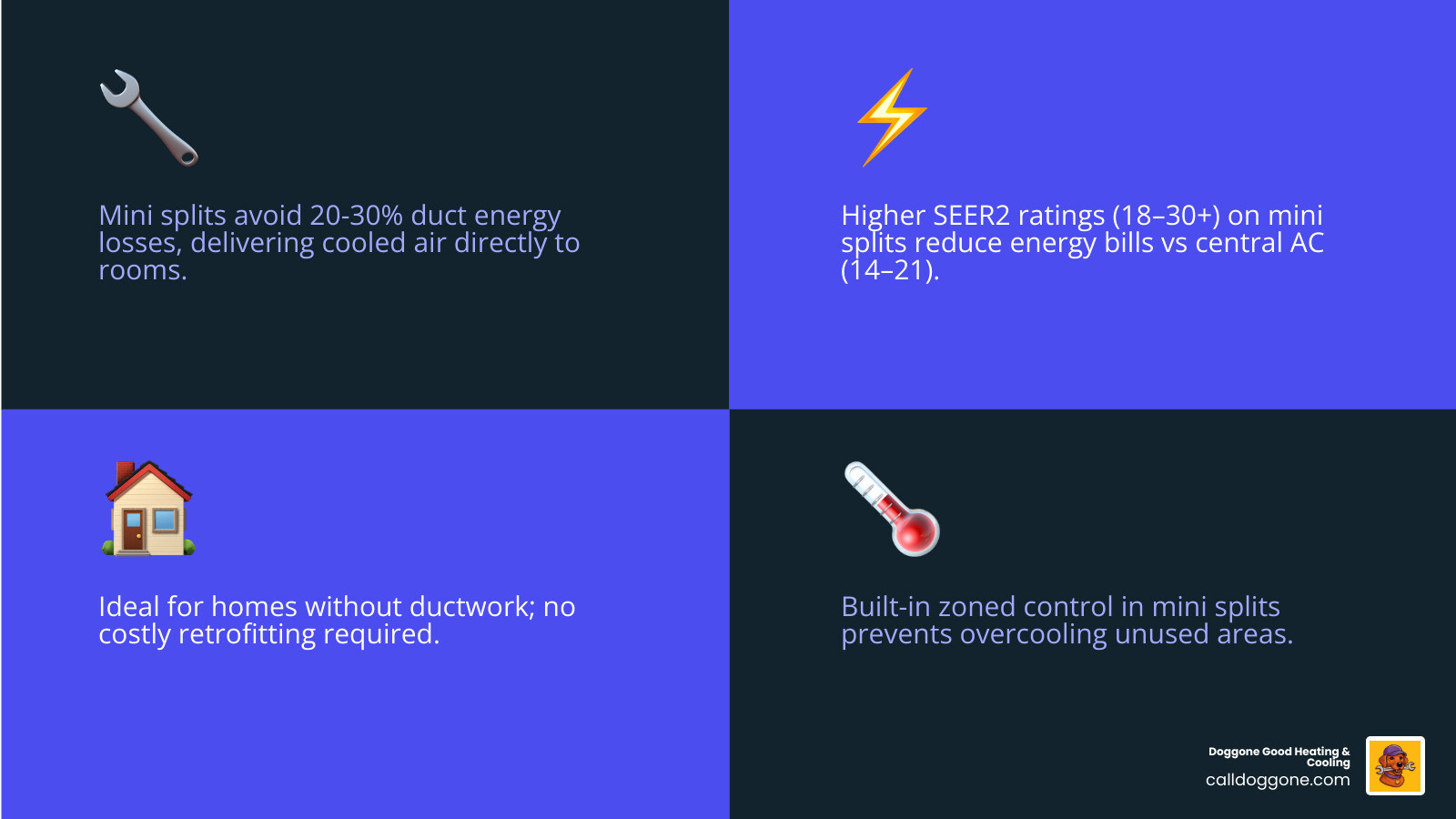
Analyzing the Mini Split vs Central AC Cost Comparison for Baton Rouge Homeowners
When we look at the mini split vs central ac cost comparison in April 2026, we have to consider more than just the price tag on the equipment. In our corner of Louisiana, from Prairieville to Zachary, the complexity of the installation and the local labor requirements play a massive role in the total investment.
Central AC systems are essentially the “all-in-one” solution for many local homes. They rely on a single, large outdoor condenser and an indoor air handler to push cooled air through a network of ducts. If your home was built with these “bones” already in place, replacing the unit is a relatively straightforward process. However, if those ducts are aging or undersized for modern high-efficiency equipment, the scope of work grows quickly.
On the flip side, ductless mini splits offer a modular approach. You have one outdoor unit connected to one or more indoor air handlers via small refrigerant lines. This eliminates the need for bulky metal or flex ducting entirely. While the equipment itself uses sophisticated technology—like inverter-driven compressors—the installation is often less invasive to your home’s structure. For many families, professional HVAC Installation for a mini split is the preferred route when they want to avoid the mess and “hidden cost monster” of major construction.
Evaluating Upfront Expenses for a Mini Split vs Central AC Cost Comparison
The upfront investment for these systems varies wildly based on how many rooms you need to cool. A single-zone mini split, which includes one outdoor condenser and one indoor head, is often the most budget-friendly way to bring comfort to a specific area like a sunroom or a workshop.
As you move toward whole-home cooling, the math shifts. Multi-zone configurations allow us to connect several indoor air handlers to a single outdoor unit. This creates a “zoned” home where you can turn off the AC in the guest room while keeping the master bedroom icy cold. While this technology is impressive, the equipment for a five-zone system can sometimes be higher than a standard central AC unit.
However, when you look at Residential Ductless systems, you aren’t just buying a cooler; you’re buying a heat pump that provides high-efficiency heating in the winter, often eliminating the need for a separate furnace.
How Ductwork Influences Your Mini Split vs Central AC Cost Comparison
Ductwork is the “great equalizer” in this comparison. If you live in a newer home in Gonzales with perfectly sealed, insulated ducts, a central AC system is likely your most economical choice for a full replacement. But what if you’re in a historic Baton Rouge home or a house on a slab with no attic space?
Installing new ductwork in an existing home can be a massive undertaking. It involves cutting into ceilings, building soffits to hide pipes, and potentially losing closet space. In these scenarios, the cost of adding ducts can sometimes double the total price of a central AC project.
This is why many homeowners find that a multi-zone mini split actually costs less in total when no ducts exist. Furthermore, even if you have ducts, if they are leaky or poorly insulated in a hot Louisiana attic, they could be losing 20% to 30% of your cooled air before it ever reaches your living room. When you choose Central AC Installation & Replacement, we always emphasize checking duct integrity to ensure you aren’t literally throwing money into your attic.
Efficiency and Monthly Savings: The Impact of SEER2 Ratings
Efficiency is where the mini split often takes the lead. In 2026, the federal standards for efficiency have moved to SEER2 (Seasonal Energy Efficiency Ratio 2), which provides a more accurate reflection of how systems perform under real-world pressure.
Mini splits are masters of efficiency because of inverter technology. Think of a standard central AC like a light switch—it’s either 100% on or 100% off. This constant “cycling” uses a lot of energy and causes temperature swings. Mini splits use variable-speed compressors that act more like a dimmer switch. They ramp up and down smoothly to maintain a perfect temperature, using only the exact amount of electricity needed.
Common SEER2 ratings for mini splits often range from 18 to 30+, while high-efficiency central systems typically top out around 21. When you combine higher SEER2 ratings with the fact that there are zero duct losses, it’s easy to see why The Best Ductless Mini-Splits for Your Baton Rouge Home can reduce monthly cooling bills by 30% or more. Over a ten-year period, those monthly savings can add up to thousands of dollars, often offsetting a higher initial equipment price.
Long-Term Ownership: Maintenance and System Lifespan
When we talk about the total cost of ownership, we have to look 15 years down the road. Both systems require regular care to survive the humid Louisiana climate, but the “to-do” list looks a bit different for each.
Central AC systems require monthly filter changes and annual professional inspections of the coils, condensate drains, and—most importantly—the ductwork. Over time, ducts can accumulate dust, develop leaks, or even become homes for local critters. Cleaning and repairing ducts every few years is an added maintenance expense that ductless owners simply don’t have.
Mini splits are generally very durable, with an expected lifespan of 15 to 20 years, compared to the 12 to 15 years we often see for central units pushed hard by our local heat. However, mini splits are more sensitive to dirt. Their indoor filters are usually reusable and need to be rinsed every few weeks to keep the airflow clear. Neglecting this can lead to mold growth or “dirty sock syndrome” inside the unit.
Regardless of which system you choose, an HVAC Replacement is a major investment. We always recommend professional annual tune-ups to ensure your warranty remains valid and your system runs at peak efficiency for as long as possible.
Choosing the Right System for Your Specific Home Layout
Every home in the Baton Rouge area has a unique “personality” that dictates which system makes more sense.
- The Room Addition: If you’ve just finished a garage conversion or added a mother-in-law suite, extending your existing central AC is often a mistake. It can “starve” the rest of the house of air and lead to a premature system failure. A single-zone mini split is almost always the better financial move here.
- The Historic Home: For older homes in Denham Springs or downtown Baton Rouge, preserving the architecture is key. Mini splits allow you to keep those beautiful plaster ceilings and original woodwork intact. Check out our guide on Why Your Denham Springs Home Needs a Ductless System Upgrade for more on this.
- The Large Family Home: If you have a 3,000-square-foot home with existing, high-quality ductwork, a modern central AC system is usually the most cost-effective way to keep every room at a uniform temperature.
Frequently Asked Questions about Cooling Systems
Which system is more effective for Louisiana humidity?
Both systems are capable of dehumidification, but mini splits often have a slight edge. Because they run for longer cycles at lower speeds (thanks to inverter technology), they spend more time pulling moisture out of the air rather than just cooling it quickly and shutting off. Some advanced central AC systems with variable-speed blowers can match this performance, but it usually requires a higher-tier model.
How long is the expected lifespan of a ductless unit?
With proper maintenance, a high-quality ductless mini split can last 15 to 20 years. This is slightly longer than the average central AC, which usually lasts 12 to 15 years in our region. The lack of ductwork means the system doesn’t have to work against the static pressure of leaky or dirty vents, which helps the components last longer.
Can I add a mini split to a home that already has central air?
Absolutely! This is what we call a “hybrid” approach. Many homeowners keep their central AC for the main part of the house but add a mini split to a “problem room”—like a master bedroom that stays too hot or a home office above the garage. This allows you to stay comfortable without cranking down the thermostat for the entire house, saving you money on your utility bills.
Conclusion
Deciding between a mini split and central AC doesn’t have to be a “ruff” experience. At Doggone Good Heating & Cooling, we pride ourselves on being the honest, reliable, and locally attuned experts you can trust. Whether you’re in Prairieville, Denham Springs, or right here in Baton Rouge, we understand the specific challenges our humidity and heat pose to your comfort.
If you’re still weighing the mini split vs central ac cost comparison, we’re here to help you crunch the numbers for your specific property. From our 24/7 emergency response to our affordable Pack Perks Membership that keeps your system running like a pup in a park, we’ve got your back.
Ready to upgrade your home’s comfort? Contact us today for a consultation on Central AC Installation & Replacement or to see if a ductless system is the right fit for your family. We’ll make sure you get the system that saves you the most money while keeping you the coolest.
About the Author
Doggone Good Heating and Cooling
Doggone Good Heating and Cooling — your local HVAC experts in Baton Rouge, LA.
Need HVAC Service?
Get a free estimate or schedule your service today. Our team is ready to help.
Recent Posts


Related Articles
Ready to Get Started?
Prefer to Call?
Talk with a local technician and get clear next steps for your home.
Call Now(225) 230-9784