Beginner’s Guide to SEER2 Ratings for Homeowners
Doggone Good Heating and Cooling


Learn how SEER2 rating explained for homeowners affects energy bills and comfort in Louisiana’s climate.
What Is a SEER2 Rating? A Quick Answer for Homeowners
If you’ve been shopping for a new AC or heat pump in Baton Rouge, seer2 rating explained for homeowners is exactly the kind of information you need before making a decision. Since January 2023, every new central air conditioner and heat pump sold in the U.S. carries a SEER2 rating instead of the old SEER rating — and the two numbers are not the same, even for identical equipment.
Here’s the short version:
SEER2 (Seasonal Energy Efficiency Ratio 2) measures how efficiently a cooling system operates over an entire season. The higher the number, the less electricity it uses to cool your home.
| Term | What It Means |
|---|---|
| SEER2 | Updated seasonal cooling efficiency rating (post-2023) |
| Old SEER | Previous rating — tested under less realistic lab conditions |
| Why numbers look lower | New testing is stricter, not because equipment got worse |
| Minimum in Louisiana | 14.3 SEER2 for split-system ACs and heat pumps |
| Good range for most homeowners | 15–18 SEER2 depending on budget and usage |
| Best for high usage/long ownership | 19+ SEER2 for maximum savings over time |
The switch happened because the old testing method didn’t reflect how systems actually perform inside real homes with real ductwork. The Department of Energy updated the standard to give homeowners a more honest picture of what their energy bills will look like — which matters a lot in a climate like Baton Rouge’s, where your AC can run eight months out of the year.
Think of SEER2 the way you think about a car’s miles-per-gallon rating. A higher number means you get more cooling for every dollar you spend on electricity. And in Louisiana’s heat and humidity, that number adds up fast.
SEER2 Rating Explained for Homeowners: What Does It Mean?
To truly understand SEER2, it helps to look at how we measure energy efficiency. In the HVAC industry, seasonal efficiency is calculated by dividing the total cooling output (measured in British Thermal Units, or BTUs) by the total electrical energy input (measured in watt-hours) used during the same period.
The primary difference between the old SEER and the new SEER2 standard comes down to the testing procedures. Under the old system, manufacturers tested equipment in laboratory environments that assumed perfectly clean, wide-open, and virtually resistance-free ductwork. In the real world, your system has to push air through tight bends, return grilles, and air filters.
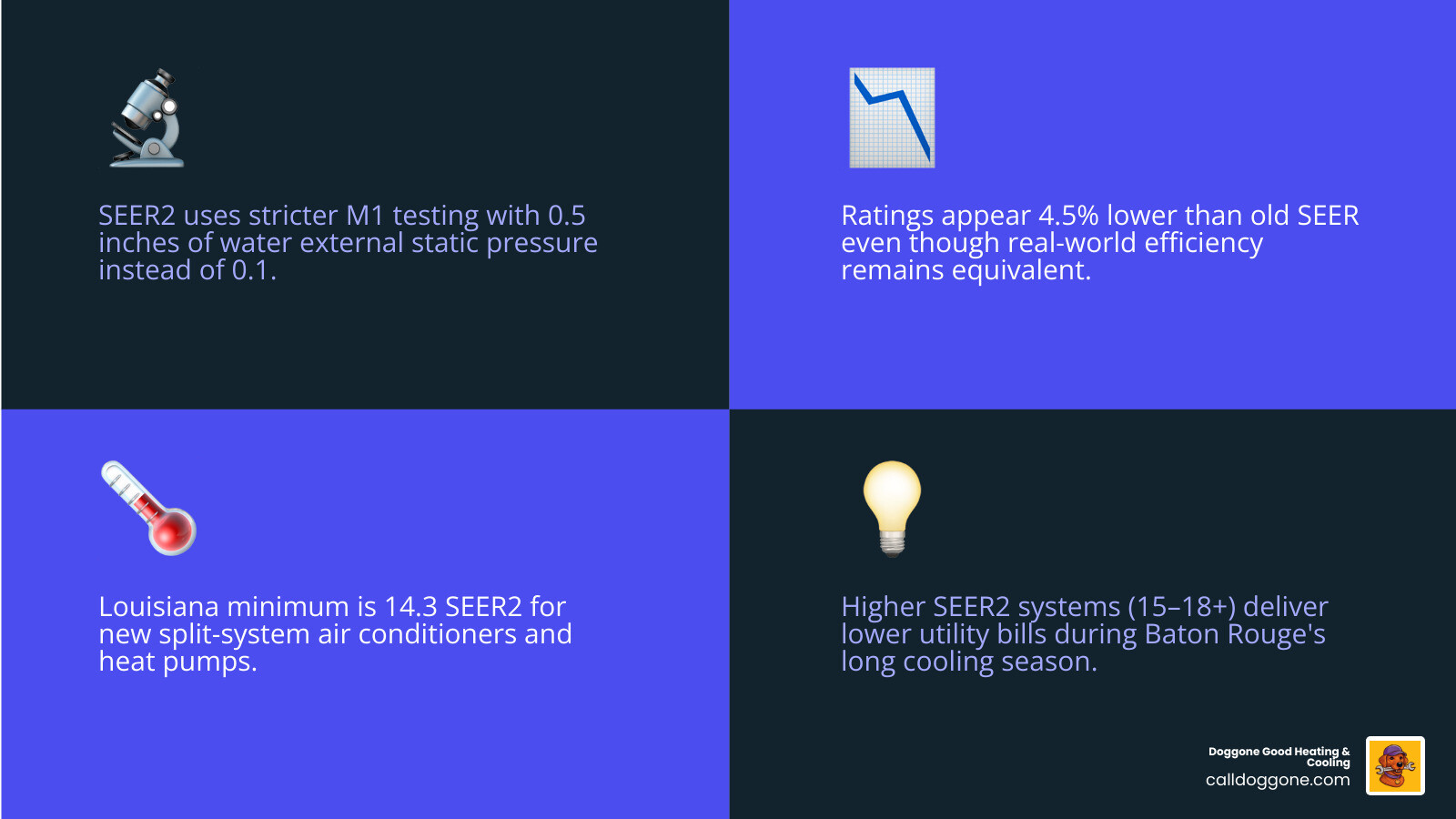
The updated M1 testing procedure introduces a much more demanding evaluation. The key change is the increase in external static pressure. While the old SEER test was conducted at 0.1 inches of water column (a measure of static pressure resistance), the SEER2 test is conducted at 0.5 inches of water column. This five-fold increase simulates the resistance air actually encounters inside a standard residential duct system.
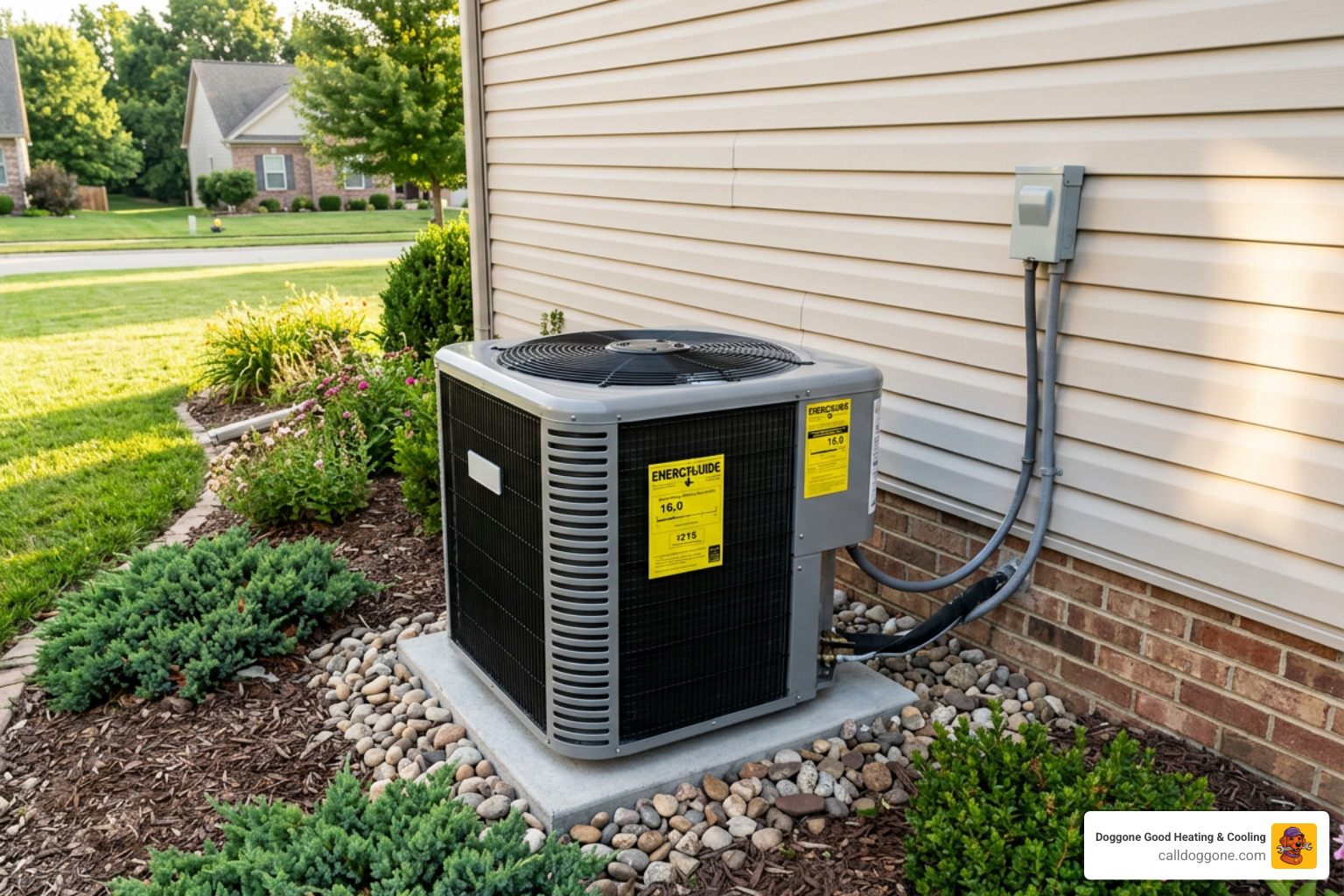
When you purchase a new system, you will see this rating displayed clearly on the yellow and black EnergyGuide label attached to the outdoor condenser. It provides an honest baseline of what you can expect from your equipment under real-world conditions.
Why SEER2 Rating Explained for Homeowners Matters for Energy Bills
Operating efficiency has a direct, measurable impact on your monthly utility bills. When you upgrade from an older, low-efficiency system to a modern SEER2-compliant unit, your electricity consumption drops.
For instance, a system rated at 20 SEER2 is approximately 43% more efficient than a base-tier 14 SEER2 unit. In places like Prairieville, Denham Springs, and Baton Rouge, where summer temperatures regularly push into the 90s with stifling humidity, your air conditioner is the single largest consumer of electricity in your household.
Modern high-efficiency systems achieve these impressive numbers through advanced technology, such as variable-speed compressors. Unlike traditional single-stage compressors that turn fully on or fully off (similar to driving a car by flooring the gas pedal and then slamming on the brakes), variable-speed compressors adjust their output dynamically. They can run at lower speeds for longer periods, consuming less energy while providing superior dehumidification. Proper humidity control means you can keep your thermostat set a degree or two higher while still feeling perfectly comfortable.
For more practical advice on keeping your cooling bills manageable during our intense summers, take a look at our guide on Don’t Sweat the Bill: Smart Ways to Cool Your Louisiana Home.
How SEER2 Compares to EER2 and HSPF2
While SEER2 is the most common acronym you will encounter, it is not the only efficiency metric that matters. To get a complete picture of your home’s HVAC performance, you should understand how it compares to EER2 and HSPF2.
| Metric | What It Measures | Testing Condition | Why It Matters |
|---|---|---|---|
| SEER2 | Seasonal cooling efficiency | Variable outdoor temperatures (65°F to 104°F) | Reflects average cooling costs over the entire spring and summer. |
| EER2 | Peak-load cooling efficiency | Steady-state extreme heat (95°F outdoor, 80°F indoor) | Indicates how well your system performs on the hottest afternoons of the year. |
| HSPF2 | Seasonal heating efficiency | Variable outdoor winter temperatures | Critical for heat pumps; measures heating output relative to electricity used. |
While SEER2 represents an average across the entire cooling season, EER2 (Energy Efficiency Ratio 2) measures steady-state efficiency at a fixed, high-temperature point. This is crucial for Southern homeowners because it tells you how hard your system has to work when the afternoon sun is beating down on your roof.
If you are installing a heat pump, HSPF2 (Heating Seasonal Performance Factor 2) is just as important as SEER2. It measures the heating efficiency of your system during the winter months. Just like SEER2, HSPF2 utilizes the more rigorous M1 testing standard to ensure the heating ratings reflect real-world ductwork conditions.
Why the Department of Energy Switched to SEER2 Testing
The Department of Energy (DOE) mandated the transition to SEER2 to close the gap between laboratory ratings and actual home performance. For decades, the HVAC industry relied on testing standards established under less demanding conditions. This meant that a system rated at 16 SEER might only deliver the equivalent of 12 or 13 SEER once installed in a home with restrictive ductwork or a dirty air filter.
By increasing the external static pressure requirement from 0.1 to 0.5 inches of water, the M1 protocol forces manufacturers to design equipment that can handle realistic airflow resistance. This change also addresses the “coil-only” rating. In the past, manufacturers could pair an outdoor condenser with an idealized indoor blower to inflate their efficiency ratings. Under the new rules, compliance is based on the lowest-performing coil-only rating listed on the EnergyGuide label, ensuring that homeowners get what they pay for.
The Conversion Factor Between SEER and SEER2
Because the new testing standards are significantly more difficult, the resulting efficiency numbers look lower on paper. It is important to realize that the equipment itself did not become less efficient; rather, the test became harder.
On average, a SEER2 rating is about 4.5% to 5% lower than the old SEER rating for the exact same piece of equipment. If you want to convert an old SEER rating to its SEER2 equivalent, you can use a simple conversion factor:
$$text{SEER2} approx text{SEER} times 0.95$$
For example, a system that was previously rated at 15 SEER under the old standard will carry a rating of approximately 14.3 SEER2 today. Manufacturers had to redesign their fan blades, upgrade to electronically commutated blower motors (ECM), and enlarge condenser coils to meet these new standards, ultimately leading to a more robust generation of HVAC equipment.
Regional SEER2 Requirements and Efficiency Standards
To account for the vast differences in climate across the United States, the Department of Energy divided the country into three distinct regions, each with its own minimum efficiency standards:
- The North: Focuses primarily on heating efficiency, with lower cooling minimums.
- The Southeast: Focuses heavily on cooling efficiency due to long, humid summers.
- The Southwest: Requires high cooling efficiency along with strict EER2 limits to handle dry, extreme heat.
In the North, compliance is determined by the equipment’s manufacture date. In the South and Southwest, however, compliance is determined by the installation date. This means that any central air conditioning system installed in our region must meet the current SEER2 minimums, regardless of when it was built.
Minimum Efficiency Standards for Louisiana Homeowners
Because Louisiana falls squarely within the Southeast region, we face some of the strictest cooling standards in the nation.
- Central Air Conditioners (Split Systems): Must meet a minimum of 14.3 SEER2 (which is equivalent to the old 15.0 SEER).
- Heat Pumps (Split Systems): Must meet a minimum of 14.3 SEER2 and 7.5 HSPF2 nationwide.
- Single-Packaged Units: Must meet a minimum of 13.4 SEER2 and 6.7 HSPF2.
These regulations ensure that any new system installed in Baton Rouge, Gonzales, or Zachary is built to withstand our demanding climate. If you are looking to replace an aging, broken system with one that meets these modern standards, we can help you find the perfect fit. Learn more about our regional services by visiting Don’t Get Steamed: Your Guide to Local AC Services Near Prairieville LA.
How to Choose the Right SEER2 Rating for Your Home
Choosing the right SEER2 rating requires balancing your upfront budget with your long-term energy goals. HVAC systems generally fall into four main efficiency tiers:
- Budget / Minimum (13.4 – 14.3 SEER2): Best for homeowners on a strict budget or those planning to sell their home in the near future.
- Standard / Best Value (15 – 16 SEER2): The “sweet spot” for most families, offering a great balance of lower utility bills and reasonable upfront equipment costs.
- High-Efficiency (17 – 19 SEER2): Features multi-stage or variable-speed compressors that excel at removing humidity and keeping temperatures perfectly consistent.
- Ultra-Premium (20+ SEER2): The absolute quietest and most efficient systems available, ideal for those committed to minimizing their carbon footprint and maximizing comfort.
To determine which tier makes sense for you, we look at your climate, how long you plan to stay in your home, and the integrity of your existing ductwork. Before choosing any system, it is vital to perform a Manual J load calculation. This calculation determines the exact cooling capacity your home needs based on its size, insulation, window orientation, and local climate. Installing an oversized system—even one with a very high SEER2 rating—will cause it to short-cycle, leading to high humidity levels and premature equipment failure.
If you are trying to decide whether to repair your current unit or invest in an upgrade, check out our comprehensive HVAC Repair vs Replacement Cost Guide for Smart Homeowners.
How to Use This SEER2 Rating Explained for Homeowners Guide to Choose a System
When shopping for a new system, use these steps to guide your decision:
- Evaluate your timeline: If you plan to live in your home for 10 or 15 years, investing in a higher SEER2 tier (16 to 18+) will pay off through lower monthly bills. If you plan to move within 3 to 5 years, a standard 14.3 SEER2 system is likely your most cost-effective option.
- Prioritize indoor comfort: If you struggle with hot spots, cold spots, or high indoor humidity, look for systems with variable-speed technology, which typically start around 16 to 17 SEER2.
- Check your ductwork: High-efficiency equipment requires proper airflow. If your ducts are leaky or undersized, they must be repaired or sealed to actually achieve the rated SEER2 efficiency.
Investing in a higher-efficiency system is one of those Energy Upgrades That Literally Pay for Themselves over time, especially when paired with local utility incentives.
Federal Tax Credits and Utility Rebates for High-Efficiency Upgrades
To make high-efficiency upgrades more accessible, there are several financial incentives available in 2026:
- Federal Tax Credits (Inflation Reduction Act): Under Section 25C, homeowners can claim a tax credit of up to $2,000 for qualifying ENERGY STAR certified heat pumps (typically requiring 16+ SEER2). For qualifying high-efficiency central air conditioners, you can claim up to $600.
- Local Utility Rebates: Depending on your specific provider in the Baton Rouge area, you may qualify for additional cash-back rebates for installing smart thermostats or high-efficiency cooling systems.
For a detailed breakdown of how to maximize these savings, read our guide on How to Score Big on Louisiana Utility Rebates for Cooling.
Frequently Asked Questions About SEER2
Does a lower SEER2 rating mean my new AC is less efficient than an older SEER model?
No, not at all! This is one of the most common misconceptions. A 14.3 SEER2 system is actually slightly more efficient than an older 14.0 SEER system. The lower number on the new label is simply the result of the stricter, more realistic M1 testing standard. Think of it like a vehicle’s updated EPA mileage rating; the car didn’t change, but the test became more accurate to reflect real-world driving conditions.
How does ductwork condition affect my system’s actual SEER2 performance?
Your ductwork is the delivery system for your home’s conditioned air. If your ducts are leaky, uninsulated, or poorly designed, you can lose up to 20% to 30% of your system’s cooling capacity before it ever reaches your living spaces.
No matter how high your system’s SEER2 rating is, it cannot compensate for poor ductwork. Regular maintenance and duct sealing are essential to keeping your utility bills low. To see what else you can do to keep your system running at peak performance, review our AC Maintenance Checklist to Lower Energy Bills.
What is the $5,000 rule for HVAC repair versus replacement?
The $5,000 rule is a simple mathematical formula designed to help homeowners decide whether to repair an older, failing system or replace it with a new, energy-efficient model.
To use the rule, multiply the age of your current system by the estimated cost of the repair:
$$text{Age of System (Years)} times text{Cost of Repair} = text{Total}$$
If the total exceeds $5,000, it is generally wiser to invest that money into a new system with a modern SEER2 rating, rather than continuing to patch up a failing unit. For a deeper look at how this rule can protect your budget, read our article on how The 5000 Dollar Rule Saves Your Wallet and Your Sanity.
Conclusion
Understanding SEER2 ratings is the key to making an informed decision about your home’s comfort and energy savings. By focusing on real-world conditions, these updated standards give you an honest look at how your new air conditioner or heat pump will perform.
At Doggone Good Heating & Cooling, we are proud to serve families across Baton Rouge, Prairieville, Denham Springs, Zachary, and Gonzales. Our team of honest, reliable, and locally attuned comfort specialists is here to help you select the perfect system for your home and budget. Whether you need a brand-new, high-efficiency installation or a quick repair on your existing system, we have you covered with our 24/7 emergency response and our affordable Pack Perks Membership.
To learn more about keeping your system running efficiently, check out How Regular Maintenance Keeps Your Bank Account from Breaking and read about The Real Deal on Whether HVAC Memberships Actually Save You Money.
When you are ready to find out Which HVAC Contractors in Baton Rouge Offer 24/7 Emergency Response for Air Conditioning Failures, look no further than our dedicated team.
Schedule an energy-efficiency consultation today to find the perfect SEER2 system for your home!
About the Author
Doggone Good Heating and Cooling
Doggone Good Heating and Cooling — your local HVAC experts in Baton Rouge, LA.
Need HVAC Service?
Get a free estimate or schedule your service today. Our team is ready to help.
Recent Posts


Related Articles
Ready to Get Started?
Prefer to Call?
Talk with a local technician and get clear next steps for your home.
Call Now(225) 230-9784