How the 5000 Dollar Rule Saves Your Wallet and Your Sanity
Doggone Good Heating and Cooling


Discover the 5000 dollar rule for ac replacement: Multiply age by repair cost. Beat Baton Rouge heat—save money with our guide!
Is It Time to Replace Your AC? The $5,000 Rule Explained
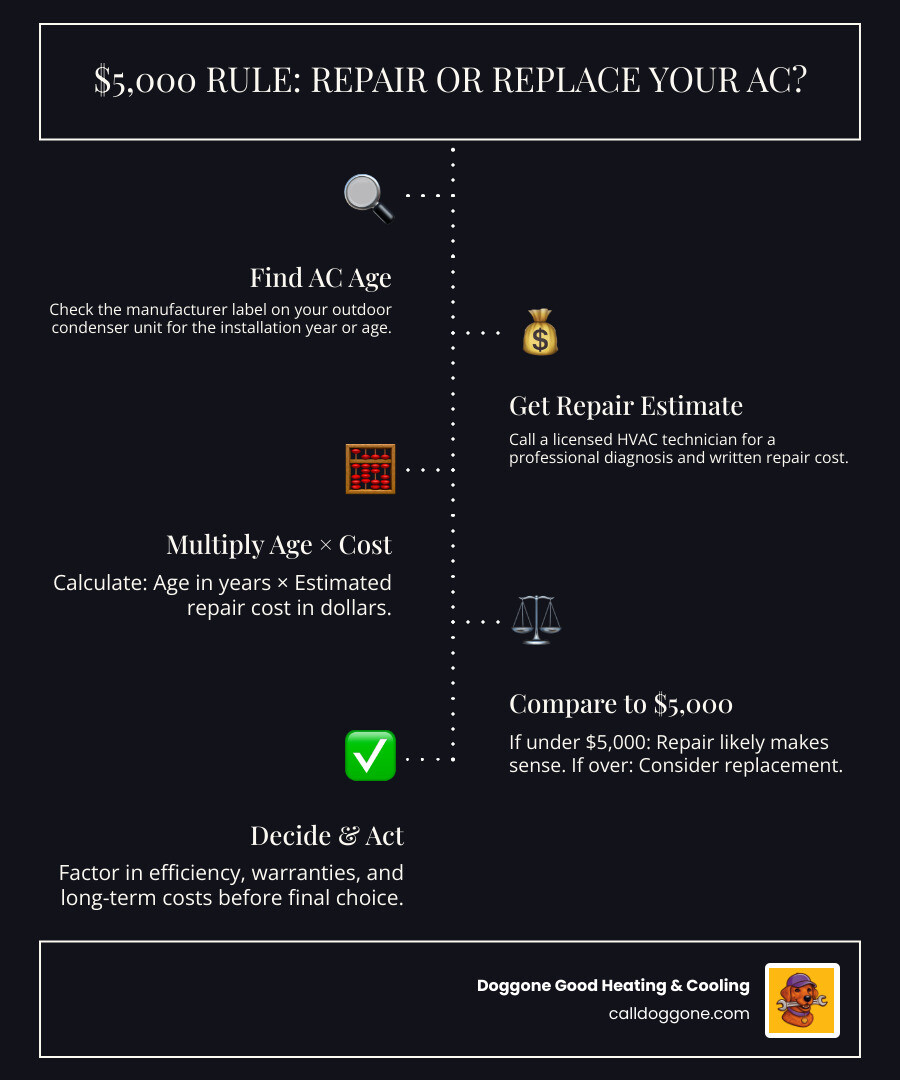
The 5000 dollar rule for AC replacement is a simple formula that helps homeowners decide whether to fix or replace their air conditioner: multiply your AC unit’s age (in years) by the estimated repair cost. If that number exceeds $5,000, replacement is generally the smarter financial move.
Here’s how it works at a glance:
- Find your AC’s age – Check the manufacturer label on your outdoor unit
- Get a repair estimate – Have a licensed technician diagnose the problem
- Do the math – Age × Repair Cost = Your number
- Compare to $5,000 – Under $5,000? Repair is likely fine. Over $5,000? It’s time to seriously consider replacement
Quick examples:
- 10-year-old unit + $600 repair = $6,000 → Replace
- 6-year-old unit + $300 repair = $1,800 → Repair
- 12-year-old unit + $400 repair = $4,800 → Repair (borderline)
When your air conditioner breaks down in the middle of a Baton Rouge summer — with humidity pushing feels-like temperatures well past 100°F — the pressure to make a fast decision is very real. Do you pay for the repair and hope it holds? Or is this finally the moment to cut your losses and replace the whole system? Most homeowners feel stuck between two uncomfortable options: spend money now on a fix that might not last, or spend significantly more on a brand-new unit.
That’s exactly the problem the 5000 dollar rule was built to solve. It gives you a fast, numbers-based starting point so you’re not making a major financial decision in a panic. It won’t answer every question on its own — but it cuts through the noise quickly and gives you a framework you can actually use.
In this guide, we’ll walk you through how to apply the rule, what it means for Baton Rouge homeowners specifically, and what other factors you should weigh before making your final call.
What is the 5000 Dollar Rule for AC Replacement?
At its core, the 5000 dollar rule for AC replacement is a decision-making framework designed to protect your long-term value. Instead of looking at a repair bill in isolation, this rule forces you to consider the system’s age—a critical factor in how much life that unit has left.
In a place like Baton Rouge or Prairieville, our air conditioners don’t exactly have an easy life. The extreme humidity and relentless heat mean our systems work harder and run longer than units in milder climates. This “Baton Rouge climate strain” often means that a mathematical threshold is the only way to stay objective when a technician hands you a significant repair estimate.
Using this rule helps you determine if you are “throwing good money after bad.” If your system is nearing the end of its functional life, even a mid-sized repair can be the first of many. By applying the rule, you can see if Central AC Installation & Replacement is actually the more responsible choice for your household budget over the next five years.
How to Calculate the 5000 Dollar Rule for AC Replacement
Calculating the rule is straightforward. You only need two pieces of information: the age of your system and the quote for the current repair.
The Formula: Age of Unit (Years) × Cost of Repair = Total Score
If your “Total Score” is higher than 5,000, the rule suggests that AC Replacement is the better path.
For example, if you live in Zachary and your 12-year-old unit needs a $500 repair, your score is 6,000. Because 6,000 is greater than 5,000, the math tips in favor of a new system. Conversely, a 5-year-old unit needing that same $500 repair results in a score of 2,500—well under the threshold—making a repair the logical choice.
Why System Age Matters in May 2026
As of May 2026, the HVAC industry has seen massive leaps in technology, but the laws of physics haven’t changed. Most air conditioners in Louisiana last between 12 and 15 years when properly maintained. While a well-maintained system can reach 20 years in some parts of the country, performance in our humid environment often plummets after the 10-year mark.
By the time a unit hits double digits, equipment fatigue sets in. Critical components like the compressor and evaporator coils have survived a decade of Louisiana summers. At this age, the internal metal has expanded and contracted thousands of times, and the efficiency has naturally degraded. The $5,000 rule respects this reality by weighing the age of the unit just as heavily as the dollar amount of the fix.
Applying the Rule: Real-Life Baton Rouge Scenarios
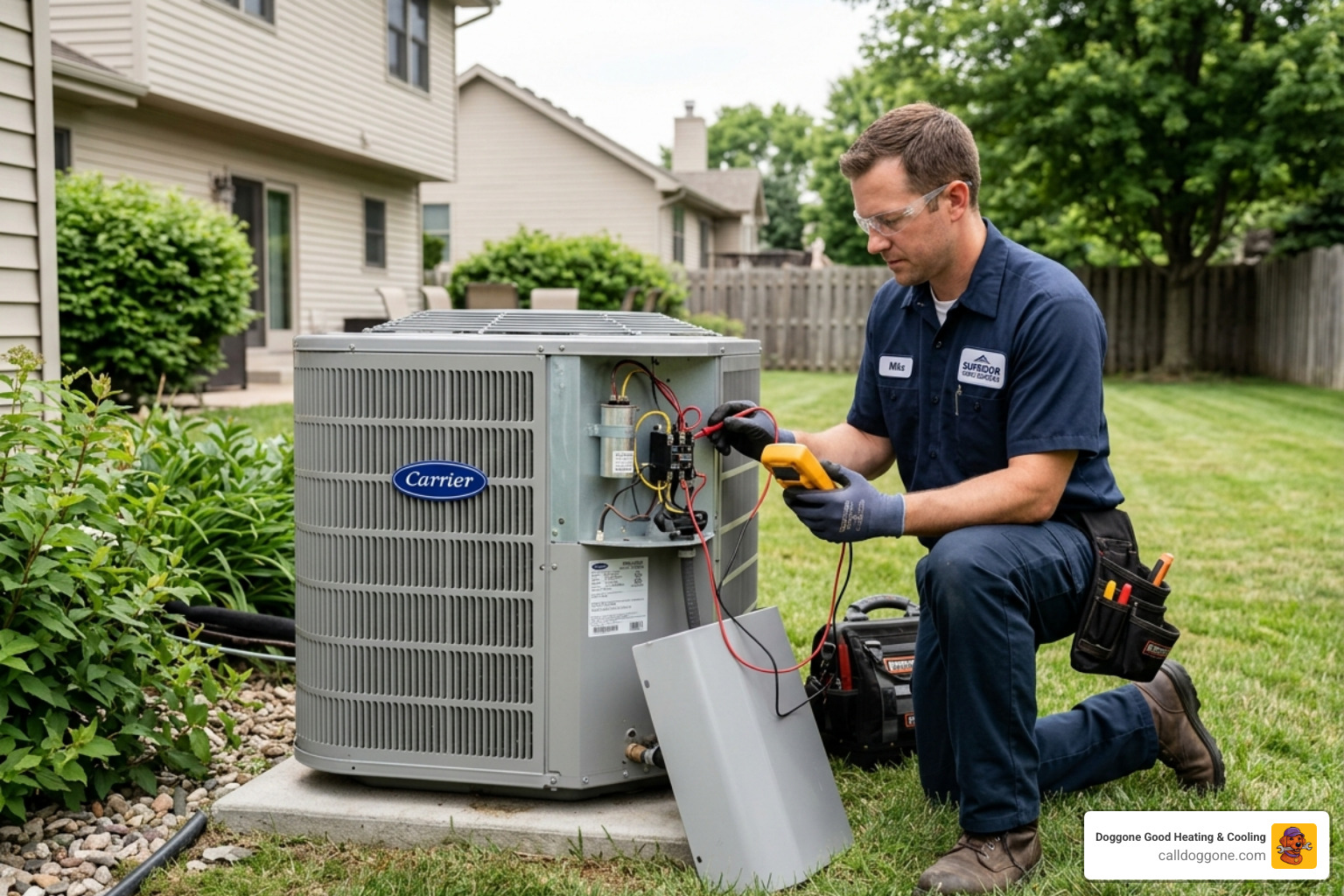
Let’s look at how this plays out in real homes across Denham Springs and Gonzales. It’s one thing to see the math on paper; it’s another to apply it when your living room is 85 degrees.
Scenario A: The Reliable Middle-Aged Unit You have an 8-year-old system. It’s been serviced every year through a program like our Pack Perks Membership. Suddenly, a capacitor blows. The repair is relatively minor.
- Math: 8 years × $250 repair = 2,000.
- Verdict: Repair it. The system still has plenty of life left, and the cost doesn’t justify a full replacement.
Scenario B: The “Money Pit” Senior Unit You have a 13-year-old unit in Prairieville. The fan motor has burnt out.
- Math: 13 years × $600 repair = 7,800.
- Verdict: Replace it. Even though $600 feels “cheaper” than a new system today, the $5,000 rule warns you that this 13-year-old machine is likely to have another expensive failure very soon.
When deciding Should You Repair or Replace an Old Air Conditioner in Baton Rouge?, refer to this quick comparison table:
| Factor | Repair Often Wins If… | Replacement Often Wins If… |
|---|---|---|
| 5000 Rule Score | Under 5,000 | Over 5,000 |
| System Age | Less than 10 years | More than 12-15 years |
| Repair History | First major issue | Frequent “small” fixes adding up |
| Energy Bills | Consistent with previous years | Rising 20-40% without explanation |
| Refrigerant | Uses R-410A | Uses phased-out R-22 |
Beyond the Math: Efficiency and Modern Standards
While the 5000 dollar rule is a fantastic baseline, it doesn’t account for the hidden costs of keeping an old unit. Modern AC systems are built to much higher SEER2 (Seasonal Energy Efficiency Ratio) standards.
Older air conditioners can cost 20–40% more to run than modern high-efficiency models. If you are paying $300 a month to cool your home in the summer, a new system could potentially save you $60 to $120 every single month. Over a few summers, those energy savings can actually pay back a significant portion of the replacement cost.
Furthermore, humidity control has improved drastically. Modern units are better at pulling moisture out of the air, which is the “secret sauce” to feeling comfortable in Baton Rouge. Sometimes, even if the math is borderline, the jump in comfort and the drop in utility bills make a Heat Pump Replacement or new AC the better life choice.
When the 5000 Dollar Rule for AC Replacement Suggests an Upgrade
The rule is a “go/no-go” gauge for repairs, but you should lean toward an upgrade if you notice these secondary signs:
- The R-22 Factor: If your unit was built before 2010, it likely uses R-22 refrigerant. This has been phased out, and the cost to “recharge” a system with a leak is now astronomical.
- Frequent Breakdowns: If you’ve had the technician out three times in two years, the 5000 rule might only capture the current bill, but your gut knows the total cost is too high.
- Hot and Cold Spots: If some rooms never get cool, your old system might be sized incorrectly or simply losing its “oomph.”
- Commercial Needs: For business owners, Light Commercial AC Replacement is often more urgent because a breakdown affects customers and employees, not just family.
Financial Incentives and Tax Credits in 2026
One reason the 5000 dollar rule is so effective in May 2026 is the availability of federal incentives. Under the Energy Efficient Home Improvement Credit, homeowners can receive up to $600 back (30% of project cost) for qualifying high-efficiency central AC systems.
When you factor in these tax credits and local utility rebates, the “real” cost of a new system drops. This makes the decision to stop repairing an old, inefficient unit even easier to justify.
Frequently Asked Questions about HVAC Replacement
Does the rule apply to heating systems?
Yes, though the “threshold” can be slightly more flexible. A furnace typically lasts longer than an AC—often 15 to 20 years. However, the logic remains the same. If you are facing a Heating Replacement, multiply the age of the furnace by the repair cost.
If you have a heat pump, the rule is especially applicable because that single unit handles both cooling and heating, meaning it sees year-round wear and tear. For business owners in the area, the same logic applies to Light Commercial Heating Replacement, where reliability is paramount for operations.
What are the limitations of the 5000 rule?
The rule is a guideline, not a law of nature. There are a few times you might ignore it:
- Moving Soon: If you plan to sell your home in six months, you might choose the repair just to keep the home functional for the sale, even if the math says replace.
- Warranty Coverage: If the expensive part is still covered under a manufacturer warranty, your out-of-pocket cost is lower, which might bring your “score” back under 5,000.
- Minor Components: If the unit is old but the fix is just a simple cleaning or a clogged drain line, don’t rush to replace it based on age alone.
What should I ask my technician during an inspection?
To get the most accurate numbers for your calculation, ask your technician these specific questions:
- “What is the exact age of this unit based on the serial number?”
- “What type of refrigerant does this system use (R-22 or R-410A)?”
- “Besides this specific part, what is the overall condition of the compressor and coils?”
- “Is the ductwork in good enough shape to handle a new, high-efficiency system?”
- “Are there any signs of significant rust or corrosion inside the cabinet?”
Conclusion
At Doggone Good Heating & Cooling, we know that an AC breakdown feels like an emergency, but your response doesn’t have to be a gamble. By using the 5000 dollar rule for AC replacement, you can move forward with confidence, knowing you’ve made the best financial choice for your home and your family’s comfort.
Whether you need a quick fix to get through the week or a full Replacement to lower your bills for the next decade, our team is here to provide honest, reliable, and locally attuned service. We serve Baton Rouge, Prairieville, Denham Springs, Zachary, and Gonzales with the expertise only a local neighbor can provide.
Don’t let a failing AC bark at your budget. Give us a whistle, and we’ll help you crunch the numbers to keep your home cool and your wallet happy.
About the Author
Doggone Good Heating and Cooling
Doggone Good Heating and Cooling — your local HVAC experts in Baton Rouge, LA.
Need HVAC Service?
Get a free estimate or schedule your service today. Our team is ready to help.
Recent Posts


Related Articles
Ready to Get Started?
Prefer to Call?
Talk with a local technician and get clear next steps for your home.
Call Now(225) 230-9784