Head Games: Deciding How Many Indoor Units Your Home Actually Needs
Doggone Good Heating and Cooling


Discover how many mini split heads do I need for your Baton Rouge home. Expert guide on sizing, BTUs, zones & efficiency for ultimate comfort.
How Many Mini Split Heads Do I Need? Here’s Your Quick Answer
How many mini split heads do I need is one of the most common questions homeowners ask before investing in a ductless system — and the honest answer is: it depends on your home’s layout, room count, and how air moves through your space.
Here’s a fast reference to get you started:
| Situation | Heads Needed |
|---|---|
| Single room or open studio | 1 |
| 2-3 bedroom home with closed rooms | 2–4 |
| Whole home (1,500–2,000 sq ft) | 3–5 |
| Large home (2,000–3,000+ sq ft) | 5–8 |
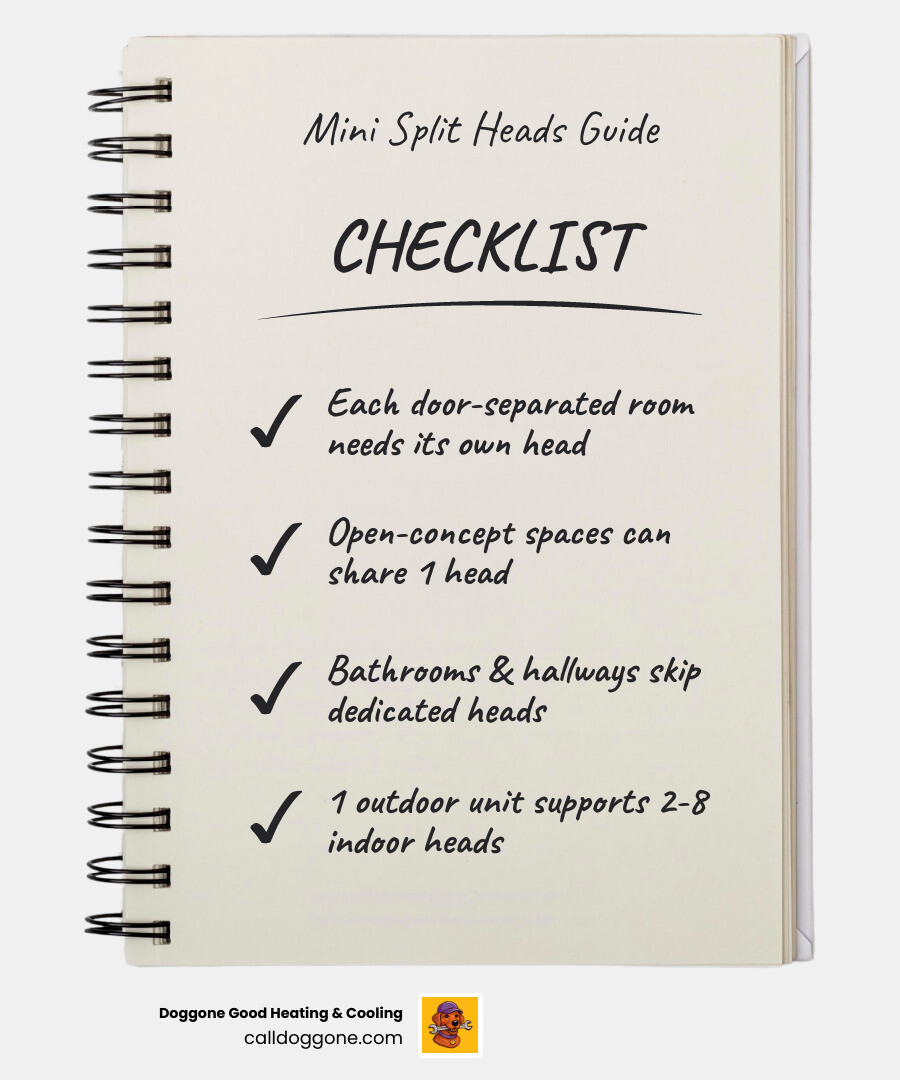
Quick rules to remember:
- Each room separated by a door typically needs its own indoor head
- Open-concept areas (living room + dining room with no wall) can often share one head
- Bathrooms and hallways generally do not need a dedicated head
- One outdoor unit can support between 2 and 8 indoor heads depending on the system
For most Baton Rouge homeowners dealing with year-round heat, sticky humidity, and the occasional winter cold snap, getting this number right isn’t just about comfort — it’s about efficiency and avoiding wasted energy. Install too few heads and you’ll have hot spots and overworked equipment. Install too many and you’re spending more than you need to.
This guide walks you through exactly how to figure out the right number for your specific home, room by room.
Understanding the Basics: How Many Mini Split Heads Do I Need?
When we talk about “heads,” we are referring to the indoor air handlers that mount to your wall, floor, or ceiling. These are the visible parts of a ductless system that actually blow the conditioned air into your living space. To understand how many you need, we first have to look at the two main types of configurations: single-zone and multi-zone systems.
A single-zone system is a one-to-one match. You have one outdoor condenser connected to exactly one indoor head. This is perfect for a garage conversion, a new sunroom, or a home office that stays a little too warm in the summer. However, if you are looking for whole-home comfort, you’ll likely want to explore Residential Mini-Split Systems that utilize a multi-zone setup.
In a multi-zone configuration, a single outdoor unit can power anywhere from two to eight indoor heads. This is where the “head game” gets interesting. You don’t necessarily need the outdoor unit’s total capacity to perfectly match the sum of all indoor heads. This concept is known as load diversity. Since you probably aren’t running every unit at maximum blast at the exact same time (for instance, you might lower the AC in the living room while you sleep in the bedroom), a smart system can distribute power where it’s needed most.
Each of these heads acts as its own independent zone with its own thermostat. This means no more family arguments over the temperature! You can keep the kitchen cool while you’re cooking dinner without freezing out someone reading in the den. For a deeper dive into how these components interact, check out The Complete Zachary Guide to Mini-Split Systems.
Key Factors That Determine Your Indoor Unit Count
Choosing the right number of heads isn’t just a math problem; it’s a lifestyle and architecture puzzle. In our experience serving the Baton Rouge area, we’ve found that several “invisible” factors play a huge role in the final count.
- Room Layout: Are your rooms “closed” or “open”? Air is like a lazy traveler—it doesn’t like to go through doors or around tight corners. If your home has a traditional layout with many walls and doors, you will likely need more heads to ensure every room stays comfortable.
- Insulation Quality: Better insulation means your home holds onto its “conditioned” air longer. If you have an older home in Denham Springs with thin insulation, you might need higher-capacity heads or an extra unit to compensate for heat gain. This is a big reason Why Your Denham Springs Home Needs a Ductless System Upgrade to modern, high-efficiency standards.
- Baton Rouge Humidity: In Louisiana, we don’t just fight heat; we fight moisture. Mini-splits are excellent dehumidifiers, but if a room is too large for its head, the unit won’t run long enough to pull the moisture out of the air, leaving you feeling “clammy.”
- Ceiling Height and Windows: A room with 12-foot vaulted ceilings has significantly more air to cool than one with standard 8-foot ceilings. Similarly, large south-facing windows act like giant heaters during a July afternoon, often requiring a dedicated head even if the square footage is small.
Calculating BTUs: How many mini split heads do I need per square foot?
The industry “rule of thumb” is roughly 20 BTUs per square foot. A BTU (British Thermal Unit) is simply a measure of cooling and heating power. While this is a great starting point, it’s not the final word. Here is how that typically breaks down for common room sizes:
| Room Size (Sq Ft) | Recommended BTU Capacity | Common Head Size |
|---|---|---|
| 150 – 350 | 9,000 BTU | Small Bedroom / Office |
| 350 – 550 | 12,000 BTU | Master Bedroom / Dining Room |
| 550 – 750 | 18,000 BTU | Large Living Room |
| 750 – 1,200 | 24,000+ BTU | Open Concept Floor |
While these numbers help you estimate, we always recommend a Manual J load calculation. This is a professional assessment that accounts for your specific windows, insulation, and local climate to ensure your system isn’t oversized (which causes “short-cycling”) or undersized (which leads to a constant, expensive hum). For residents in the northern part of our service area, we provide Expert Mini-Split Services for Zachary Residents to help nail down these exact numbers.
Room-by-Room Planning: Do You Need a Head in Every Room?
One of the most frequent misconceptions is that you must have a head in every single room. While that provides the ultimate control, it’s often overkill.
Bedrooms: We generally recommend a dedicated head for every bedroom that is frequently used. Because bedroom doors are usually closed at night for privacy, a unit in the hallway simply won’t be able to push enough cool air into the room to keep you comfortable.
Living Areas: This is where you spend most of your time. A high-capacity head here is essential. If your living room flows directly into the kitchen without a wall or door, one large unit can often handle both. We discuss these specific layout challenges in our guide on The Best Ductless Mini-Splits for Your Baton Rouge Home.
Bathrooms and Hallways: You can almost always skip these. Bathrooms are small enough that they will naturally stay conditioned by the air from the adjacent bedroom or hallway. Hallways are “transition zones” and don’t require their own thermostat.
Sunrooms and Basements: These areas often have unique temperature needs. A sunroom might need a 12,000 BTU head even if it’s small, simply because of the glass. A basement, being naturally cooler, might only need a small 9,000 BTU unit to keep things dry and crisp.
Maximizing Efficiency: How many mini split heads do I need for an open floor plan?
If you have a modern, open-concept home, you can save on equipment by being strategic. Instead of putting a head in the kitchen, dining room, and living room, you might be able to use one or two larger heads placed at opposite ends of the space.
The goal is to encourage airflow sharing. By placing a head where it has a clear “shot” across the room, you eliminate hot pockets where air might get trapped behind a sofa or a kitchen island. This approach is a core part of Residential Ductless design—it’s about moving air, not just cooling it.
In areas like Gonzales, where homes often feature sprawling layouts, planning the “throw” of the air is vital. For more tips on managing these larger spaces, see Ducting the Issue: A Guide to the Best Ductless Systems in Gonzales, LA.
Advanced Configurations and Professional Sizing
Sometimes, the standard wall-mounted “white box” isn’t the best fit for your home’s aesthetic or layout. That’s where slim-ducted mini-splits come in. These units are hidden in the attic or crawlspace and use very short, compact ducts to service two or three small rooms (like a cluster of bedrooms) from a single “head.” This can significantly reduce the number of visible units on your walls while still giving you the efficiency of a ductless system.
When planning these advanced setups, we also have to consider line set length. The copper pipes that carry refrigerant between the outdoor unit and indoor heads have maximum length limits. If the distance is too great, the system loses efficiency. In very large homes, it’s often smarter to install two separate outdoor units on different sides of the house rather than trying to stretch one unit to its limit.
Professional sizing also involves system prioritization. Some multi-zone systems allow you to designate a “master” zone. For example, in the heat of a Louisiana summer afternoon, the system can prioritize the living room, and then shift that cooling power to the bedrooms in the evening. This level of customization is why our Mini-Split Services start with a comprehensive home evaluation.
Frequently Asked Questions about Mini-Split Sizing
Can one outdoor unit support my entire house?
In many cases, yes! Most modern outdoor condensers can support up to 5 zones, and some high-capacity models can handle up to 8 indoor heads. For a standard 1,500 to 2,000 square foot home in Baton Rouge, a single outdoor unit is usually sufficient. However, if you have a massive home or a very spread-out layout, using two outdoor units provides redundancy—if one unit needs maintenance, the other half of the house stays cool.
Will a single unit in the living room cool my bedrooms?
It is very unlikely. We’ve seen many homeowners try to save by installing one giant 36,000 BTU unit in the center of the house, hoping it will “spill” into the bedrooms. Unfortunately, physics isn’t on your side. Without a fan to push that air through a doorway and into a room, you’ll end up with a freezing living room and bedrooms that stay stubbornly warm and humid.
How does the Louisiana climate affect the number of units?
Our climate is unique because of the latent heat load—that’s the scientific term for humidity. Because our air is so heavy with moisture, our systems have to work harder than a system in a dry climate like Arizona. This often means we might recommend a slightly higher BTU capacity for certain rooms to ensure the unit can run long enough to effectively dehumidify the space without over-cooling it.
Conclusion
Deciding how many mini split heads do i need doesn’t have to be a guessing game. By focusing on your home’s layout, understanding the “20 BTU per square foot” baseline, and identifying which rooms truly need independent control, you can design a system that delivers perfect comfort without breaking the bank.
At Doggone Good Heating & Cooling, we pride ourselves on providing honest, reliable, and locally attuned service to our neighbors in Baton Rouge, Prairieville, and beyond. We don’t believe in one-size-fits-all solutions; we believe in custom comfort designed for the way you actually live in your home.
Ready to stop the “head games” and start enjoying zoned comfort? Schedule your professional mini-split consultation today and let us help you find the perfect bark—and bite—for your home’s climate control.
About the Author
Doggone Good Heating and Cooling
Doggone Good Heating and Cooling — your local HVAC experts in Baton Rouge, LA.
Need HVAC Service?
Get a free estimate or schedule your service today. Our team is ready to help.
Recent Posts


Related Articles
Ready to Get Started?
Prefer to Call?
Talk with a local technician and get clear next steps for your home.
Call Now(225) 230-9784