How to Cool an Older Home Without Tearing Down the Walls
Doggone Good Heating and Cooling


Discover adding cooling without ductwork options compared for older Baton Rouge homes. Explore mini-splits vs. alternatives for efficient, non-invasive cooling!
Cooling an Older Home Without Ductwork: Your Best Options at a Glance
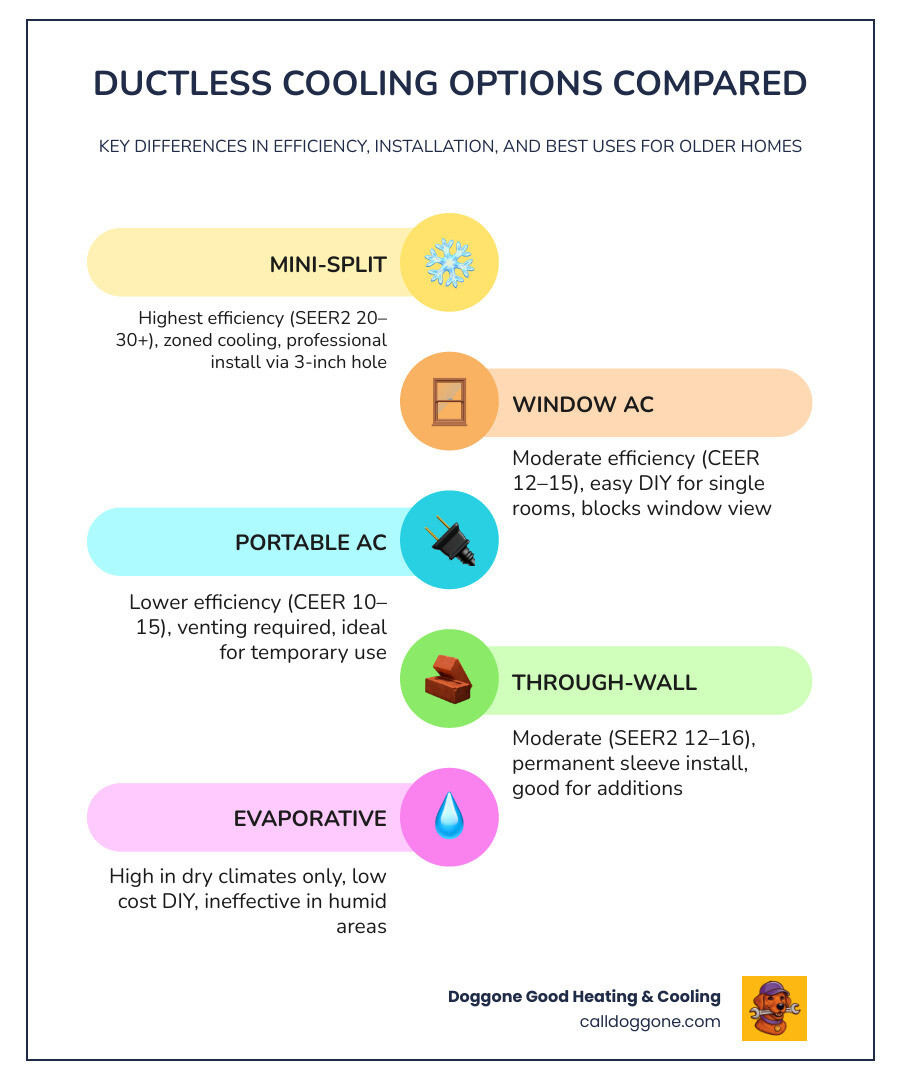
Adding cooling without ductwork options compared side by side is the fastest way to find the right fit for your home. Here’s a quick breakdown:
| Cooling Option | Best For | Efficiency | Installation |
|---|---|---|---|
| Ductless mini-split | Whole-home or multi-room cooling | Highest (SEER2 20–30+) | Professional, 3-inch wall hole |
| Window AC unit | Single rooms, renters | Moderate (CEER 12–15) | DIY |
| Portable AC | Temporary, windowless rooms | Lower (CEER 10–15) | DIY, needs venting |
| Through-the-wall / PTAC | Rentals, additions | Moderate (SEER2 12–16) | Wall sleeve required |
| Evaporative cooler | Dry climates only | High in low humidity | DIY to moderate |
Mini-splits are typically the strongest long-term choice for Baton Rouge homeowners — but the right answer depends on your space, budget, and how long you plan to stay.
Older homes in Baton Rouge have a lot going for them — character, history, solid construction. What many of them don’t have is ductwork. And in a climate where summer heat and relentless humidity push cooling systems hard for months on end, that’s a real problem.
Adding central air to a home without existing ducts means cutting into walls, running new duct lines through tight spaces, and spending significantly more than most homeowners expect. For older homes with plaster walls, narrow attics, or architectural details worth protecting, that kind of work can cause more damage than it fixes.
The good news is that you have real options — and some of them are genuinely excellent. Ductless systems have advanced dramatically, and the gap between “ductless workaround” and “whole-home comfort solution” has nearly closed. Traditional ductwork can lose up to 30% of its cooling power through leaks alone, meaning a well-installed ductless system can actually outperform a ducted one in real-world efficiency.
This guide walks through every major ductless cooling option available to Baton Rouge homeowners — how they work, where they shine, and where they fall short — so you can make a confident choice for your home.
Understanding Your Choices for Adding Cooling Without Ductwork Options Compared
When we talk about historic home preservation in areas like Gonzales or Prairieville, we aren’t just talking about the facade. We’re talking about the integrity of the structure. Traditional central AC requires massive trunk lines and branch ducts that simply don’t fit in homes built before the 1950s. Forcing them in usually means dropping ceilings or building “soffits” (those boxy protrusions in the corner of a room) that ruin the aesthetic of a classic high-ceiling home.
This is why Residential Ductless solutions have become the go-to for our local homeowners. By choosing a non-invasive installation, you avoid the “demo day” nightmare. Instead of weeks of drywall dust and construction, most ductless installations are completed in a day or two.
In our specific Baton Rouge climate, the choice isn’t just about getting the air cold; it’s about managing the “latent load”—that heavy, wet feeling in the air. A system that is poorly matched to the home’s layout will leave you feeling clammy. Adding cooling without ductwork options compared reveals that modern systems are now designed specifically to handle southern humidity while maintaining high energy efficiency.
Why adding cooling without ductwork options compared often favors mini-splits
By 2026, the technology inside ductless mini-splits has far outpaced traditional window units. The secret sauce is “inverter technology.” While a standard AC is either 100% on or 100% off (which wastes a ton of energy during startup), an inverter-driven mini-split can slow down or speed up like a dimmer switch. It provides exactly the amount of cooling needed to maintain a steady temperature.
This precision is why new models are hitting SEER2 ratings above
- To put that in perspective, a SEER 16 central system with leaky ducts might effectively perform like a SEER
- A SEER 30 mini-split is nearly three times more efficient than that leaky central system. Furthermore, as of the 2025 regulatory updates, all new split-system heat pumps must meet a 14.3 SEER2 minimum, ensuring that even the “entry-level” models we install today are significantly more advanced than the units of five or ten years ago.
Limitations of adding cooling without ductwork options compared to whole-home solutions
While we love ductless tech, we have to be honest about the alternatives. Window units and portable ACs are often the first thing people try because they are “plug and play.” However, for a whole-home solution, they struggle.
First, there’s the window security issue. A window unit provides a literal opening into your home for intruders. Then there’s the noise; because the compressor is sitting right in your window, it sounds like a small jet engine is taking off in your bedroom. Portable units aren’t much better; single-hose models actually create “negative pressure,” pulling hot, humid Baton Rouge air in through cracks in your doors and windows to replace the air they are exhausting. This makes them incredibly inefficient. If you are looking for a permanent, quiet, and secure way to cool your home, these temporary fixes usually fall short.
The Gold Standard: Ductless Mini-Split Systems
If you’ve ever walked into a high-end hotel or a modern apartment and noticed a sleek white unit high on the wall, you’ve seen a mini-split. These systems consist of two main parts: an outdoor condenser and one or more indoor air handlers.
They are connected by a small “lineset” containing refrigerant pipes and electrical wiring. The beauty of this setup is the 3-inch wall penetration. We don’t need to tear out studs or remove plaster; we just need one small hole to link the two halves. This makes Mini Split Systems the least invasive way to get professional-grade cooling into an older structure.
Benefits of zoned comfort in Louisiana
One of the biggest complaints we hear in Denham Springs is that the upstairs is a sauna while the downstairs is a walk-in freezer. Ductless systems solve this through “zoning.” Each indoor unit has its own thermostat. If you like your bedroom at 68 degrees but want the living room at 74, you can have both simultaneously.
This isn’t just about comfort; it’s about your wallet. Why pay to cool the guest room or the formal dining room if no one is in there? Zoned control allows you to turn down the cooling in unused spaces, which is Why Your Denham Springs Home Needs a Ductless System Upgrade. In many cases, homeowners see their summer power bills drop by up to 40% after switching from a traditional ducted system to a multi-zone mini-split.
Indoor air quality and noise reduction
Because ductless systems don’t have ducts, they don’t have “duct dust.” In a traditional system, dust, pet dander, and allergens can settle in the ductwork and get blown back into your face every time the AC kicks on. Ductless units use multi-stage filtration located right at the air handler, which is much easier to clean and maintain.
Then there’s the silence. Traditional window units run at about 50–60 decibels (dB). For comparison, a whisper is about 30 dB. Modern Residential Mini-Split Systems often operate as low as 22–25 dB. You’ll literally forget the unit is even running, which is a game-changer for light sleepers in Zachary or Gonzales.
Comparing Room-Specific Cooling Alternatives
When adding cooling without ductwork options compared, it helps to see the numbers.
| Feature | Mini-Split | Window AC | Portable AC | PTAC (Wall Unit) |
|---|---|---|---|---|
| Noise Level | 22–40 dB | 50–60 dB | 55–70 dB | 50–65 dB |
| Lifespan | 15–20 years | 5–10 years | 5–8 years | 10 years |
| Efficiency | Up to 30+ SEER2 | 12–15 CEER | 10–15 CEER | 12–16 SEER2 |
| Security | High (small hole) | Low (window open) | Low (vent in window) | Moderate (wall hole) |
Window units are the classic budget choice, but they block your view and ruin your home’s “curb appeal.” Through-the-wall units (PTACs), like the ones you see in hotels, are more permanent but require a large rectangular hole cut through your exterior wall, which can be even more invasive than a mini-split’s 3-inch hole.
Best use cases for temporary cooling
We usually recommend window or portable units for very specific, short-term situations. If you are a renter in Baton Rouge and your landlord won’t approve a permanent install, a portable AC is your best friend. They are also handy for temporary workshops or a guest room that only gets used two weekends a year.
However, if you own the home, the long-term value of a permanent system is undeniable. According to The Complete Zachary Guide to Mini-Split Systems, a mini-split not only saves you money every month on energy but also adds actual resale value to the property—something a window unit simply cannot do.
Efficiency and long-term value
Let’s talk about the “duct tax.” In a standard ducted home, you are paying for air that never reaches you. Leaky ducts waste 20–30% of cooling energy. If your ducts are in a hot Louisiana attic, that number can climb even higher.
Ductless systems avoid this entirely. When you look at Ducting the Issue: A Guide to the Best Ductless Systems in Gonzales, LA, you see that most mini-splits lose less than 5% efficiency over their entire lifespan due to wear and tear. Compare that to a central AC that can lose 40% of its effectiveness if the ducts aren’t professionally cleaned and sealed every few years.
Specialized Solutions for Unique Spaces and Climates
Sometimes, you don’t need to cool the whole house—you just need to fix that one room that always feels like an oven. We see this a lot with home additions, converted garages, or sunrooms. These spaces are often “off the grid” for the main HVAC system.
Trying to extend ductwork to a new addition is often a mistake. It can undersize your existing unit, causing it to burn out faster. Instead, The Best Ductless Mini Splits for Your Baton Rouge Home can be installed as a “single-zone” solution. This gives that new space its own dedicated cooling power without straining the rest of your home.
Hybrid approaches for larger homes
You don’t have to choose between all-central or all-ductless. Many homeowners in our area use a hybrid approach. They keep their central AC for the main living areas but add a mini-split to a primary bedroom or a finished attic.
This “supplemental cooling” is perfect for remediation of hot spots. If your central system is in good shape but just can’t keep up with the afternoon sun hitting your upstairs windows, a small ductless unit can take the pressure off. This is a popular choice and we provide Expert Mini-Split Services for Zachary Residents who want to optimize their comfort without replacing a functioning central unit.
Frequently Asked Questions about Ductless Cooling
Can a mini-split cool my entire Baton Rouge home?
Absolutely. While many people think of mini-splits for single rooms, “multi-zone” systems are designed for whole-home comfort. A single outdoor condenser can power up to five or six indoor air handlers. We strategically place these air handlers in the main living areas and bedrooms to ensure every square inch of your home stays cool. For a typical 2,000-square-foot home in Prairieville or Denham Springs, a multi-zone system is often more effective than a central unit because it eliminates those annoying hot and cold spots.
How does humidity affect ductless AC performance?
Humidity is the real enemy in Louisiana. Ductless systems are actually superior at dehumidification because they run for longer, lower-speed cycles. A traditional AC kicks on, blasts cold air, and then shuts off. This “short-cycling” doesn’t give the system enough time to pull moisture out of the air. Because mini-splits use inverter technology to run at a steady, low speed, they are constantly pulling water out of the air. This lowers the “latent load,” making 75 degrees feel like 70. Just make sure your condensate drain is properly installed—something our Doggone Good technicians handle with every job.
Is a mini-split quieter than a window unit?
It’s not even a fair fight. In a window unit, the noisy compressor is literally sitting in your window frame. In a ductless mini-split, the compressor is located outside in the yard, often mounted on a pad or the exterior wall. The only thing inside is a quiet fan. Most of our customers in Baton Rouge tell us they have to look at the lights on the unit to even tell if it’s on. It is the gold standard for quiet operation.
Conclusion
If your home lacks ductwork, you aren’t stuck with sweaty nights or noisy window units. Whether you are in a historic cottage in Baton Rouge or a new addition in Gonzales, there is a ductless solution that fits your life.
At Doggone Good Heating & Cooling, we pride ourselves on honest, reliable service. We know the local climate because we live here, too. From 24/7 emergency response to our affordable Pack Perks Membership that keeps your system running peak-efficiency year-round, we are here to make sure your home stays a sanctuary from the Louisiana heat.
Ready to see how a ductless system can transform your home? Whether you need a brand-new Central AC Installation Replacement or a custom ductless layout, our team is ready to help. Give us a whistle—we’re on our way!
About the Author
Doggone Good Heating and Cooling
Doggone Good Heating and Cooling — your local HVAC experts in Baton Rouge, LA.
Need HVAC Service?
Get a free estimate or schedule your service today. Our team is ready to help.
Recent Posts


Related Articles
Ready to Get Started?
Prefer to Call?
Talk with a local technician and get clear next steps for your home.
Call Now(225) 230-9784