A Comprehensive Guide to Higher SEER Rating Costs
Doggone Good Heating and Cooling


Is a higher SEER rating worth the extra cost for Baton Rouge homeowners seeking energy savings and comfort?
Is a Higher SEER Rating Worth the Extra Cost in Baton Rouge, LA?
Is a higher SEER rating worth the extra cost? The honest answer depends on where you live, how long you run your AC, and which efficiency tiers you’re comparing. Here’s a quick breakdown:
Quick Answer: When a Higher SEER Rating Is (and Isn’t) Worth It
| Your Situation | Best SEER Tier | Worth the Upgrade? |
|---|---|---|
| Hot, humid climate (like Baton Rouge) with long cooling seasons | 16-18 SEER2 | Yes — strong payback in 5-9 years |
| Upgrading from an old 8-12 SEER system | 16+ SEER2 | Yes — significant savings immediately |
| Comparing 14 SEER to 16 SEER in the South | 16 SEER2 | Usually yes — qualifies for tax credits |
| Comparing 16 SEER to 20+ SEER | 20+ SEER2 | Only for comfort features, not savings alone |
| Short-term homeowner (under 5 years) | 14-15 SEER2 | Probably not — payback period too long |
| Mild climate with short cooling seasons | 14-15 SEER2 | No — savings rarely justify the premium |
If you’re a homeowner in Baton Rouge dealing with eight or more months of heavy cooling season, the math shifts meaningfully in favor of a mid-range efficiency upgrade. Louisiana’s combination of extreme heat, relentless humidity, and rising electricity rates means your AC runs far longer than it would in a northern state — and that runtime is exactly what turns a modest efficiency gain into real dollar savings on your energy bill.
That said, not every jump up the SEER ladder pays off equally. The difference between a 14 SEER and a 16 SEER unit delivers a proportionally larger efficiency gain than pushing from 16 SEER to 20 SEER. At the higher end of the scale, the law of diminishing returns kicks in hard — and the payback period can stretch longer than the system’s lifespan.
In this guide, we’ll walk through the real numbers, explain the difference between SEER and SEER2, break down which upgrades make financial sense for Baton Rouge homeowners, and help you identify the sweet spot between upfront cost and long-term savings.
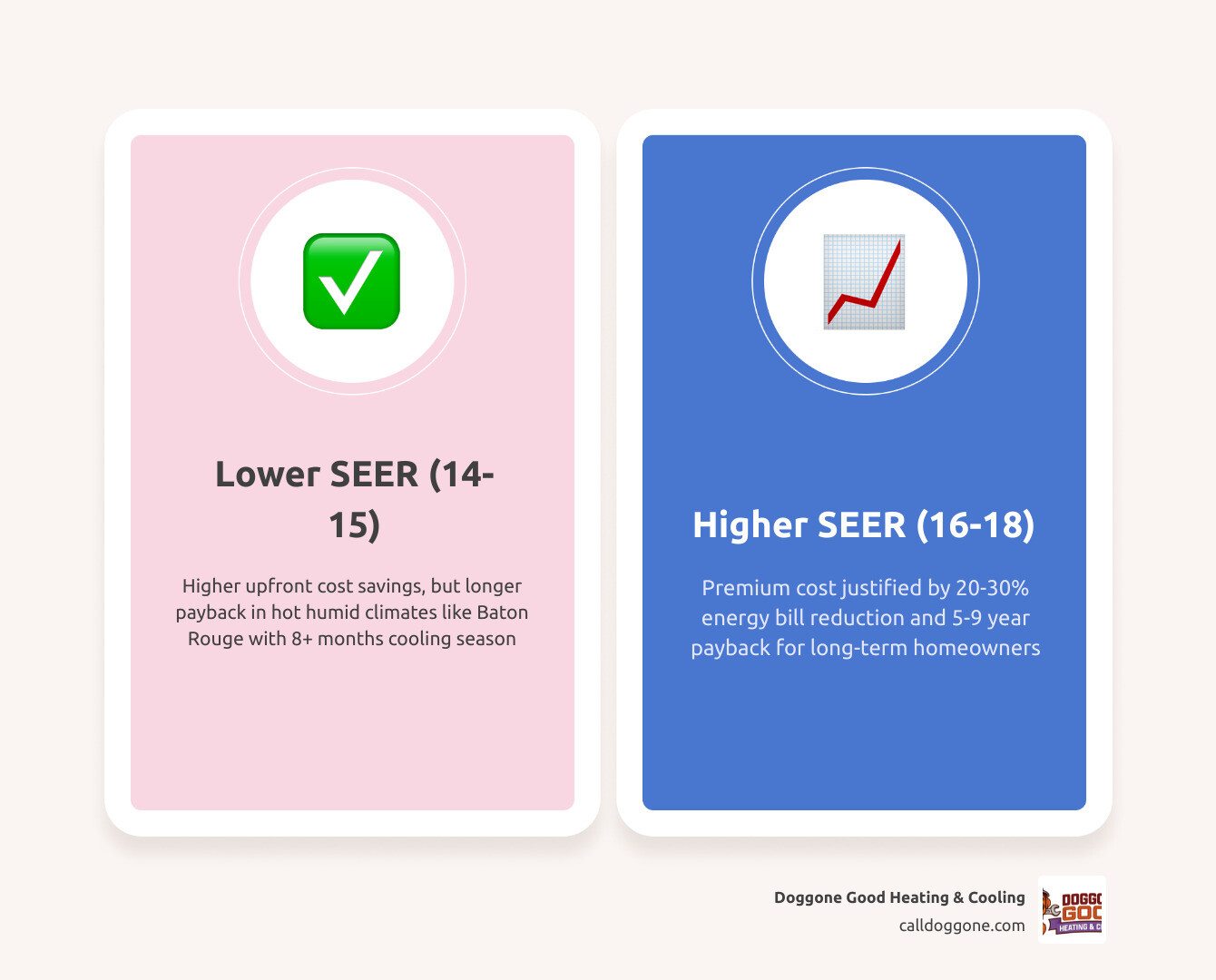
Quick look at is a higher seer rating worth the extra cost:
Understanding SEER, SEER2, and Other Efficiency Metrics
Before diving into the financial math, we need to clarify what these efficiency ratings actually mean. Historically, the standard metric for measuring cooling efficiency has been SEER, which stands for Seasonal Energy Efficiency Ratio. Mathematically, it represents the ratio of cooling output (measured in British Thermal Units, or BTUs) divided by the total electrical energy input (measured in watt-hours) over a typical cooling season.
To put it simply: the higher the SEER number, the more cooling comfort you get for every unit of electricity you buy.
However, the HVAC industry underwent a major regulatory shift that updated how these ratings are calculated. To understand how these changes impact your purchasing decisions today, check out our comprehensive Beginners Guide to SEER2 Ratings for Homeowners.
SEER vs. SEER2: What Changed in 2026?
As of January 1, 2023, the Department of Energy officially transitioned to a new rating system called SEER2. This standard remains the law of the land in 2026.
Why the change? The old SEER testing protocol didn’t accurately mimic real-world conditions. It tested systems in a laboratory setting under very low static pressure, assuming perfectly designed, leak-free ductwork. In reality, most homes have restrictive duct systems that force the air conditioner to work much harder.
The SEER2 testing procedure, known as the M1 testing protocol, uses five times higher static pressure to better replicate the actual conditions in a typical home. Because the test is significantly more demanding, the resulting ratings are lower. On average, a SEER2 rating is roughly 4.5% to 5% lower than its legacy SEER equivalent. For example:
- A legacy 14 SEER unit is roughly equivalent to a 13.4 SEER2 unit.
- A legacy 15 SEER unit is roughly equivalent to a 14.3 SEER2 unit.
- A legacy 16 SEER unit is roughly equivalent to a 15.2 SEER2 unit.
When shopping for a new system, it is crucial to ensure you are comparing apples to apples. Most new equipment lists the SEER2 rating, but some older inventory or marketing materials may still reference legacy SEER. To learn more about utilizing these standards to maximize your cooling efficiency, read our guide on How to Cut Energy Bills in Hot Weather with SEER2 Ratings.
How SEER Compares to EER and HSPF
While SEER2 is the most widely discussed metric, it is not the only efficiency rating that matters when evaluating a new system.
- EER and EER2 (Energy Efficiency Ratio): While SEER measures efficiency over an entire season with fluctuating outdoor temperatures, EER measures efficiency at a single, peak outdoor temperature (specifically 95°F). EER2 is highly relevant for homeowners in places like Baton Rouge and Prairieville. During July and August, our systems run flat-out during the hottest parts of the day. A system with a high SEER2 but a mediocre EER2 might struggle to maintain peak efficiency on those brutal 100°F afternoons.
- HSPF and HSPF2 (Heating Seasonal Performance Factor): If you are installing a heat pump rather than a straight air conditioner, HSPF2 measures the system’s heating efficiency over the winter months. Even though our winters in South Louisiana are relatively mild, a high HSPF2 rating ensures that your utility bills won’t spike during those occasional freezing Zachary or Denham Springs nights.
Is a higher SEER rating worth the extra cost for Baton Rouge homeowners?
Now let’s tackle the core question: is a higher seer rating worth the extra cost?
In our hot, humid climate, the answer is often a resounding yes — but only up to a certain point. To understand why, we have to look at the relationship between efficiency gains and the upfront price premium.
Every point increase in a SEER rating yields roughly an 8% reduction in energy consumption compared to the previous tier. However, the price of the equipment does not scale linearly. Moving from a base-tier system to a mid-range system comes with a moderate upfront premium, but jumping to an ultra-high efficiency system (20+ SEER2) requires a massive leap in equipment costs.
To weigh the financial trade-offs of these different tiers, it helps to read our detailed analysis on Don’t Sweat the Decision: A Guide to High Efficiency AC Pros and Cons.
Calculating the Payback Period of High-Efficiency Systems
To determine if a higher SEER2 rating is worth the investment, we calculate the system’s payback period. This is the amount of time it takes for your monthly utility savings to completely offset the higher upfront equipment premium.
The formula is straightforward:
Payback Period (Years) = Upfront Equipment Premium / Annual Utility Savings
Because our cooling season in South Louisiana is incredibly long — often running from April through October — our systems rack up high annual operating hours. This high usage means that upgrading from a base-tier 14 SEER2 system to a mid-range 16 or 17 SEER2 system typically pays for itself in just 5 to 9 years. Given that a well-maintained air conditioner in Baton Rouge should last 15 to 20 years, you will enjoy many years of pure financial savings after the system pays for itself.
However, if you attempt to upgrade from a 16 SEER2 to an ultra-high 20+ SEER2 system, the math changes. Because of the law of diminishing returns, the incremental energy savings are much smaller, while the equipment premium is exceptionally high. In many cases, the payback period for a 20+ SEER2 system can exceed 19 years, which may actually outlast the lifespan of the air conditioner itself.
When is a higher SEER rating worth the extra cost in humid climates?
In places like Gonzales and Denham Springs, humidity is often a bigger comfort obstacle than the actual temperature. This is where high-SEER systems truly shine, offering benefits that go far beyond simple utility bill math.
Standard-efficiency systems (14 to 15 SEER2) typically use single-stage compressors. These systems operate like a light switch: they are either 100% on or 100% off. Because they blast cold air at full capacity, they tend to cool the home quickly and shut off. These short cycles do not give the system enough time to pull moisture out of the air, leaving you with a home that feels cold but clammy.
Mid-to-high SEER systems (16 to 18 SEER2) often utilize two-stage compressors, while ultra-high systems (20+ SEER2) use variable-speed (inverter-driven) compressors. These advanced systems can run at lower capacities (often down to 30% of peak power) for longer, continuous periods.
By running continuously at a lower speed, a high-efficiency system:
- Removes up to twice as much humidity from your indoor air.
- Eliminates hot and cold spots throughout the house.
- Operates much more quietly.
- Prevents the constant on-and-off cycling that causes wear and tear on electrical components.
Because the air is properly dehumidified, you can actually set your thermostat a couple of degrees higher without sacrificing comfort, which saves you even more on your monthly energy bills.
When is a higher SEER rating worth the extra cost to avoid?
While we love high-efficiency technology, we are always honest with our customers. There are several scenarios where paying extra for a high SEER rating simply does not make financial sense:
- Short-Term Residency: If you plan to sell your home and move within the next 3 to 5 years, you will not live in the home long enough to recoup the upfront premium through utility savings. While a high-efficiency system can slightly boost home resale value, you rarely get a dollar-for-dollar return on that investment.
- Mismatched Systems: If you attempt to save money by replacing only your outdoor condenser with a high-SEER unit while leaving your old, dirty indoor air handler in place, you will not achieve the rated efficiency. In fact, mismatched systems can lead to premature compressor failure and void your manufacturer warranty. For more guidance on this critical decision, consult our HVAC Repair vs Replacement Cost Guide for Smart Homeowners.
- Complex Future Repairs: High-SEER units utilize highly sophisticated electronics, variable-speed motors, and proprietary control boards. When these parts eventually fail out of warranty, their replacement parts typically cost 10% to 20% more than standard single-stage components. If you prefer simple, low-cost maintenance down the road, a mid-range system is usually the safer bet.
Real-World Factors That Impact Your Actual SEER Performance
It is a common misconception that buying an 18 SEER2 air conditioner guarantees 18 SEER2 efficiency. In the real world, an air conditioner is not a plug-and-play appliance like a refrigerator. It is a complex system that must be custom-installed and integrated into your home.
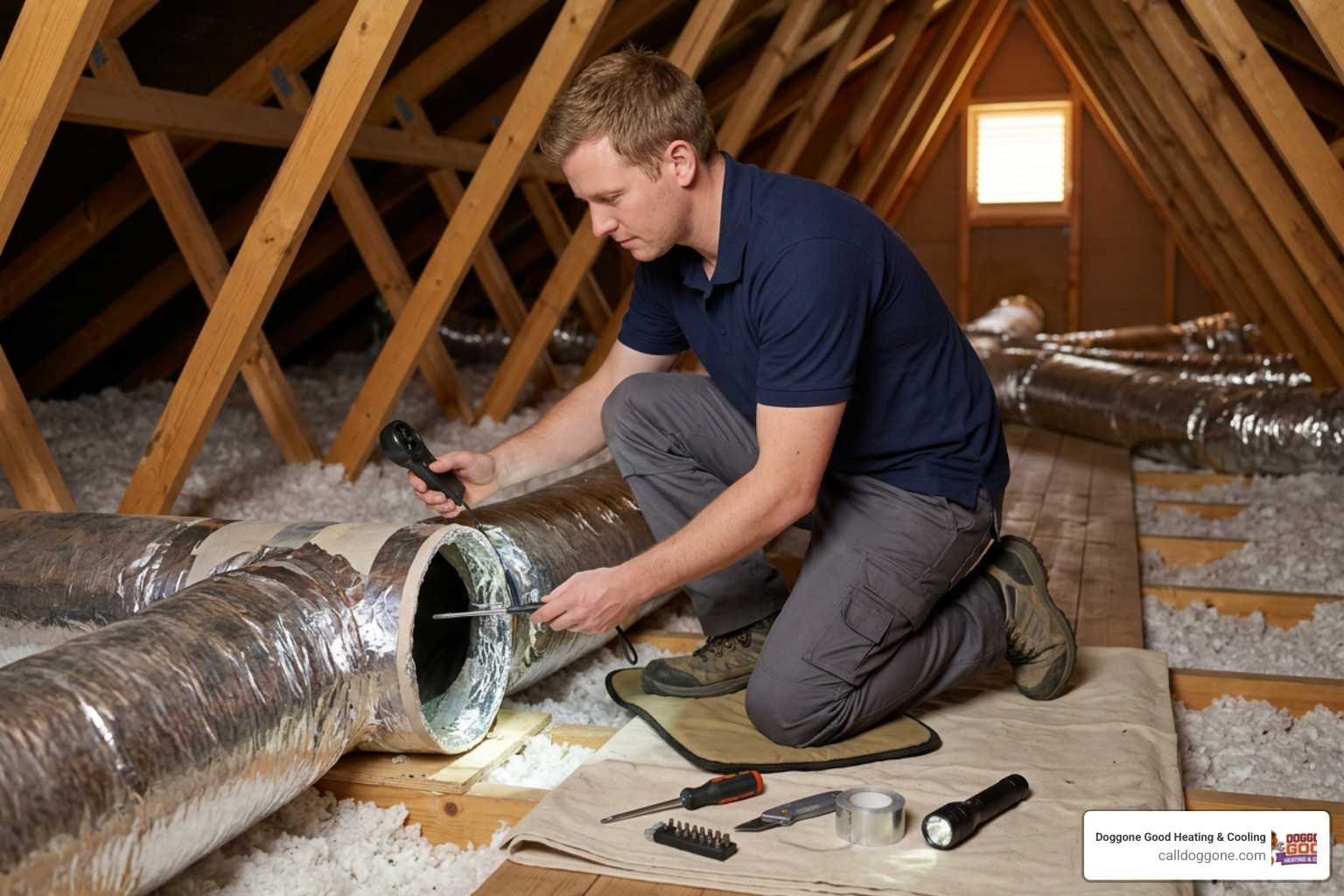
Several critical factors can severely degrade the real-world performance of a high-efficiency system:
- Installation Quality: Proper installation is the single most important factor in achieving your system’s rated efficiency. If the refrigerant charge is slightly off, or if the airflow is not properly balanced, a premium 18 SEER2 system can easily perform like a standard 14 SEER2 unit.
- System Sizing: Some contractors use outdated “rules of thumb” to size systems based solely on square footage. To get the true efficiency you paid for, your contractor must perform a detailed Manual J load calculation. This calculation accounts for your home’s insulation levels, window orientations, air infiltration rates, and local climate. An oversized system will short-cycle constantly, destroying its efficiency and humidity-removal capabilities.
- Ductwork Integrity: Leaky, uninsulated ductwork in a hot attic can waste up to 30% of your system’s cooling energy. If you connect a brand-new high-SEER unit to collapsed or leaky ducts, you are essentially throwing your energy savings right out of the cracks.
To keep your system running at peak performance year after year, be sure to follow our comprehensive AC Maintenance Checklist to Lower Energy Bills.
Frequently Asked Questions About SEER Ratings
What SEER2 rating qualifies for federal tax credits and rebates in 2026?
Under the Inflation Reduction Act, homeowners can take advantage of the 25C Energy Efficient Home Improvement Credit. For split-system central air conditioners installed in 2026, the system must meet or exceed 16.0 SEER2 and 12.0 EER2 to qualify for a federal tax credit of up to $600.
If you choose to install a qualifying high-efficiency heat pump instead, you may be eligible for a tax credit of up to $2,000. Additionally, local utility companies in the Baton Rouge area occasionally offer promotional rebates for upgrading to certified high-efficiency systems, which can significantly shorten your payback period.
What SEER rating is the best balance of cost and savings for most homes?
For the vast majority of homeowners in Baton Rouge, Prairieville, and surrounding areas, the “sweet spot” lies in the 15 to 17 SEER2 range (which corresponds to roughly 16 to 18 in legacy SEER ratings).
Systems in this tier are usually equipped with two-stage compressors. This gives you a massive jump in comfort and humidity control compared to entry-level single-stage units, while keeping the upfront equipment premium reasonable. It also allows you to qualify for federal tax credits and utility rebates, maximizing your return on investment.
Do high-SEER systems require special maintenance or have higher repair costs?
High-SEER systems do not require a different maintenance schedule than standard units, but keeping up with annual preventative maintenance is far more critical for them. Because these systems utilize advanced variable-speed blowers and electronic expansion valves, dirty coils or clogged filters can trigger system faults more easily than they would on a simpler, older unit.
Furthermore, because high-SEER replacement parts can cost 10% to 20% more than standard parts, protecting your system under a preventative maintenance agreement is a smart way to avoid costly out-of-warranty repairs.
Conclusion
At the end of the day, deciding if a higher SEER rating is worth the extra cost comes down to balancing your budget, your long-term comfort goals, and how long you plan to stay in your home. In our hot and humid South Louisiana climate, upgrading to a mid-range, high-efficiency system is almost always a smart financial move that pays off in lower utility bills and a much more comfortable, dehumidified home.
At Doggone Good Heating & Cooling, we are proud to serve our neighbors in Baton Rouge, Prairieville, Denham Springs, Zachary, and Gonzales with honest, reliable advice. We never push ultra-high-efficiency systems on homeowners if the math doesn’t make sense for their specific situation.
If you want to keep your new system running at peak efficiency for its entire lifespan, we highly recommend looking into our affordable Pack Perks Membership, which includes seasonal tune-ups, priority service, and exclusive discounts on repairs.
Ready to find the perfect efficiency sweet spot for your home? Contact us today to schedule a professional consultation and explore our Doggone Good Heating & Cooling energy efficiency services.
{"@context": "https://schema.org", "@graph": [{"@type": "Article", "headline": "Higher SEER Rating Cost | Doggone Good Heating & Cooling", "description": "Wondering is a higher SEER rating worth the extra cost in Baton Rouge? Compare savings, payback, and smart AC upgrade tips. Call today.", "author": {"@type": "Person", "name": "Arthur Lancaster"}, "publisher": {"@type": "Organization", "name": "Doggone Good Heating & Cooling", "logo": {"@type": "ImageObject", "url": "https://calldoggone.com/wp-content/uploads/2025/04/menu-logo.png"}}, "datePublished": "2026-06-30T02:48:12+00:00", "dateModified": "2026-06-30T02:48:29.722115", "mainEntityOfPage": {"@type": "WebPage", "@id": "https://calldoggone.com/blog/a-comprehensive-guide-to-higher-seer-rating-costs/"}, "image": "https://images.bannerbear.com/direct/4mGpW3zwpg0ZK0AxQw/requests/000/149/693/742/nE38ekNX9Qn4oMaDzMamprWxZ/54cdc6044900d6c55f894578c0cf8dce785ce299.jpg"}, {"@type": "FAQPage", "mainEntity": [{"@type": "Question", "name": "Is a higher SEER rating worth the extra cost in Baton Rouge, LA?", "acceptedAnswer": {"@type": "Answer", "text": "Yes, a higher SEER rating is often worth it in Baton Rouge because the area has extreme heat, high humidity, and eight or more months of heavy cooling demand. A mid-range efficiency upgrade can create real energy bill savings, especially when moving from an older or lower-efficiency system."}}, {"@type": "Question", "name": "What SEER rating is best for a hot and humid climate like Baton Rouge?", "acceptedAnswer": {"@type": "Answer", "text": "For Baton Rouge homeowners, the article identifies 16-18 SEER2 as the best efficiency tier for long cooling seasons. This range can provide strong payback, often in about 5-9 years."}}, {"@type": "Question", "name": "Is it worth upgrading from 14 SEER to 16 SEER in the South?", "acceptedAnswer": {"@type": "Answer", "text": "Usually, yes. The article says the jump from 14 SEER to 16 SEER delivers a meaningful efficiency gain in the South and may qualify for tax credits."}}, {"@type": "Question", "name": "Is upgrading from 16 SEER to 20 SEER worth it?", "acceptedAnswer": {"@type": "Answer", "text": "Upgrading from 16 SEER to 20+ SEER is usually worth it only for comfort features, not energy savings alone. At higher efficiency levels, diminishing returns can make the payback period longer than the system’s lifespan."}}, {"@type": "Question", "name": "What does SEER mean for an air conditioner?", "acceptedAnswer": {"@type": "Answer", "text": "SEER stands for Seasonal Energy Efficiency Ratio and is the historical standard metric for measuring cooling efficiency. It represents the ratio of cooling output, measured in British Thermal Units, to energy use over a cooling season."}}]}]}About the Author
Doggone Good Heating and Cooling
Doggone Good Heating and Cooling — your local HVAC experts in Baton Rouge, LA.
Need HVAC Service?
Get a free estimate or schedule your service today. Our team is ready to help.
Recent Posts


Related Articles
Ready to Get Started?
Prefer to Call?
Talk with a local technician and get clear next steps for your home.
Call Now(225) 230-9784