How to Compare AC Efficiency Ratings Easily
Doggone Good Heating and Cooling


Learn how to compare AC efficiency ratings like SEER2 and EER2 to choose the right system for your climate and save on energy costs.
Why Knowing How to Compare AC Efficiency Ratings Can Save You Real Money in Baton Rouge
If you want to know how to compare AC efficiency ratings, here is the short answer:
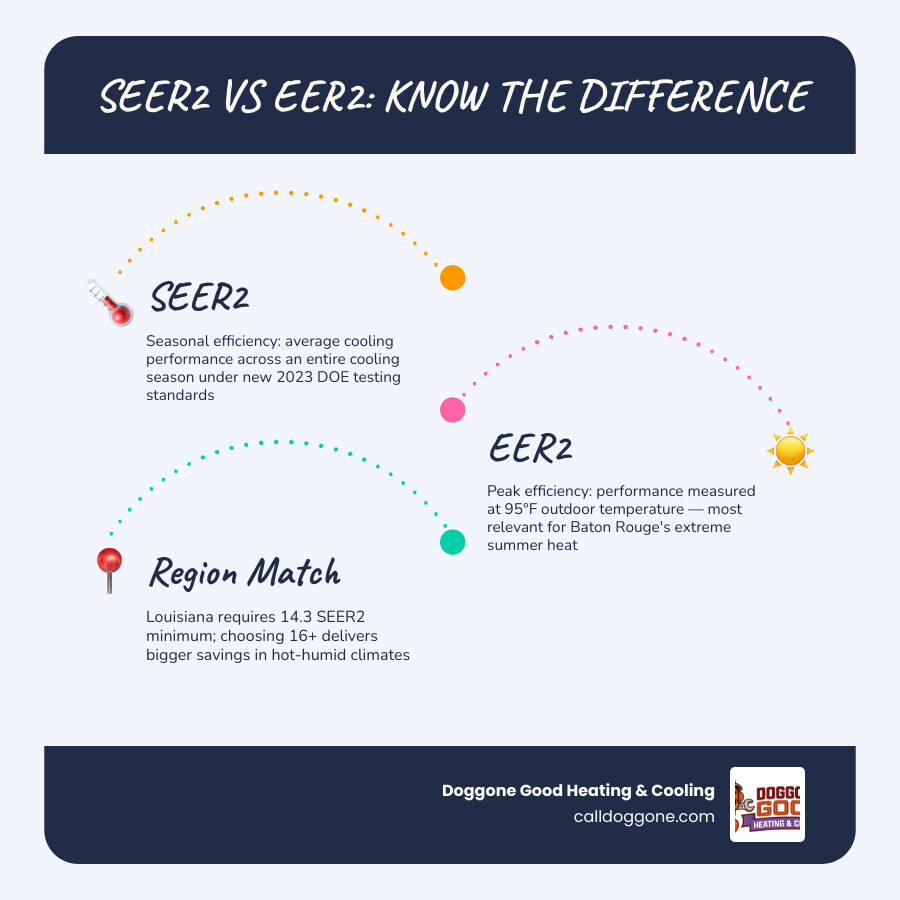
- Look at SEER2 first — it measures average seasonal cooling efficiency and is the current DOE standard for all new systems sold since January 2023.
- Check EER2 second — it measures peak efficiency on the hottest days, which matters a lot in hot-humid climates like Baton Rouge.
- Match the rating to your region — Louisiana falls in the Southeast zone, where the federal minimum is 14.3 SEER2.
- Go higher for bigger savings — 16 SEER2 is mid-range, 18 SEER2 is high-efficiency, and 20+ SEER2 is ultra-efficient.
- Remember the rating is only part of the picture — installation quality, duct condition, and proper sizing all affect real-world performance.
Baton Rouge summers are brutal. The heat runs long, the humidity never really lets up, and your air conditioner works harder here than it would almost anywhere else in the country. That means your AC’s efficiency rating has a direct, measurable impact on what you pay every month from May through October — and beyond.
The problem is that shopping for a new AC unit means wading through a sea of numbers: SEER, SEER2, EER, EER2. These ratings were updated by the Department of Energy in 2023, and many homeowners are still unclear on what changed and why it matters. Getting this right can mean the difference between a system that pays for itself over time and one that quietly drains your wallet for the next 15 years.
Decoding the Metrics: What Do SEER2, SEER, EER2, and EER Mean?
To understand how to compare AC efficiency ratings, we have to start with the alphabet soup of the HVAC industry. At their core, these ratings are mathematical ratios. They measure how much cooling comfort you get out of a system compared to how much electricity it pulls from your electrical panel.
The primary metrics you will see on any modern air conditioner include:
- SEER (Seasonal Energy Efficiency Ratio): This is the legacy standard that was used for decades. It measures the total cooling output of an air conditioner over a typical cooling season divided by the total electric energy input during that same time frame. Think of it like your car’s average miles-per-gallon (MPG) rating over a mix of highway and city driving.
- SEER2 (Seasonal Energy Efficiency Ratio 2): Effective January 1, 2023, the Department of Energy (DOE) mandated this updated rating. It uses the exact same fundamental math as SEER but changes the laboratory testing environment to better mimic how systems actually operate inside real homes.
- EER (Energy Efficiency Ratio): Unlike SEER, which averages out performance over a whole season of fluctuating temperatures, EER is a steady-state measurement. It calculates how efficiently the system runs at a single, high-stress temperature: exactly 95°F outdoor temperature, 80°F indoor temperature, and 50% relative humidity.
- EER2 (Energy Efficiency Ratio 2): Just like SEER2, EER2 is the modern version of EER, tested under updated laboratory standards that reflect realistic home ductwork conditions.
If you want to dive deeper into the basics of these modern efficiency standards, check out our Beginner’s Guide to SEER2 Ratings for Homeowners.
The Core Differences: SEER vs. SEER2
Why did the Department of Energy change a system that had been working for decades? The answer comes down to real-world accuracy.
The old SEER testing protocol (often called the M1 standard) assumed that residential ductwork was virtually perfect. It tested systems under an external static pressure of only 0.1 inches of water column (in. w.c.). In reality, almost no home has ductwork that free-flowing. Between bends, registers, grilles, and typical dust buildup, real-world static pressure is much higher.
The new SEER2 testing procedure increases this static pressure testing requirement five-fold, raising it to 0.5 in. w.c. Because the system’s blower motor has to work significantly harder to push air against this realistic resistance, the system consumes more power during the test.
As a result, SEER2 ratings are approximately 4.7% lower than equivalent SEER ratings for the exact same physical piece of equipment. For example, a system that was rated at 15 SEER under the old standards will typically carry a 14.3 SEER2 rating today. It is important to remember that the physical equipment didn’t become less efficient; rather, the test simply became more honest.
Peak vs. Seasonal Performance: EER2 vs. SEER2
When learning how to compare AC efficiency ratings, homeowners often ask whether they should look at SEER2 or EER2. The answer depends heavily on where you live and how you use your system.
- SEER2 represents the long game. It accounts for seasonal temperature swings ranging from 65°F to 104°F. It is the best metric for estimating your overall cooling bills over the course of an entire spring, summer, and autumn.
- EER2 represents peak performance. It tells you how well your system will perform when the afternoon sun is beating down on your roof, the outdoor temperature is hovering in the mid-90s, and your system is running flat-out at 100% capacity.
In dry, desert climates like Arizona or Nevada, EER2 is heavily prioritized because the system operates under extreme, steady-state heat for months on end. In hot-humid climates like Baton Rouge, Prairieville, and Gonzales, both metrics are highly valuable. We have long, humid seasons where the AC runs at partial capacity to manage moisture (making SEER2 critical), but we also experience prolonged stretches of intense summer heat where peak efficiency (EER2) saves significant money on peak-load electricity rates.
How to Compare AC Efficiency Ratings for Your Climate and Region
The Department of Energy does not treat the entire United States the same way. Because weather patterns vary drastically, the federal government enforces regional minimum efficiency standards. If you are replacing an air conditioner, you must select a system that complies with the minimum standards set for your specific geographic zone.
To understand how these standards impact your purchasing options, it helps to explore our comprehensive breakdown of HVAC Services Energy Efficiency.
Regional Minimum Standards: North vs. South
The United States is divided into three primary regulatory regions: the North, the Southeast, and the Southwest.
- The Northern Region: Homeowners in cooler states have a federal minimum standard of 13.4 SEER2 (equivalent to the old 14 SEER) for split-system air conditioners.
- The Southeast Region (including Louisiana): Because we experience much higher cooling loads, our minimum standard is higher. All new split-system air conditioners installed in Baton Rouge, Denham Springs, and Zachary must meet a minimum of 14.3 SEER2 (equivalent to the old 15 SEER).
- The Southwest Region: This zone also requires a minimum of 14.3 SEER2, but adds strict minimum EER2 requirements to account for the extreme dry heat.
For heat pumps, the standards are unified nationwide. All residential split-system heat pumps must meet a minimum of 14.3 SEER2 and 7.5 HSPF2 (Heating Seasonal Performance Factor 2).
What is a Good SEER2 Rating for Baton Rouge Homes?
If 14.3 SEER2 is the bare minimum we can legally install in Louisiana, what should you actually aim for? We generally divide residential equipment into four distinct tiers:
- Standard Efficiency (14.3 to 15 SEER2): These systems meet the baseline federal mandates. They are reliable, have the lowest upfront cost, and are great for tight budgets or for homes you do not plan to live in for more than a few years.
- Mid-Range Efficiency (15.2 to 17 SEER2): This tier offers an excellent balance of upfront affordability and long-term utility savings. They often qualify for local utility rebates.
- High-Efficiency (17.2 to 19 SEER2): These units provide substantial monthly utility savings and superior indoor comfort. They almost always utilize multi-stage or variable-speed compressors, which are phenomenal at pulling humidity out of the sticky Louisiana air.
- Ultra-High Efficiency (20+ SEER2): These are premium, top-of-the-line systems. They represent the absolute pinnacle of energy savings, quiet operation, and precise climate control.
Calculating Your Savings: Upgrading to High-Efficiency Systems
The average American household spends around $2,000 per year on energy bills, with roughly half of that total going directly to heating and cooling. In South Louisiana, where our air conditioners run for up to nine months out of the year, that HVAC portion is often much higher.
Upgrading an older, inefficient system can yield incredible financial returns. For instance, upgrading from an older 10 SEER unit to a modern 20 SEER2 system can reduce energy consumption by roughly 50%. Even moving from a standard 14 SEER rating to a high-efficiency 20 SEER2 rating can result in energy savings of up to 30% or more.
To help you visualize how to compare AC efficiency ratings in terms of actual power consumption, look at the relative efficiency improvements below:
| Current System Rating | Upgraded System Rating | Estimated Cooling Energy Savings |
|---|---|---|
| 9 SEER (Legacy) | 14.3 SEER2 (Standard) | 35% to 40% Savings |
| 10 SEER (Legacy) | 16 SEER2 (Mid-Range) | 40% to 45% Savings |
| 14 SEER2 (Standard) | 18 SEER2 (High-Efficiency) | ~20% Savings |
| 14 SEER2 (Standard) | 20 SEER2 (Ultra-Efficient) | ~43% Savings |
For a detailed look at the financial and comfort-related trade-offs of investing in these higher tiers, read our guide: Don’t Sweat the Decision: A Guide to High Efficiency AC Pros and Cons.
Single-Stage vs. Variable-Speed: How to Compare AC Efficiency Ratings
You cannot fully understand how to compare AC efficiency ratings without looking at the technology inside the cabinet. The type of compressor your system uses dictates how it achieves its SEER2 rating and how comfortable your home will feel.
- Single-Stage Systems: These systems operate like a light switch — they are either 100% on or 100% off. When your thermostat calls for cooling, the system blasts cold air at full capacity until the target temperature is met, then shuts down. These systems are common in the 14.3 to 15 SEER2 range.
- Two-Stage Systems: These units have a high and a low setting (typically running at about 65% capacity on low and 100% on high). They run for longer, gentler cycles on the low setting, which saves energy and provides more consistent dehumidification.
- Variable-Speed (Inverter) Systems: These systems can adjust their output incrementally anywhere from 30% to 100% capacity. They operate continuously at incredibly low speeds, matching the exact cooling needs of your home in real-time.
Because variable-speed systems avoid the massive energy spikes associated with frequently turning on and off, they easily reach 18 to 25+ SEER2. More importantly for our local climate in Prairieville and Zachary, their long, slow run cycles allow them to constantly pull moisture out of the air, keeping your home feeling cool and dry even when it is 90% humidity outside.
Balancing Upfront Investment with Long-Term Utility Savings
When choosing a SEER2 rating, you must balance the upfront purchase price against the expected lifetime utility savings.
If you plan to move out of your home within two to three years, a standard 14.3 SEER2 system is often the most practical choice. However, if you are in your “forever home” in Denham Springs or Gonzales, investing in a high-efficiency 16 to 18+ SEER2 system makes immense financial sense. The payback period — the time it takes for monthly utility savings to completely offset the higher initial equipment cost — typically ranges from five to eight years. Over a system’s 15-year lifespan, a high-efficiency unit can easily save you thousands of dollars.
To learn more about prioritizing home improvements that yield the best return on investment, explore our article on Energy Upgrades That Literally Pay for Themselves.
Real-World Factors That Impact Your System’s Actual Efficiency
Here is an industry secret that many HVAC manufacturers won’t tell you: the SEER2 rating on the yellow EnergyGuide label is a best-case scenario.
A system rated at 18 SEER2 will only deliver 18 SEER2 efficiency if it is sized correctly, installed flawlessly, paired with pristine ductwork, and maintained meticulously. If any of these factors are off, your high-efficiency system can easily perform like a standard-efficiency unit.
To find out where your home might be losing precious conditioned air, you can read our guide on How to Identify Waste with a Home Energy Audit.
Why Installation Quality and Sizing Matter
If an air conditioner is oversized for your home, it will suffer from a phenomenon known as “short cycling.” It will turn on, rapidly cool down the air in your home before it has a chance to pull out the humidity, and shut back off. This constant on-and-off cycling places immense wear and tear on the electrical components and destroys the system’s operational efficiency. Conversely, an undersized system will run continuously without ever cooling your home, wasting massive amounts of electricity.
To prevent this, a professional contractor must perform an ACCA Manual J load calculation. This calculation takes into account your home’s total square footage, wall heights, window orientations, insulation values, and local climate data to determine the exact BTU capacity your home requires.
Furthermore, field studies show that up to 50% of new HVAC installations fail to deliver their rated efficiency due to basic installation errors, such as incorrect refrigerant charge. In fact, a system undercharged by just 10% loses approximately 20% of its cooling efficiency.
To learn more about how we calculate the perfect system size for your property, visit our resource on Load Calculations & System Sizing or read our guide on What Size Air Conditioner Do You Need for Your Home?.
The Role of Ductwork and Maintenance: How to Compare AC Efficiency Ratings
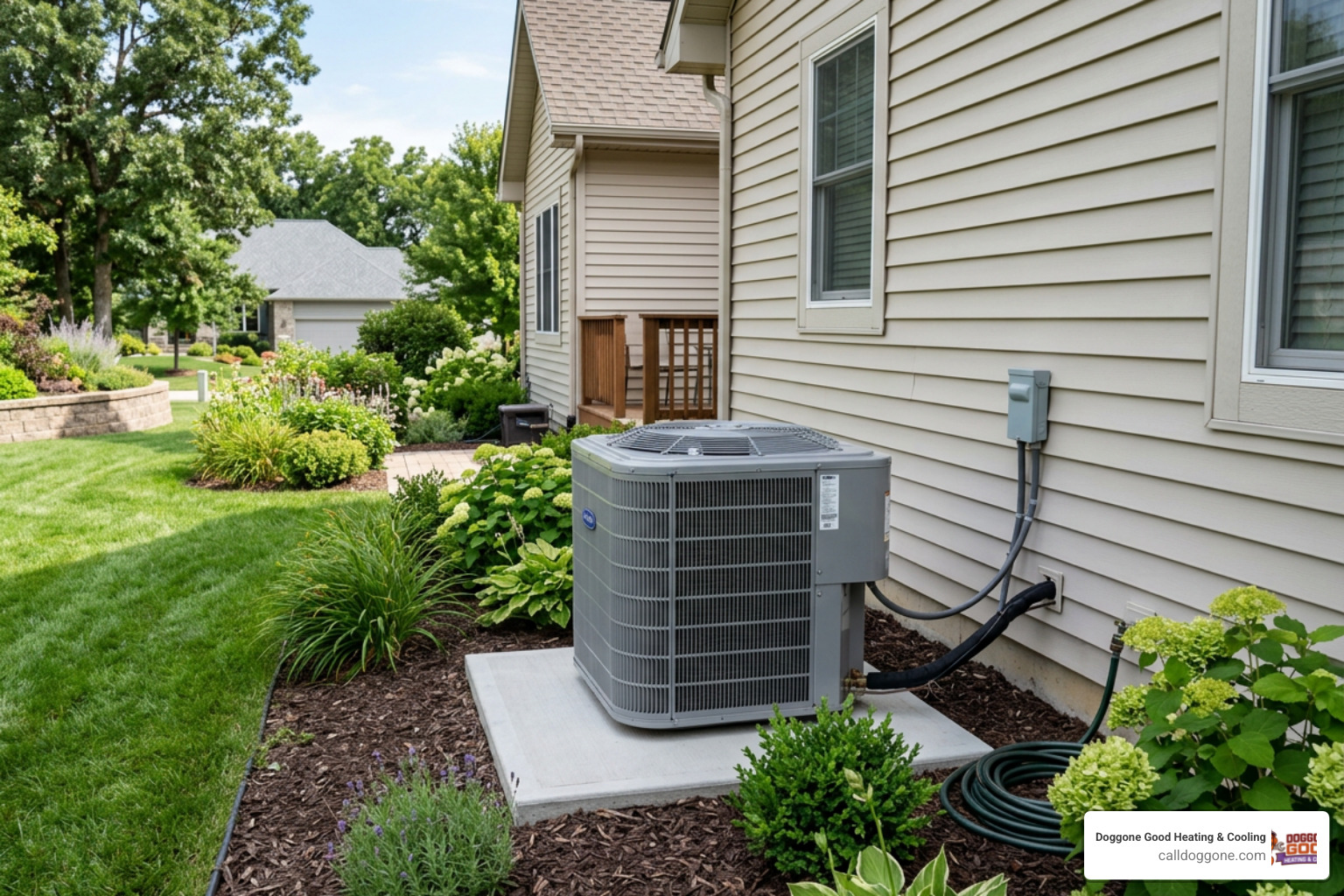
Even the most efficient outdoor condenser unit is at the mercy of your home’s ductwork. The average American home loses 20 to 30 percent of conditioned air through duct leakage alone. If your ducts are run through a scorching hot Louisiana attic and have unsealed joints, you are paying to cool your attic space rather than your living room.
Additionally, ongoing maintenance is crucial for protecting your system’s efficiency rating over time. Airflow is the lifeblood of an HVAC system. When dust and dirt build up on your system’s indoor evaporator coil, it acts as an insulating blanket. A coil with just 1/16 inch of dust buildup can drop cooling efficiency by 21 percent.
To keep your system running like the day it was installed, check out these essential maintenance guides:
- How to Keep Your AC Running Efficiently All Summer
- AC Maintenance Checklist to Lower Energy Bills
- How Regular Maintenance Keeps Your Bank Account from Breaking
Financial Incentives: Tax Credits and Rebates Under the Inflation Reduction Act
To make high-efficiency upgrades more accessible, the federal government offers substantial financial incentives under the Inflation Reduction Act.
Through the 25C Energy Efficient Home Improvement Credit, homeowners can claim a federal tax credit of 30% of the total installation cost (up to $2,000) for qualifying air-source heat pumps. For qualified central air conditioners, the tax credit is capped at $600.
To qualify for these federal incentives, the equipment must meet strict Energy Star efficiency minimums, which generally require split-system air conditioners to achieve at least 16 SEER2 and split-system heat pumps to meet at least 16 SEER2 and 15.2 EER2.
Additionally, local utility companies in the Baton Rouge area frequently offer direct rebates ranging from several hundred to over a thousand dollars for upgrading to high-efficiency systems. When you combine these rebates with federal tax credits, the upfront cost difference between a standard system and a high-efficiency system becomes incredibly small.
Frequently Asked Questions About AC Efficiency Ratings
What is the difference between SEER and SEER2?
SEER2 is the updated version of the original SEER rating system, made mandatory by the DOE in 2023. The core difference is that SEER2 testing uses five times higher external static pressure (0.5 in. w.c. vs 0.1 in. w.c.) to better represent real-world ductwork conditions. Because of this tougher test, SEER2 ratings are about 4.7% lower than old SEER numbers for the same unit.
How much can I save by upgrading to a 20 SEER2 system?
It depends on what you are upgrading from. Upgrading from an older 10 SEER unit to a modern 20 SEER2 system can cut your cooling energy consumption by roughly 50%. If you are upgrading from a standard 14 SEER2 system to a 20 SEER2 system, you can expect up to a 43% boost in efficiency, translating to significant monthly savings on your utility bills.
Which SEER2 ratings qualify for federal tax credits?
Under the 25C tax program, split-system central air conditioners must typically meet or exceed 16 SEER2 and 12 EER2 to qualify for the $600 tax credit. Split-system heat pumps must generally meet at least 16 SEER2, 12 EER2, and 9 HSPF2 to qualify for the more substantial tax credit of up to $2,000.
Conclusion
Knowing how to compare AC efficiency ratings is the first step toward taking control of your home comfort and your monthly utility bills. While the numbers, ratings, and testing protocols can feel overwhelming, focusing on SEER2 for seasonal averages and EER2 for peak summer performance will give you a clear picture of how any system will perform in our demanding South Louisiana climate.
However, an efficiency rating is only as good as the team installing the system. At Doggone Good Heating & Cooling, we provide honest, reliable, and locally attuned HVAC services across Baton Rouge, Prairieville, Denham Springs, Zachary, and Gonzales. Whether you need a precise Manual J load calculation, a high-efficiency system replacement, or a preventative tune-up to keep your current unit running at peak performance, our team is here to help 24/7.
Ready to maximize your home’s energy efficiency and slash your utility bills? Contact us today to schedule your personalized consultation, and don’t forget to ask about our affordable Pack Perks Membership to keep your system running flawlessly all year long!
Learn more about our energy-saving options by visiting our HVAC Services Energy Efficiency page.
{"@context": "https://schema.org", "@graph": [{"@type": "Article", "headline": "How to Compare AC Efficiency Ratings | Doggone Good", "description": "Learn how to compare AC efficiency ratings like SEER2 and EER2 for Baton Rouge homes. Get expert HVAC tips and save on cooling costs today.", "author": {"@type": "Person", "name": "Arthur Lancaster"}, "publisher": {"@type": "Organization", "name": "Doggone Good Heating & Cooling", "logo": {"@type": "ImageObject", "url": "https://calldoggone.com/wp-content/uploads/2025/04/menu-logo.png"}}, "datePublished": "2026-06-26T02:48:40+00:00", "dateModified": "2026-06-26T02:48:51.202078", "mainEntityOfPage": {"@type": "WebPage", "@id": "https://calldoggone.com/blog/how-to-compare-ac-efficiency-ratings-easily/"}, "image": "https://images.bannerbear.com/direct/4mGpW3zwpg0ZK0AxQw/requests/000/149/366/142/nE38ekNX9Qn4qWoyzMamprWxZ/c6571d6c211d2c2bc0c690f4c8c47ea6af4ca0ae.jpg"}, {"@type": "FAQPage", "mainEntity": [{"@type": "Question", "name": "How do I compare AC efficiency ratings?", "acceptedAnswer": {"@type": "Answer", "text": "Look at SEER2 first because it measures average seasonal cooling efficiency and is the current DOE standard for new systems sold since January 2023. Check EER2 second because it measures peak efficiency on the hottest days, which is especially important in hot, humid climates like Baton Rouge."}}, {"@type": "Question", "name": "What is SEER2 for air conditioners?", "acceptedAnswer": {"@type": "Answer", "text": "SEER2, or Seasonal Energy Efficiency Ratio 2, is the updated DOE efficiency rating effective January 1, 2023. It measures how much seasonal cooling output an air conditioner provides compared with the electricity it uses."}}, {"@type": "Question", "name": "What is the minimum SEER2 rating in Louisiana?", "acceptedAnswer": {"@type": "Answer", "text": "Louisiana is in the Southeast zone, where the federal minimum efficiency standard is 14.3 SEER2. Homeowners can choose higher-rated systems for greater potential energy savings."}}, {"@type": "Question", "name": "What SEER2 rating is considered high efficiency?", "acceptedAnswer": {"@type": "Answer", "text": "A 16 SEER2 system is described as mid-range, 18 SEER2 is high-efficiency, and 20+ SEER2 is ultra-efficient. Higher ratings generally offer bigger savings, especially during long cooling seasons."}}, {"@type": "Question", "name": "Do AC efficiency ratings guarantee lower energy bills?", "acceptedAnswer": {"@type": "Answer", "text": "Efficiency ratings are important, but they are only part of real-world performance. Installation quality, duct condition, and proper system sizing also affect how efficiently an AC system operates."}}]}]}About the Author
Doggone Good Heating and Cooling
Doggone Good Heating and Cooling — your local HVAC experts in Baton Rouge, LA.
Need HVAC Service?
Get a free estimate or schedule your service today. Our team is ready to help.
Recent Posts


Related Articles
Ready to Get Started?
Prefer to Call?
Talk with a local technician and get clear next steps for your home.
Call Now(225) 230-9784