Everything You Need to Know About Average HVAC Lifespan in Humid Climates
Doggone Good Heating and Cooling

Discover the average lifespan of an HVAC system in humid climates and learn how Baton Rouge homeowners can maximize comfort and efficiency with expert local care.
How Long Does an HVAC System Really Last in a Humid Climate?
The average lifespan of an HVAC system in humid climates like Baton Rouge, Louisiana is significantly shorter than what most homeowners expect. Here’s a quick breakdown:
| System Type | Humid Climate Lifespan | National Average |
|---|---|---|
| Central Air Conditioner | 10-15 years | 15-20 years |
| Heat Pump | 8-14 years | 10-15 years |
| Ductless Mini-Split | 15-20 years | 15-20 years |
| Package Unit | 8-12 years | 12-15 years |
If your system is approaching or past that 10-year mark and you live somewhere hot and humid, it’s worth paying close attention.
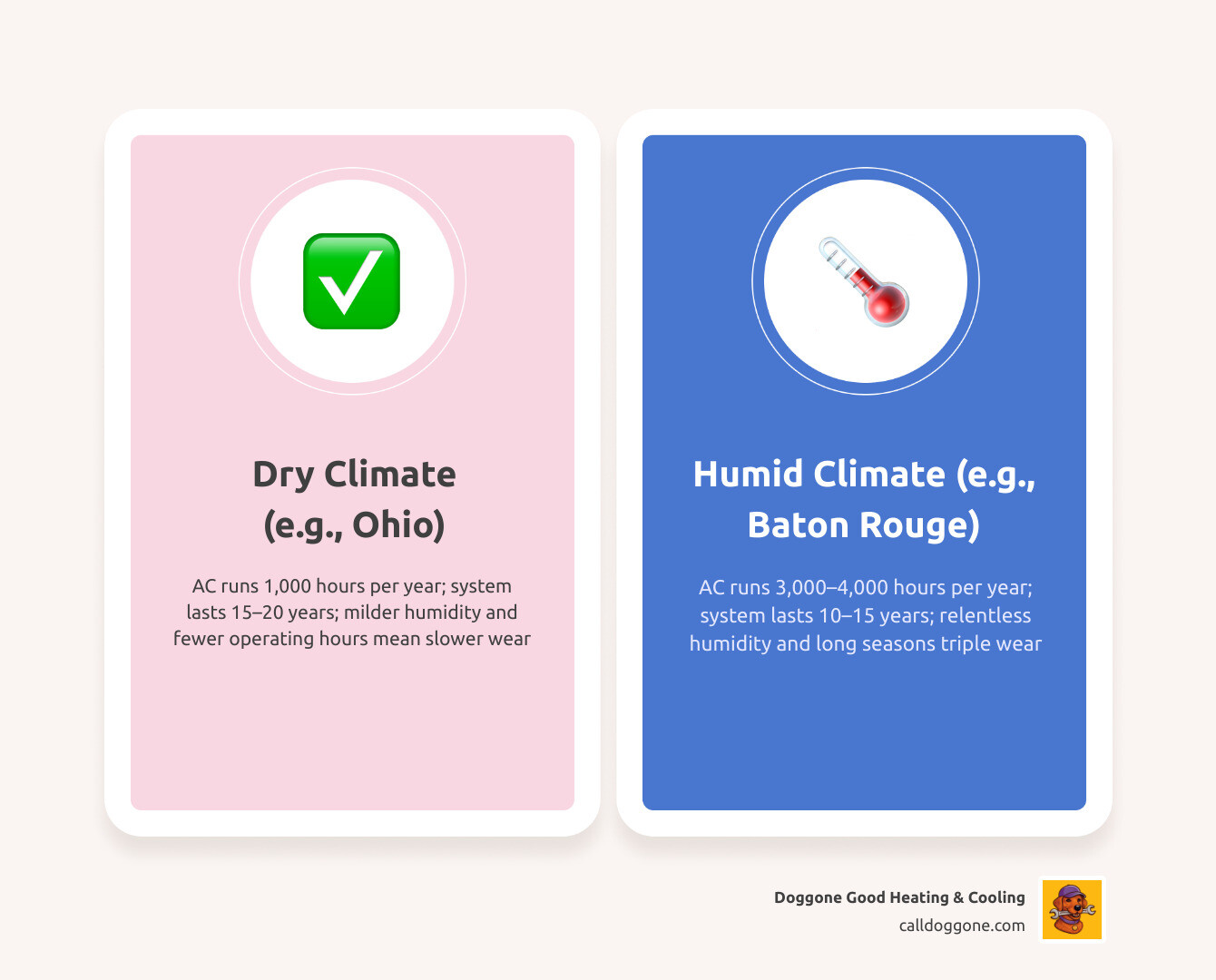
Here in South Louisiana, the air never really takes a break. Neither does your HVAC system. While a homeowner in Ohio might run their AC for around 1,000 hours a year, systems in humid Gulf Coast climates like Baton Rouge routinely log 3,000 to 4,000 operating hours annually. That’s not just a longer season – it’s the equivalent of aging your system at three to four times the normal rate.
Think of it less like a calendar and more like mileage on a car. A system that’s only six or seven years old in Baton Rouge may already have accumulated the same wear as a fifteen-year-old unit in a northern state.
Add in relentless humidity, corrosive air, heavy pollen, thunderstorm power surges, and the occasional flooding risk, and you’ve got a recipe for early system failure – unless you know what to watch for and how to stay ahead of it.
This guide breaks down exactly what shortens HVAC life in humid regions, which systems hold up best, what warning signs to watch for, and when repair stops making sense for homeowners in Baton Rouge, Prairieville, Denham Springs, Zachary, and Gonzales.
Simple average lifespan of an hvac system in humid climates glossary:
Understanding the Average Lifespan of an HVAC System in Humid Climates
When we talk about how long an air conditioner lasts, we have to look at the environment it lives in. In a perfect world, a central AC unit might hum along for 20 years. But in places like Prairieville or Gonzales, the reality is closer to 10 to 15 years. This discrepancy exists because our local weather is essentially a marathon for mechanical equipment.
The average lifespan of an HVAC system in humid climates is dictated by runtime. In northern states, an AC unit might only run for three or four months out of the year. In Louisiana, we often start the AC in March and don’t turn it off until November—and sometimes we even need it for a random humid day in January! This Why Louisiana Weather Is a Workout for Your Air Conditioner explanation helps illustrate why our units “age” so much faster than those in the Midwest.
Comparing System Types: Central AC vs. Heat Pumps
Not all systems handle the humidity the same way. Central air conditioners generally last between 12 and 15 years in our region because they typically get a break during the winter months when the furnace takes over.
Heat pumps, however, are the “all-season” athletes of the HVAC world. Because they provide both heating and cooling, they run year-round. In Baton Rouge, a heat pump might log 4,000 hours of operation annually. This constant usage leads to a slightly shorter lifespan, often landing between 10 and 14 years. The compressor in a heat pump undergoes more stress because it never gets a “vacation” season.
The Mini-Split Advantage in Humid Regions
If you’re looking for longevity, ductless mini-splits are the rising stars. These systems can often last 15 to 20 years, even in our sticky climate. Why? They use inverter technology, which allows the compressor to speed up or slow down rather than constantly slamming on and off.
Furthermore, because they don’t rely on a massive network of ductwork, they avoid the efficiency losses and moisture traps common in traditional systems. Managing Louisiana Humidity vs Your AC: A Survival Guide often involves looking at these more efficient alternatives that can better withstand the local environmental load.
Environmental Stressors That Shorten System Life
It’s not just the heat that kills AC units; it’s the chemistry of the air. High humidity means there is constant moisture on your evaporator coils. When that moisture mixes with pollutants or salt air (if you’re closer to the coast), it creates a corrosive environment.
One of the biggest silent killers is “formicary pitting.” This is a type of microscopic corrosion that eats tiny holes into copper coils. Because our dew points stay so high, the coils stay wet for months at a time, accelerating this process. You can learn more about the Warning Signs Your AC Can’t Handle the Louisiana Humidity to see if your system is already struggling with these invisible threats.
How Maintenance Impacts the Average Lifespan of an HVAC System in Humid Climates
The single most important factor within your control is maintenance. Without it, the average lifespan of an HVAC system in humid climates can drop to less than a decade. We recommend a bi-annual service schedule: once in the spring to prep for the heat, and once in the fall.
During these visits, we focus on:
- Coil Cleaning: Removing the “blanket” of dust and pollen that traps heat and moisture.
- Drain Line Clearing: Humid air produces gallons of water (condensate). If these lines clog, moisture backs up into your home, causing mold and electrical shorts.
- Electrical Inspection: Checking for wear caused by the frequent start/stop cycles required to dehumidify our air.
Following a thorough AC Maintenance Checklist to Lower Energy Bills is the best way to ensure your unit reaches its full potential.
Regional Hazards: Storms, Pollen, and Pests
Living in the Baton Rouge area means dealing with specific local hazards:
- Thunderstorms: Power surges from our frequent summer storms can fry sensitive circuit boards. We always recommend whole-home surge protection.
- Pests: Believe it or not, fire ants are attracted to electrical fields. They can swarm inside your contactors and short out the entire condenser.
- Pollen: The thick yellow dust we see every spring acts like a sweater for your outdoor unit, causing it to overheat and work twice as hard.
Warning Signs Your System is Nearing End-of-Life
How do you know if your system is just having a bad day or if it’s actually “toast”? Usually, the signs start small. You might notice the unit is “short-cycling” (turning on and off every few minutes) or that the air coming from the vents just doesn’t feel as crisp as it used to.
Rising electricity costs are often the first red flag. As components wear down, they draw more power to produce the same amount of cooling. If you’ve noticed your power company is getting a lot more of your paycheck lately, check out How High Energy Bills Signal HVAC Problems.
Warning Signs You’ve Reached the Average Lifespan of an HVAC System in Humid Climates
Once a system hits that 12-year mark in Zachary or Denham Springs, it’s officially in the “danger zone.” At this age, the cost of a major repair—like a failed compressor or a leaking evaporator coil—often doesn’t make sense compared to the cost of a new, more efficient unit.
If you find yourself calling us for repairs more than once a season, it’s a clear indicator. We’ve put together The Ultimate Guide to Knowing When Your AC Is Toast to help you navigate this transition.
Performance Indicators and Indoor Air Quality
In a humid climate, your HVAC is also your primary dehumidifier. If your home feels “sticky” or you see condensation on your windows even when the AC is running, the system is failing its most important job. You might also notice musty odors—often called “dirty sock syndrome”—which suggests mold or bacterial growth inside the dark, damp coils. These are major Signs Your HVAC System Needs Professional Service and shouldn’t be ignored.
Repair vs. Replace: Making the Right Decision in 2026
Deciding whether to keep repairing an older unit or move forward with a replacement is a tough call. In 2026, homeowners in Baton Rouge and nearby communities can use a few practical guidelines to make the decision with more confidence.
| Factor | Consider Repair If… | Consider Replacement If… |
|---|---|---|
| Age | System is under 10 years old | System is over 12-15 years old |
| Refrigerant | Uses R-410A | Uses obsolete R-22 (Freon) |
| Efficiency | Monthly bills are stable | Bills have increased significantly |
| The Rule of Thumb | System still has strong performance and no major repeated issues | Breakdowns are becoming more frequent and major components are failing |
A good rule of thumb is to look at the whole picture, not just the immediate repair. If your system is older, struggles to control humidity, and keeps needing service, replacement may be the smarter long-term move. For a deeper dive, read Should You Repair or Replace an Old Air Conditioner in Baton Rouge?
Financial Considerations for Aging Systems
While a new system is a major home improvement decision, it can often help reduce ongoing energy use. Modern SEER2-compliant units are significantly more efficient than many older systems. Homeowners in our area often notice meaningful reductions in cooling-related energy use after upgrading. You can find a detailed breakdown in our HVAC Repair vs Replacement Cost Guide for Smart Homeowners.
Long-Term Benefits of High-Efficiency Upgrades
Modern systems do more than just blow cold air. Variable-speed compressors are a game-changer for Louisiana. Instead of being “all on” or “all off,” they can run at a low, steady speed. This allows them to pull significantly more humidity out of the air, making your home feel comfortable at a higher temperature setting. These are the kinds of Energy Upgrades That Literally Pay for Themselves over the long haul.
Frequently Asked Questions about Humid Climate HVACs
Can an AC unit last 20 years in a humid climate?
While it’s possible, it is extremely rare in the Baton Rouge area. A unit reaching 20 years usually requires a perfect storm of circumstances: a shaded outdoor location, meticulous bi-annual maintenance, and perhaps a homeowner who keeps the thermostat a bit higher. For most of us, 12 to 15 years is the realistic functional limit.
Why do heat pumps fail faster than furnaces in the South?
It comes down to mechanical wear. A furnace only works for a few months a year and has very few moving parts compared to a compressor. A heat pump’s compressor works year-round, switching between cooling and heating modes. This constant “mileage” leads to faster fatigue of the mechanical components.
Does high humidity actually damage the physical unit?
Yes. Humidity is a catalyst for rust and corrosion. Beyond the coils, high humidity can lead to moisture buildup in the electrical cabinet, causing wires to corrode and connections to loosen. It also creates the perfect breeding ground for mold within the air handler, which can eventually clog components and reduce airflow.
Conclusion
Understanding the average lifespan of an HVAC system in humid climates helps you plan ahead instead of being caught off guard by a breakdown during peak cooling season. At Doggone Good Heating & Cooling, we understand the specific strain Baton Rouge area weather puts on residential HVAC systems. Whether you’re in Denham Springs, Prairieville, Zachary, Gonzales, or Baton Rouge, our team can help you protect your current system with routine maintenance and professional service.
Want to make sure your system is getting the care it needs? Our Pack Perks Membership offers affordable, regular maintenance designed to help support performance, reliability, and system longevity. Don’t wait for the next heatwave to find out your AC is on its last legs.
Explore your options for service and replacement with Doggone Good Heating & Cooling:
Let our local team help you stay cool and comfortable.
{"@context": "https://schema.org", "@graph": [{"@type": "Article", "headline": "HVAC Lifespan in Humid | Doggone Good Heating & Cooling", "description": "Learn the average lifespan of an HVAC system in humid climates, warning signs, and when to repair or replace. Call Doggone Good today!", "author": {"@type": "Person", "name": "Arthur Lancaster"}, "publisher": {"@type": "Organization", "name": "Doggone Good Heating & Cooling", "logo": {"@type": "ImageObject", "url": "https://calldoggone.com/wp-content/uploads/2025/04/menu-logo.png"}}, "datePublished": "2026-07-03T02:48:02+00:00", "dateModified": "2026-07-03T02:48:15.092588", "mainEntityOfPage": {"@type": "WebPage", "@id": "https://calldoggone.com/blog/average-lifespan-of-an-hvac-system-in-humid-climates/"}, "image": "https://images.bannerbear.com/direct/4mGpW3zwpg0ZK0AxQw/requests/000/145/828/999/9BvRDJ724zWmONOvQlAKNOd03/9d73e235d6860837a308184d65a88d3e3ff2b73c.jpg"}, {"@type": "FAQPage", "mainEntity": [{"@type": "Question", "name": "How long does an HVAC system last in a humid climate?", "acceptedAnswer": {"@type": "Answer", "text": "In humid climates like Baton Rouge, central air conditioners typically last 10-15 years, heat pumps last 8-14 years, ductless mini-splits last 15-20 years, and package units last 8-12 years."}}, {"@type": "Question", "name": "Why do HVAC systems wear out faster in humid climates?", "acceptedAnswer": {"@type": "Answer", "text": "HVAC systems in humid Gulf Coast climates often run 3,000 to 4,000 hours per year, compared with about 1,000 hours in cooler regions. The added runtime, humidity, corrosive air, pollen, power surges, and flooding risk can accelerate wear and lead to earlier failure."}}, {"@type": "Question", "name": "Is a 10-year-old HVAC system old in Baton Rouge or South Louisiana?", "acceptedAnswer": {"@type": "Answer", "text": "Yes, an HVAC system approaching or past 10 years old in a hot, humid climate should be monitored closely. A six- or seven-year-old unit in Baton Rouge may have wear comparable to a much older system in a northern state because of the longer cooling season."}}, {"@type": "Question", "name": "Which HVAC system type lasts the longest in humid climates?", "acceptedAnswer": {"@type": "Answer", "text": "According to the article, ductless mini-splits tend to last the longest in humid climates, with an estimated lifespan of 15-20 years. Central air conditioners typically last 10-15 years, while heat pumps and package units usually have shorter lifespans."}}, {"@type": "Question", "name": "How often does an AC run in humid climates like Louisiana?", "acceptedAnswer": {"@type": "Answer", "text": "In Louisiana, homeowners may start using air conditioning in March and continue through November, with systems often logging 3,000 to 4,000 operating hours annually. This heavy use makes system age more like vehicle mileage than calendar years."}}]}]}About the Author
Doggone Good Heating and Cooling
Doggone Good Heating and Cooling — your local HVAC experts in Baton Rouge, LA.
Need HVAC Service?
Get a free estimate or schedule your service today. Our team is ready to help.
Recent Posts


Related Articles
Ready to Get Started?
Prefer to Call?
Talk with a local technician and get clear next steps for your home.
Call Now(225) 230-9784